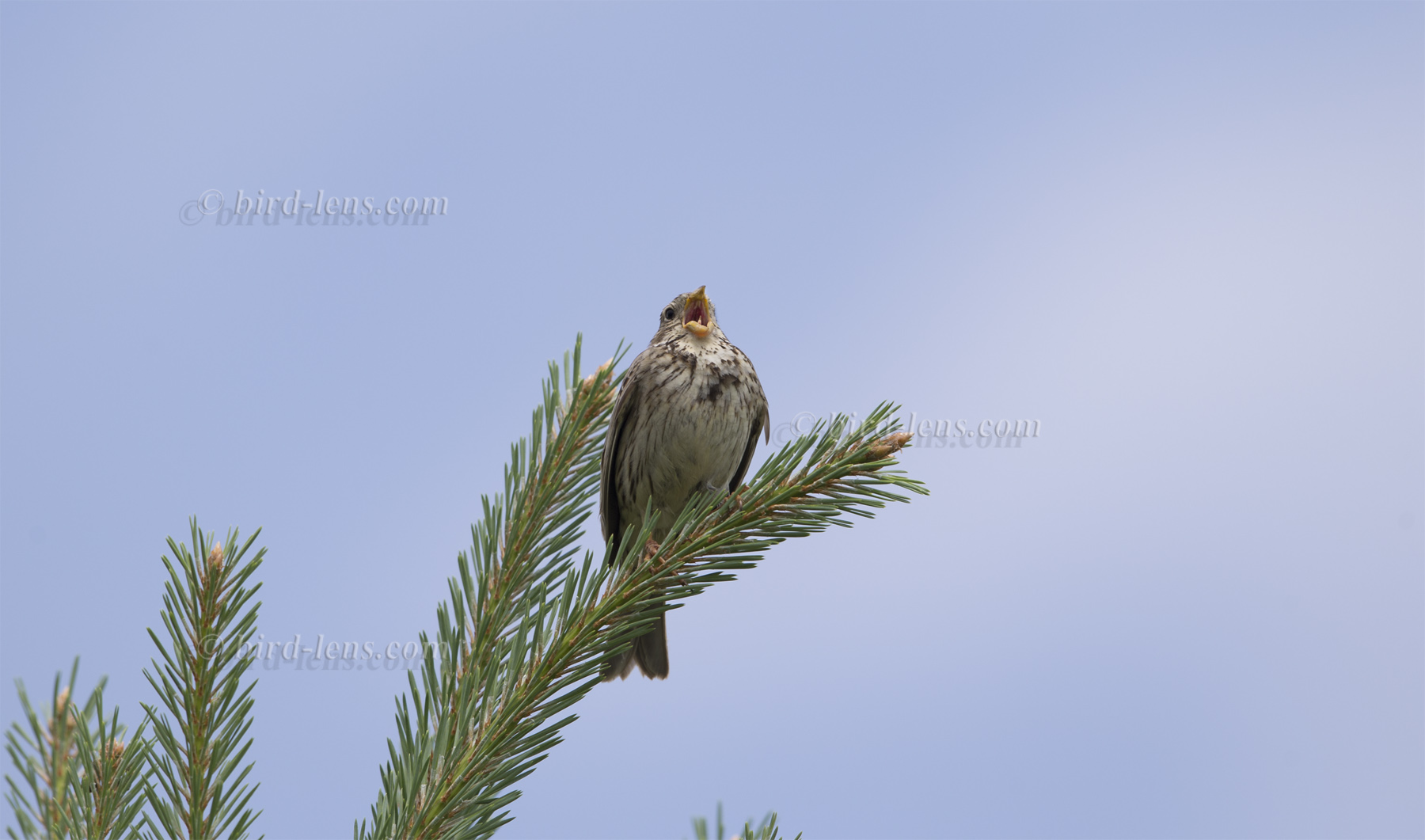
 It’s early morning, and the light still lies low over the fields. The cold lingers stubbornly, yet something has already shifted. Then it can be heard, harsh and unwavering: the Corn Bunting (Emberiza calandra). Its song sounds almost like a rusty clang, not very flattering, but surprisingly present. It sits on a fence post, seemingly unmoved, and calls out into the open landscape. In this moment, it seems as if it is not only announcing spring but actually demanding it.
With the onset of spring, the singing activity of many bird species intensifies significantly. This increase is closely linked to the breeding season. The song fulfills two central functions: demarcating a territory and attracting a mate. Males use species-specific call patterns to keep rivals away and simultaneously signal their fitness to females.
The Corn Bunting is a classic example of a species whose song is primarily designed for range and recognizability. In open agricultural landscapes, its penetrating call allows for effective sound propagation. In contrast, the Skylark (Alauda arvensis) delivers its complex, long-lasting song in flight. Here, visual presentation plays a role alongside the acoustic signaling effect, suggesting a combination of sexual selection and territorial behavior.
The Blackbird (Turdus merula) is another of the defining sounds of March. Its variable, melodic song is usually delivered from elevated positions and exhibits a high degree of individual differentiation. This not only facilitates territory recognition but can also provide clues about the age and experience of the singing male.
In mid-March, the Chiffchaff (Phylloscopus collybita) returns to its breeding grounds. At first subdued, then increasingly insistent, its catchy song can be heard. It uses a simply structured, rhythmically repeated call pattern that, despite its simplicity, allows for clear species-specific identification.
Overall, the spring song demonstrates a close connection between ecological conditions, physiological performance, and evolutionary adaptations. For attentive observers, it becomes clear: what initially appears to be a random soundscape is in reality a finely tuned communication system that marks the beginning of a new reproductive cycle.
In order to meet the growing demand for top images of the rarer species of Palaearctic Bird-lens.com has specifically made trips not only to remote places. Additionally every chance is used, if a rare bird is around the homeground. This to do everything to ensure excellent photos of the Birds of the Western Palearctic. The yield of pictures also of rare Western Palaearctic birds is very good. There are other nice images of birds, that you will find behind the tab “Picture Shop“. Just give a notice if you need a picture of a bird which is not online.