 It is dawn when I have circled the Cildir Gölü, the Cildir Lake halfway. Not far from the border with Georgia I am driving. At the sign for Akçakale I drive into a sleepy town and pass a tourist restaurant with a few seagulls and above all 2 young – probably tame – Dalmatian Pelicans (Pelecanus crispus). Of course I have to photograph the Dalmatian Pelicans. Then I drive over the dam to the island in front oft he village in Lake Çıldır. From the dam I can see and take pictures of Eurasian Coots (Fulica atra) and Armenian Gulls (Larus armenicus) as well as Black-headed Gulls (Larus ridibundus). The picnic areas on the islet are still deserted. That is beautiful and the weather is fantastic, I also drive around the island in hilly terrain. The sun is just emerging from behind the mountains to the east. There are a surprising number of Marsh Harriers (Circus aeruginosus) on the hilly terrain, probably all of them young. They scan the area intensively in a search flight. But also 2 Steppe Buzzards (Buteo buteo vulpinus) can be seen. Right at the beginning I photograph a Chat, which I initially think is a European Stonechat (Saxicola rubicola). The white throat is telltale. However, underneath there are brown speckles on an ocher background. So it is – as confirmed by birdforum.net – a young Whinchat (Saxicola rubetra).
I don’t walk much, but I rely on the car as a photo-hide. Despite – or perhaps because of – the early morning hour, many birds can be seen sitting quietly on the bushes (mostly consisting of rose hips). The many Red-backed Shrikes (Lanius collurio) (of which I note 25 at the end) and 2 Lesser Gray Shrike (Lanius minor) are striking. In between, a Eurasian Wryneck (Jynx torquilla) sits very still, which of course I also have to photograph. Even if the distance is unfortunately quite large. The Eurasian Wrynecks are just not as trusting as the Red-backed Shrikes are. Due to the bad light in the beginning, I sometimes can only take pictures with 1/40 sec. The pictures are therefore mostly blurred and out of focus. I think I hear the calls of a Little Owl (Athene noctua). But despite intensive effort, no owl is to be seen.
Bird migration is in full swing. Within a few minutes I see a total of 4 Eurasian Hoopoes (Upupa epops), each of which can be photographed nicely on a rock in the first morning sun. 2 individuals sit right next to each other and preen themselves. I can drive very close to it. However, I have to drive ever closer very carefully. I start shortly after 6:00 am when it’s still twilight with a shutter speed of 1/125 sec. And increase both the exposure time and the aperture with increasing brightness. Because then the sun comes over the mountain. There is a really great morning light now.
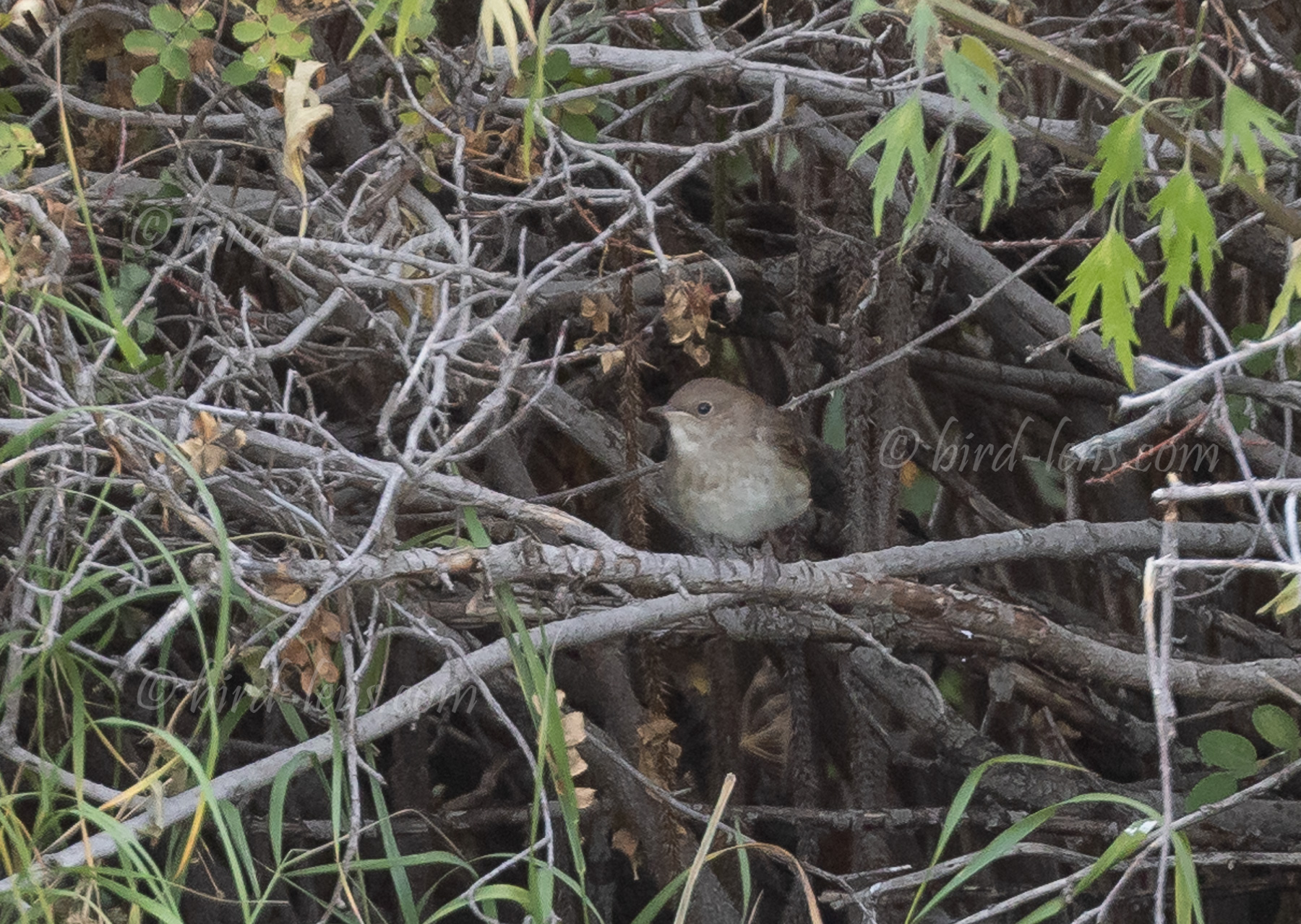
Driving around a bush, I see in the shade of a bush a gray little bird that has a conspicuous eye stripe. The calls a little later then only allow one conclusion: Thrush Nightingale (Luscinia luscinia) or Common Nightingale (Luscinia megarhynchos)? The bird is too gray for the Nightingale and the breast is too dark. So I actually photographed a Thrush Nightingale that was featured in G. Kirwan et.al.’s The Birds of Turkey. is rated as a rare passenger (passage migrant in small numbers). It is described as “..seemingly very rare in East Anatolia and the eastern Black Sea Coastland”. But the main reason for the few reports might be the lack of observers in the area being around in migration times. I can take a few images of proof of the bird. My attempts to lure the for the few reports out of the bushes with a tape on the side facing the sun fail. The Thrush Nightingale calls eagerly, but simply does not show itself.
After a good hour – the sun is already high in the sky – I leave the bushes. Now I can devote myself to the other birds on migration.
A selection of the Birds migrating at Cildir Lake in eastern Turkey can be seen in the bird-lens gallery “Cildir Lake 2022 Migratory Birds“.
At 1,959 m above sea level, Çildir Gölü in Ardahan province is one of the highest freshwater lakes in Turkey. It is also the largest lake in Eastern Anatolia after Lake Van. Surrounded by the mountains of Kisir Dagi and Akbaba Dagi, the lake covers an area of more than 120 km². The borders with Armenia and Georgia are very close by. Surprisingly, we didn’t see a single boat on the lake during our 3-day stay. We also didn’t note anglers or fishermen. I suspected that the water was very salty. Then again I heard that the water from the lake was used for irrigation in agriculture. Appropriate irrigation systems were not recognizable either. An inflow into the lake probably takes place at the west end, part of the lake water also flows off through a stream towards the Black Sea. Çildir Gölü is a beautiful sight with its stark beauty in an open hilly landscape. Many tourists don’t seem to be drawn here. One or the other excursion restaurant at the lake was deserted at the beginning of September; a restaurant at the western end only little frequented.
Bird-lens is primarily a website designed to meet the growing demand for high-quality photographs of the birds of the Western Palearctic. In order to satisfy the demand for top-quality photographs of rare bird species, Bird-Lens.com has also made targeted trips to distant places such as Asia, Africa and the Americas. All this in order to be able to take excellent photos of birds. The yield of pictures not only of rare Western Palearctic birds is very good. The beautiful action image of the blog is only a first impression, what you can find in behind the tab “Picture Shop” very soon. Just leave a message if bird-lens.com can serve with a picture.