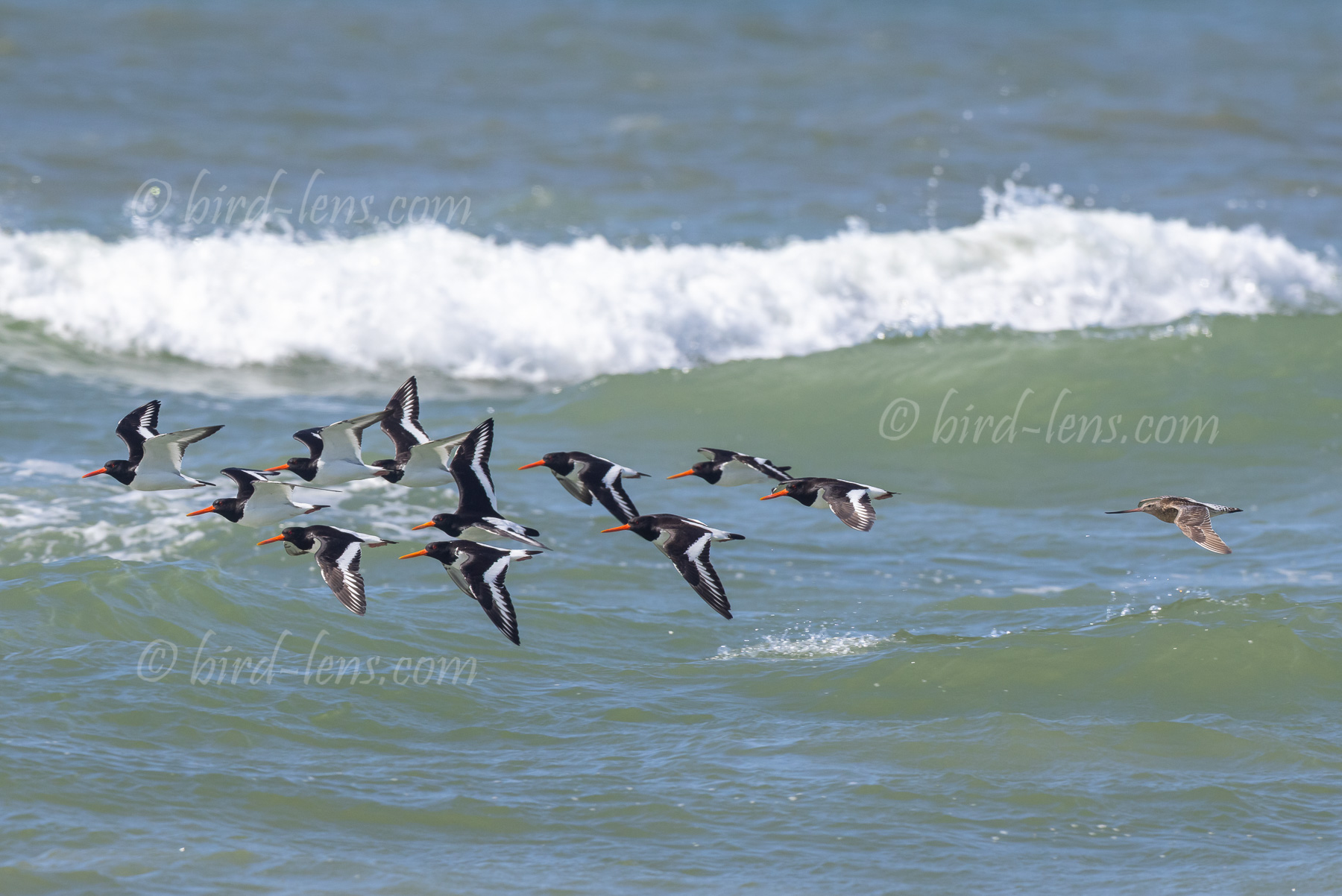
 In early August at Blåvandshuk, a mere glance across the surf is often enough to spot a string of dark dots moving along the horizon. A casual beach walk can quickly turn into a counting session: at this time of year, Eurasian Oystercatcher (Haematopus ostralegus) are the dominant waders here.
Eurasian Oystercatchers account for more than half of the wader migration at Blåvand. The numbers fluctuate significantly; on good days, counts range from several hundred to over 2,000 individuals. A single afternoon of observation on August 5, 2026, yielded an impressive 262 oystercatchers in just an hour and a half. Historical data covering entire days reveal even larger figures: in 1972, a total of 50,160 Oystercatchers were recorded between July 20 and August 25. The migration is concentrated on specific peak days; across two study years, approximately 80 percent of the birds passed through on just 27 days that saw counts exceeding 1,000 individuals.
The birds do not fly as a single, unified flock. Instead, they appear in smaller and larger groups that move in waves. At the same time, observations show that the migration can span many hours. Some birds appear to depart in stages from stopover sites further north, following the Danish west coast southward. Consequently, the headland at Blåvand serves as a natural gathering point before the birds continue their journey toward the Wadden Sea. Grey Plovers (Pluvialis squatarola), Red Knots (Calidris canutus), Bar-tailed Godwits (Limosa lapponica), Common Redshanks (Tringa totanus), Common Ringed Plovers (Charadrius hiaticula), Dunlins (Calidris alpina), Sanderlings (Calidris alba), and Eurasian Curlews (Numenius arquata) also regularly appear in early August. They are joined by terns—such as Common Terns (Sterna hirundo), Arctic Terns (Sterna paradisaea), and Sandwich Terns (Thalasseus sandvicensis)—as well as skuas when weather conditions are favorable. On the morning of August 5, the count included 217 Oystercatchers, 4 Grey Plovers, 5 Ringed Plovers, 2 Whimbrels, 2 Eurasian Curlews, 12 Bar-tailed Godwits, 1 Common Redshank, 28 Red Knots, 37 Sanderlings, and 47 Dunlins.
Naturally, rarities can also hide within these flocks. On August 15, 2024, the second nearly leucistic Oystercatcher of the season was spotted. Occasionally, individual shorebirds of other species fly along with the flocks; for instance, I have managed to spot Ruddy Turnstones (Arenaria interpres), Bar-tailed Godwits, and—repeatedly—Dunlins within otherwise single-species Oystercatcher flocks. Genuine surprises among the waders are also possible; on August 8, 2024, a Little Stint (Calidris minuta) appeared—a species rather unusual for Blåvand.
Easterly to southeasterly winds are particularly favorable for strong Oystercatcher migration. Data from the Blåvand Bird Observatory generally rate easterly conditions as beneficial for wader migration, whereas northerly and northwesterly winds are considered unfavorable. It is also important to observe the area shortly after sunrise: historical analyses show that the first hour is often particularly productive, even though heavy waves of migration may occur later in the day.
In order to meet the growing demand for top images of the rarer species of Palaearctic Bird-lens.com has specifically made trips not only to remote places. Additionally every chance is used, if there is a good opportunity around the homeground. This to do everything to ensure excellent photos of the Birds of the Western Palearctic. The yield of pictures also of rare Western Palaearctic birds is very good. There are other nice images of birds, that you will find behind the tab “Picture Shop“. Just give a notice if you need a picture of a bird which is not online.
Tolle umfangreiche Arbeit.
Wie lange arbeiten Sie schon an der Seite ?
Schön, daß es Ihnen gefällt. Die Seite habe ich 2012 etabliert & stetig weiter entwickelt. Morgen kommt ein Beitrag zur Wiedehopf-Fotografie, wo auch etwas über die verwendete Technik steht…. Viel Spaß damit & nochmal vielen Dank.