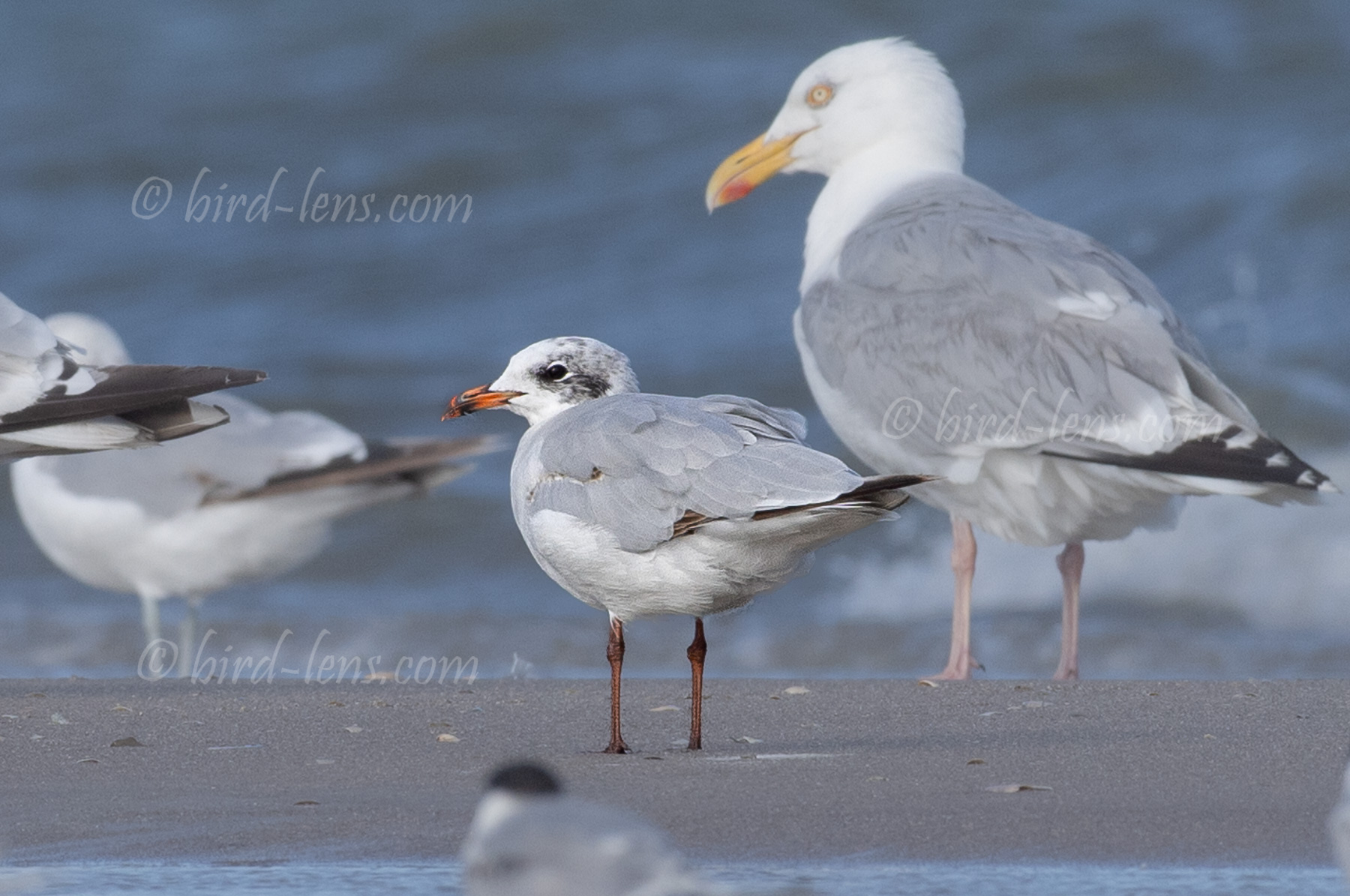
 You might simply be looking at the gulls on the beach at Blåvandshuk when, suddenly, one stands out as not quite belonging: a young Mediterranean Gull (Ichthyaetus melanocephalus) amidst the familiar grey and brown birds. Such a sighting is particularly interesting in early August.
At this time of year, the gatherings of gulls at the westernmost point of Jutland are primarily driven by post-breeding dispersal. Once the breeding season ends, birds leave their colonies, undergo a molt, and seek out coastal areas rich in food. Blåvandshuk is situated along a key stretch of coastline between the North Sea and the Wadden Sea. Long-term studies show that gull numbers here depend heavily on local food availability. Birds from northern and eastern populations arrive in particularly large numbers after the breeding season.
Regular visitors include Common Black-headed Gulls (Larus ridibundus), Herring Gulls (Larus argentatus), Lesser Black-backed Gulls (Larus fuscus), Common Gulls (Larus canus), and Great Black-backed Gulls (Larus marinus). The Lesser Black-backed Gull passes through Denmark mainly in August and September, while Common Gulls also appear in increasing numbers as migrants starting in August.
The Mediterranean Gull, by contrast, is far less common. At Blåvand, it is considered a regular but scarce visitor during spring and autumn, with peak sightings in September and October. Its appearance as early as high summer is noteworthy; local observation records indicate that these individuals are predominantly young birds.
This age distribution makes biological sense. After fledging, young Mediterranean Gulls begin their post-breeding dispersal early and migrate along the coast. A young bird, therefore, does not necessarily have to travel along a classic migration route; instead, it might visit food-rich coastal sites like Blåvandshuk.
It is precisely there that it inevitably mingles with other gull species.
Age thus provides an important clue: in early August, a young Mediterranean Gull at Blåvandshuk is less of an unusual vagrant and more a typical representative of the post-breeding dispersal period—albeit a rare sight amidst a large, very ordinary flock of gulls. An observation from August 5, 2026, for instance, documents a juvenile Mediterranean Gull right at the “Huk” (the tip of the peninsula).
It was a fantastic day for migration, surprisingly featuring 11 Grey Herons (Ardea cinerea) flying in two flocks. I was already packing up around 8:45 AM. Just as I was about to leave, I scanned the flock of gulls one last time. There stood a medium-sized gull that strongly reminded me of a Mediterranean Gull in non-breeding plumage. A photo and the Merlin app confirmed the identification. I carefully moved toward the gull and managed to take a few decent reference photos, which I later uploaded to eBird that morning. The bird observatory apparently spotted the bird as well, recording it in the DOF database as a juvenile in its first calendar year. Yes, a stroke of luck for bird-lens.com.
In order to meet the growing demand for top images of the rarer species of Palaearctic Bird-lens.com has specifically made trips not only to remote places. Additionally every chance is used, if there is a good opportunity around the homeground. This to do everything to ensure excellent photos of the Birds of the Western Palearctic. The yield of pictures also of rare Western Palaearctic birds is very good. There are other nice images of birds, that you will find behind the tab “Picture Shop“. Just give a notice if you need a picture of a bird which is not online.