 Sometimes, it is precisely those days when you simply want to “take a quick look” that you suddenly realize: there is more activity here than expected. In mid-July, unusually lively bird migration was observed on the Pomeranian coast near Dziwnów. A scan of the coastline revealed a whole range of species already on the move. Amidst north-westerly gusts and periods of freshening, strong headwinds, numerous birds were migrating from east to west along the former Prussian province of Pomerania. The question arises: is autumn migration already beginning, or are these merely short-term shifts in location?
Observed species included several Common Teals (Anas crecca) and Tufted Ducks (Aythya fuligula), as well as a female Goosander (Mergus merganser). Such movements in July can stem from various causes, particularly among waterfowl. Following the breeding season, many adult birds and fledged juveniles leave the immediate vicinity of their nesting grounds. Often, these initial movements are not directed long-distance migration but rather so-called dispersal movements or journeys to molting grounds. Nevertheless, these early movements can already be part of large-scale migratory activity.
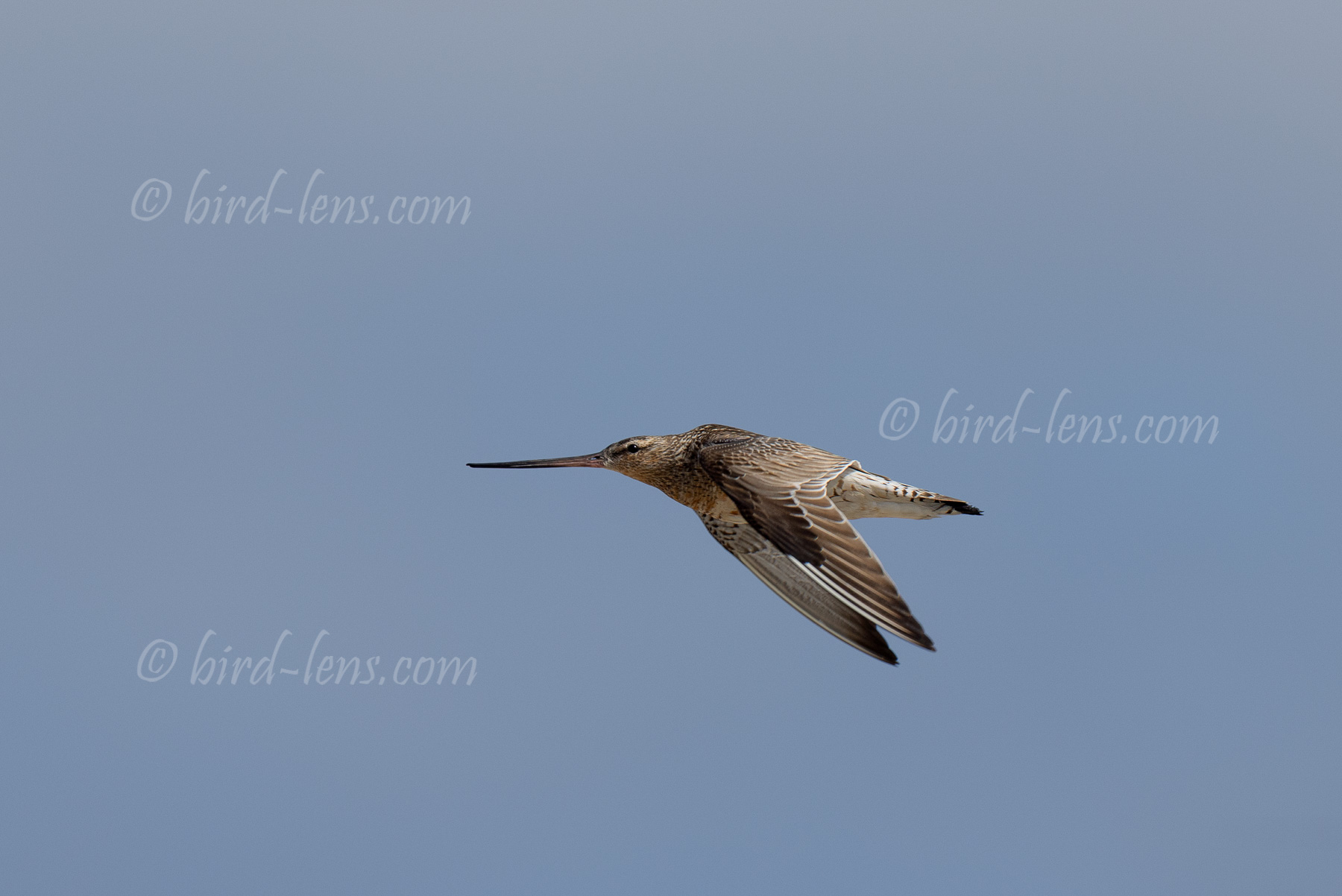
A clear pattern was also evident among the waders. Observations included Oystercatchers (Haematopus ostralegus), three European Golden Plovers (Pluvialis apricaria)—initially misidentified as Grey Plovers—a Eurasian Curlew (Numenius arquata), Common Redshanks (Tringa totanus), and numerous Dunlins (Calidris alpina). Particularly noteworthy was the sighting of a total of three Bar-tailed Godwits (Limosa lapponica).
For many northern waders, July represents an interesting transitional phase. Numerous species are already beginning to depart from their Arctic and sub-Arctic breeding grounds. Early movements are particularly common among Bar-tailed Godwits, as adult birds often leave the breeding region very early after a successful breeding season. For this species, the first southward movements begin as early as July; consequently, some of the observed individuals can certainly be interpreted as marking the true start of the autumn migration.
The question regarding the eastern subspecies of the Bar-tailed Godwit—the Siberian Bar-tailed Godwit (Limosa lapponica menzbieri)—is particularly intriguing. This subspecies breeds primarily in northeastern Siberia and belongs to populations capable of covering extraordinary distances during migration. While its occurrence on the southern Baltic coast is certainly possible, it is far less frequent than sightings of the more westerly distributed subspecies. Positive identification generally requires excellent viewing conditions, as distinguishing between subspecies in the field is difficult and often relies on extensive documentation—specifically regarding plumage characteristics and body proportions—to be conclusive.
Regarding three Bar-tailed Godwits observed on the Pomeranian coast in mid-July, an eastern origin cannot be ruled out, though the likelihood remains low. It is more probable that these individuals belong to the more frequently encountered western migratory populations. A definitive assessment would require additional details, such as precise size comparisons, bill length, upper-body coloration, behavior, and—ideally—photographs.
In addition to the waders, several tern species attracted attention. Common Terns (Sterna hirundo) were present, alongside a juvenile Caspian Tern (Hydroprogne caspia) and an apparently adult Sandwich Tern (Thalasseus sandvicensis). Coastal lines, in particular, can serve as guiding routes for the migratory movements of terns. Wind conditions play a significant role in this: strong north-westerly winds can cause birds to drift off course or lead them to favor specific stretches of coastline in order to conserve energy or reach suitable stopover sites.
Another interesting observation was a swimming Common Scoter (Melanitta nigra). Summer sightings of this species along the Baltic coast do occur, particularly outside their traditional breeding grounds during the molting and migration periods.
The combination of various northern wader species, migrating ducks, terns, and the presence of Bar-tailed Godwits suggests that the first genuine southward migratory movements along the Pomeranian coast are already becoming apparent by mid-July. At the same time, however, not every movement should automatically be interpreted as long-distance migration; some of the birds are likely in a transitional phase between their breeding grounds, molting areas, and eventual wintering grounds.
Nevertheless, the notable east-to-west movement observed near Dziwnów demonstrates that the coast serves as an important migration route even in high summer. Days characterized by unsettled weather and strong north-westerly winds, in particular, can signal the onset of the upcoming autumn migration.
In order to meet the growing demand for top images of the rarer species of Palaearctic Bird-lens.com has specifically made trips not only to remote places. Additionally every chance is used, if there is a good opportunity around the homeground. This to do everything to ensure excellent photos of the Birds of the Western Palearctic. The yield of pictures also of rare Western Palaearctic birds is very good. There are other nice images of birds, that you will find behind the tab “Picture Shop“. Just give a notice if you need a picture of a bird which is not online.