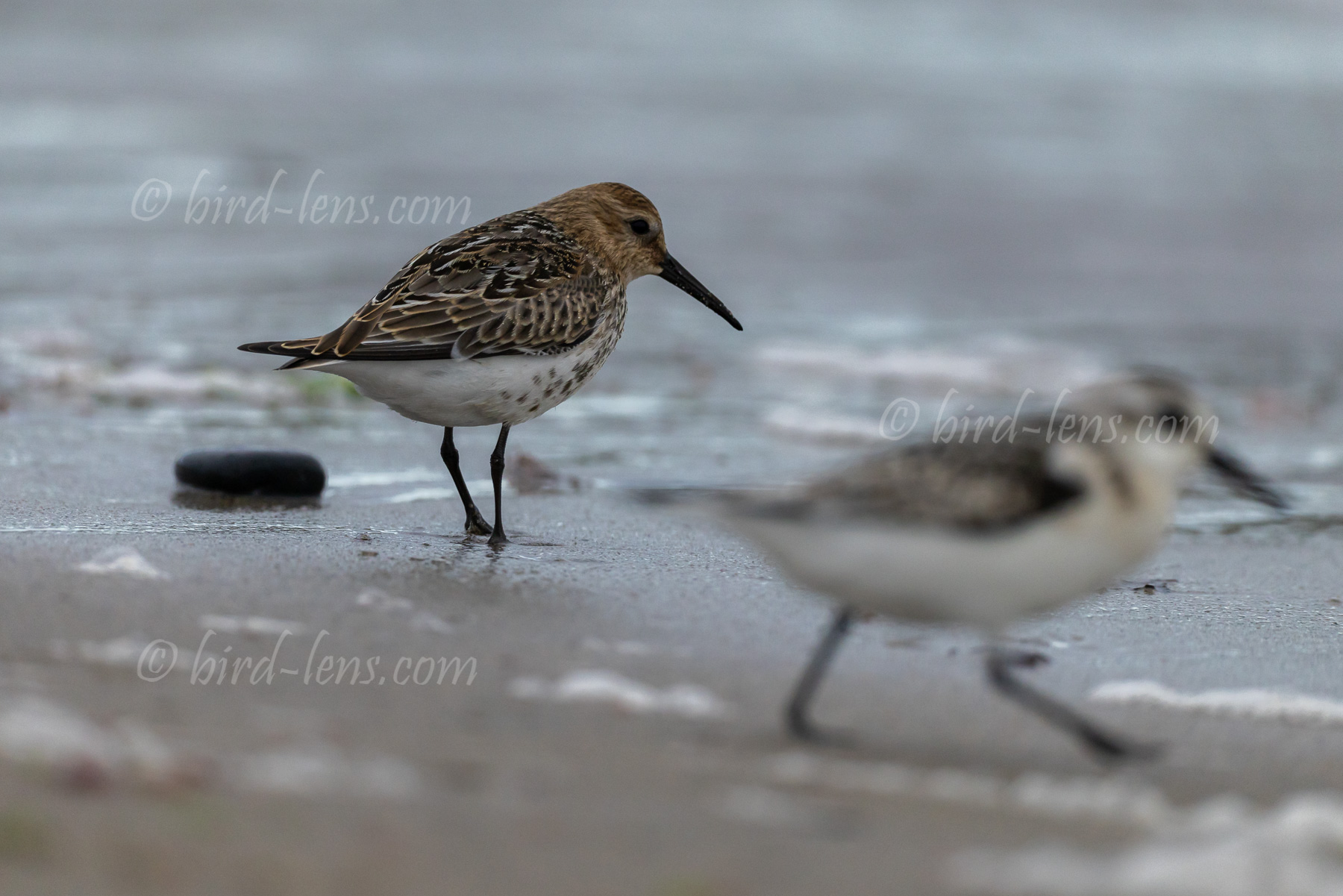
 It’s early morning, and the pebble-strewn shore is alive with the soft chatter of shorebirds. Among them, a strong flock of Sanderlings (Calidris alba) scurries back and forth, their pale plumage blending into the beach’s muted tones. Darting in sync with the rhythm of the waves, they feed eagerly on small invertebrates. Just beyond them, a lone Dunlin (Calidris alpina), darker and more solitary, picks its way through the stones with a slower, more deliberate pace. It is easy to miss the Dunlin. But on second sight, the contrast is striking, yet these two species share more than meets the eye.
Sanderlings are known for their frenetic feeding behavior, a hallmark of their survival strategy. These small waders are perfectly adapted to the dynamic intertidal zone. Their short, stout bills allow them to probe quickly into the sand or pebbles, seeking out small crustaceans, mollusks, and worms. With their pale grayish-white plumage, they are easily identified as they chase retreating waves, always on the move to capture prey uncovered by the receding water. The rapid pace of their movements is not just a feeding strategy but also a reflection of their high-energy lifestyle, necessary to fuel their long migrations.
In contrast, the solitary Dunlin on the beach presents a different foraging strategy. Typically found in larger flocks, this individual’s solitary behavior is unusual, though not unheard of. The Dunlin’s longer, slightly downcurved bill allows it to forage deeper into the substrate, probing for a similar range of invertebrates, but often at a slower, more methodical pace. With darker plumage and a distinctive black belly patch during the breeding season, the Dunlin stands out not just in appearance but also in its foraging rhythm. Its slower, more deliberate movements allow it to access food in slightly deeper pockets of the beach, giving it a niche advantage.
The coast along Wild Atlantic Way in North Mayo, where Ballycastle Beach belongs to, and Mullet Peninsula the peninsula around Annagh Head are strategically located along important migration routes, making them prime spots for observing a variety of bird species. During the autumn migration, many species pass through on their way to warmer climates, while others settle in for the winter, taking advantage of the mild coastal conditions.
Together, the Sanderlings and the Dunlin create a vivid example of how different species can coexist in the same habitat, each with its specialized adaptations. While they share the same beach, their feeding techniques, body structures, and behaviors reveal their nuanced strategies in feeding.
But there are many rare, unusual and scarce birds reported from the area. The winter is good for geese, swans and ducks, but autumn provides excellent chances to see passage migrants, too.
Rare or scarce or unusual birds, which had been seen quite recently at Annagh Beach includes Lesser Yellowlegs (Tringa flavipes) (Sept 2021), White-rumped Sandpiper (Calidris fuscicollis) (July 2021), American Golden-Plover (Pluvialis dominica) (April 2021), Baird’s Sandpiper (Calidris bairdii) (12/09/2006) and Collared Pratincole (Glareola pratincola).
In conclusion, the Mullet Peninsula and Annagh Head provide an excellent opportunity to observe a diverse array of bird species, from hardy wintering geese to delicate passing waders. For bird enthusiasts, these locations offer a blend of breathtaking scenery and the chance to witness the incredible journey of these birds, whether they are stopping over or settling in for the winter. Annagh Beach is part of a peninsula, in the northwest of the county Mayo, that includes Blacksod and Broadhaven Bays, headlands, beaches, lakes, marshes, hills and many offshore islands.
In order to meet the growing demand for top images of the rarer species of Palaearctic Bird-lens.com has specifically made trips to remote places. Additionally every chance is used, if a rare bird is around the homeground. This to do everything to ensure excellent photos of the Birds of the Western Palearctic. The yield of pictures also of rare Western Palaearctic birds is very good. There are other nice images of birds, that you will find behind the tab “Picture Shop“. Just give a notice if you need a picture of a bird which is not online.