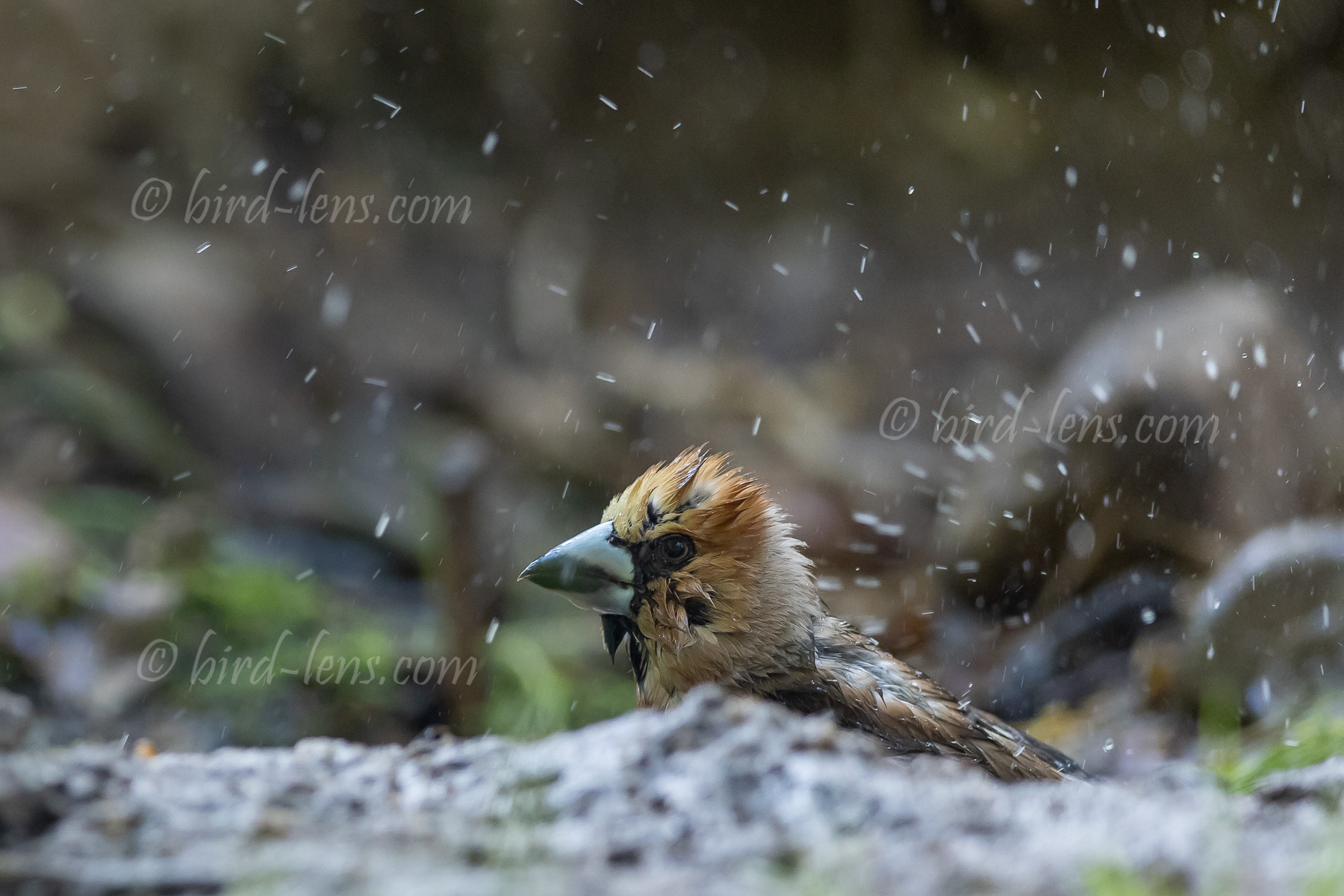
 It was one of those warm late summer days, when the heat slowly cools and the golden sun streams through the canopy. I heard a rustling at the edge of the forest, and there it was – a Hawfinch (Coccothraustes coccothraustes). With its powerful head and massive beak, it appears rather stocky, but as it approached the spring, it displayed a surprising lightness. It stepped into the shallow water, fluffed up its feathers, and began to spray drops through the air with sweeping wing movements. Then it shook itself vigorously, so that tiny beads of water sparkled like glass in the sun’s rays.
Watching a Hawfinch bathing is one thing – capturing it on camera is another. The bird is considered shy and sensitive to movements in its environment. Sneaking unnoticed to within a few meters in dense forest with a camera and telephoto lens (from 200 mm upwards, ideally around 400 mm focal length) is almost impossible. Even the faint crack of branches is enough for the bird to retreat.
One solution is the use of modern camera apps, which allow remote shutter release and image control. The camera can be discreetly positioned near the source, while the photographer remains invisible to the birds at a safe distance. This allows for authentic shots without disturbing the natural bathing process. Remote control is also an alternative. In addition to camera apps, a radio shutter release can also be used. However, this requires the photographed area to be seen, which may make the hiding place less convincing.
That would be something for a remotely triggered shot with the Canon EOS 1DX Mark III. And this provided a good opportunity to position the Canon EOS 1DX Mark III on a Gitzo tripod again. Now I wanted to remotely control the camera myself from a distance using the so-called WFT-E9 Wireless File Transmitter, which operates at 5 GHz. I waited well hidden behind camouflage netting between trees, a bit away from the source, and occasionally just looked at the laptop, then remotely triggered the shutter when I saw something. After the camera and laptop recognized each other via the EOS Utility on the laptop and the “Communication Function” (a tab in the camera controls), I was ready to go.
That worked very well. Of course, the delay in displaying what’s happening on the screen and setting/changing the autofocus point takes a bit of time. At first, I worked with single-point AF. It’s great that you can also adjust the focus “manually” remotely. There are even three different modes for this, ranging from very fine to rather coarse focusing. To do this, you’d need to switch to 5x magnification to get every last bit of sharpness out of your subject. This is basically impossible with moving subjects. I then used ambient AF, initially at 1/320 sec. It’s always astonishing, however, how shallow the depth of field actually is. By setting a minimum aperture of 4.0 in the EOS 1 DX Mark III’s menu in manual mode, I tried to achieve a bit more depth of focus. However, this wasn’t particularly successful, and the ASA values also increased to levels that weren’t necessarily beneficial to the final image. Occasionally, I was even able to photograph a bathing Hawfinch at 1/125 sec.
In principle, camouflage nets or a small camouflage tent can help with inconspicuous positioning of the camera. Here, however, the cover provided by branches and brambles was good enough—and there wasn’t a person in the immediate vicinity anyway. I haven’t yet been able to determine to what extent the (unmanned) camera is viewed as a threat. However, covering shiny parts of the equipment can be useful anyway.
It’s best to position the camera so that the morning or evening light illuminates the source from the side – this way, the contrast is less pronounced and the water droplets appear particularly vivid.
Bathing serves several key functions for the Hawfinch. It removes dust, dirt, and possible parasites from the plumage. At the same time, it moistens the feather structures, which are then restored to their original shape by shaking and careful preening with the beak. The Hawfinch’s plumage consists of contour feathers, which are important for its external shape and flight, as well as down feathers, which have insulating properties. Each feather is stabilized by tiny hooks that must be reattached after bathing. This is the only way the plumage remains aerodynamic and water-repellent. Shaking the feathers immediately after the bath not only serves to mechanically clean them, but also to restore the insulating effect. For the Hawfinch, which lives mainly in the dense
Bird-lens is primarily a website designed to meet the growing demand for high-quality photographs of the birds of the Western Palearctic. In order to satisfy the demand for top-quality photographs of rare bird species, Bird-Lens.com has also made targeted trips to distant places. All this in order to be able to take excellent photos of birds. The yield of pictures not only of rare Western Palearctic birds is very good. The beautiful action image of the blog is only a first impression, what you can find in behind the tab “Picture Shop” very soon. Just leave a message if bird-lens.com can serve with a picture.