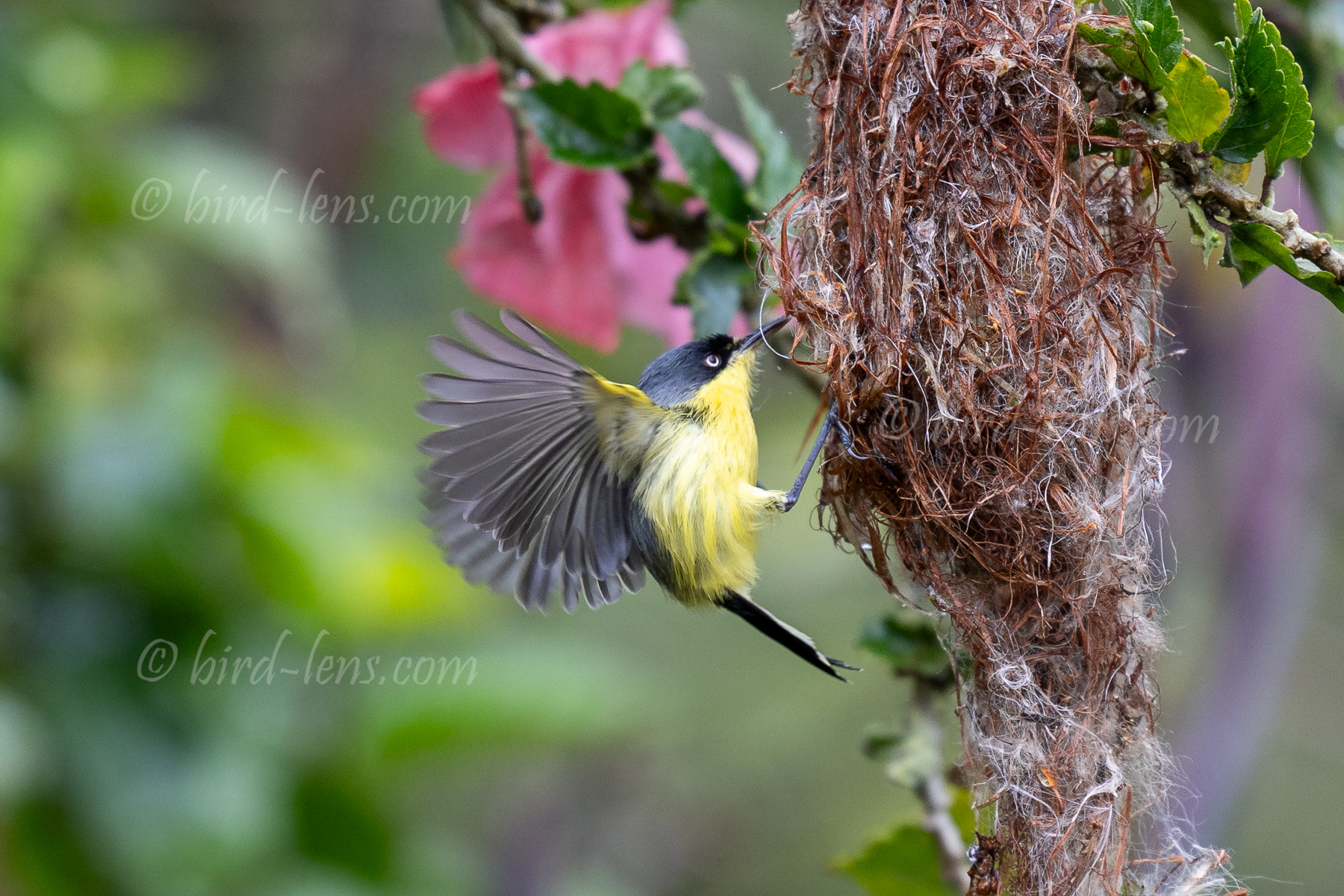
 You’re sitting in your hide by a stream, camera at the ready, finger half-on the shutter button. The Common Kingfisher (Alcedo atthis) sits serenely on its perch – a stick driven into the ground specifically for this purpose. Unfortunately, it’s sitting too still. Everyone knows what’s coming next, but no one knows when. Then a twitch, a barely perceptible tilt of its body, and it’s already too late. Or rather: it used to be. This is precisely where Canon’s new pre-shot function on the EOS R1 comes in. The camera saves images before the shutter button is fully pressed. The moment is suddenly no longer fleeting, but revisitable retrospectively. Sounds like magic. Or like a small break with conventional photography. In this case, I give pre-shot a try with a Common Tody-Flycatcher (Todirostrum cinereum) at its nest. From time the Common Tody-Flycatcher entered the hanging construction to build on it at Ibague in the Andes of Columbia. No chance to catch the birds departure in the conventional way. But with the Pre-Shot Function of the Canon EOS R1 it workd very well. The image of the blog is a striking proof.
Technically speaking, pre-shot is an extension of the familiar continuous shooting mode. The camera continuously buffers images as long as the shutter button is half-pressed. When it’s fully pressed, the camera also saves a defined number of images from the past. Remarkably, this works not only with JPEGs but also with RAW files. Canon impressively demonstrates the capabilities of modern sensors, processors, and buffer memory. The data volumes are enormous, processing occurs in real time, and from a purely engineering perspective, this feature is impressive.
For bird photography, the benefits are obvious. Takeoffs, prey captures, wing openings, or the decisive moment in courtship displays can be captured much more reliably. Situations that previously required perfect timing, experience, and a bit of luck become more predictable. The camera reduces the influence of human reaction time to almost zero. This is a real advantage, especially with shy or extremely fast species, measurably increasing the success rate.
At the same time, this feature raises fundamental questions. Photography has always been a discipline of anticipation. The photographer observes, interprets behavior, and consciously chooses the moment to press the shutter. With pre-capture, this decision is partially shifted to post-processing. The actual act of taking a photograph is decoupled from the moment of capture. The decision is no longer when to photograph, but rather which of the already captured moments will be selected later. This fundamentally alters the creative process.
From a technical perspective, new challenges also arise. The constant pre-capture significantly strains the battery, memory, and processor. Even if Canon implements the function efficiently, the increased energy consumption remains a fact. Added to this is the drastically growing mountain of data. Series of several seconds of pre-capture at a high frame rate produce hundreds of RAW files per short burst. This demands powerful computers, fast storage media, and, above all, time for image selection. The actual work shifts even further from the field to the desk.
Another critical point is the question of photographic fairness. In competitions, nature documentaries, or scientific image use, pre-capture could become a gray area. Is an image still an expression of photographic skill if the decisive moment is technically retrospectively captured? The camera here no longer acts merely as a tool, but as an active co-decision-maker. This isn’t a moral judgment, but a development that should be discussed.
For tech enthusiasts, the Canon R1’s pre-shoot feature is a logical and fascinating step. For birdwatchers, it’s a powerful tool that reduces frustration and increases success rates. At the same time, it demands a rethinking of one’s own photographic approach. The question isn’t whether this technology is useful. The question is how consciously one uses it and whether one accepts that the “decisive moment” is increasingly managed by the camera and no longer solely by the person behind the viewfinder.
Ultimately, the Canon R1 represents a paradigm shift. For tech-savvy photographers and birdwatchers willing to relinquish control to software, it offers real advantages. However, those seeking maximum predictability, direct control, and a tool without room for interpretation might still find a serious benchmark in the older Canon EOS 1DX DSLRs.
To meet the growing demand for top-quality images of the rarer Palearctic species, Bird-lens.com is committed to further expanding its range of images of Western Palearctic birds. Trips to local and distant locations to photograph rare Western Palearctic birds have been very successful. At the same time, finding the right equipment is a constant challenge. Bird-lens.com uses Canon equipment. The latest developments in camera technology are closely monitored – without necessarily chasing after the very latest gimmicks. Genuine, additional functionality is, of course, particularly valued. The results in pictures also of rare Western Palaearctic birds is very good. There are other nice images of birds, that you will find behind the tab “Picture Shop“ (http://www.bird-lens.com/zencardshop/). Just give a notice if you need a picture of a bird which is not online.