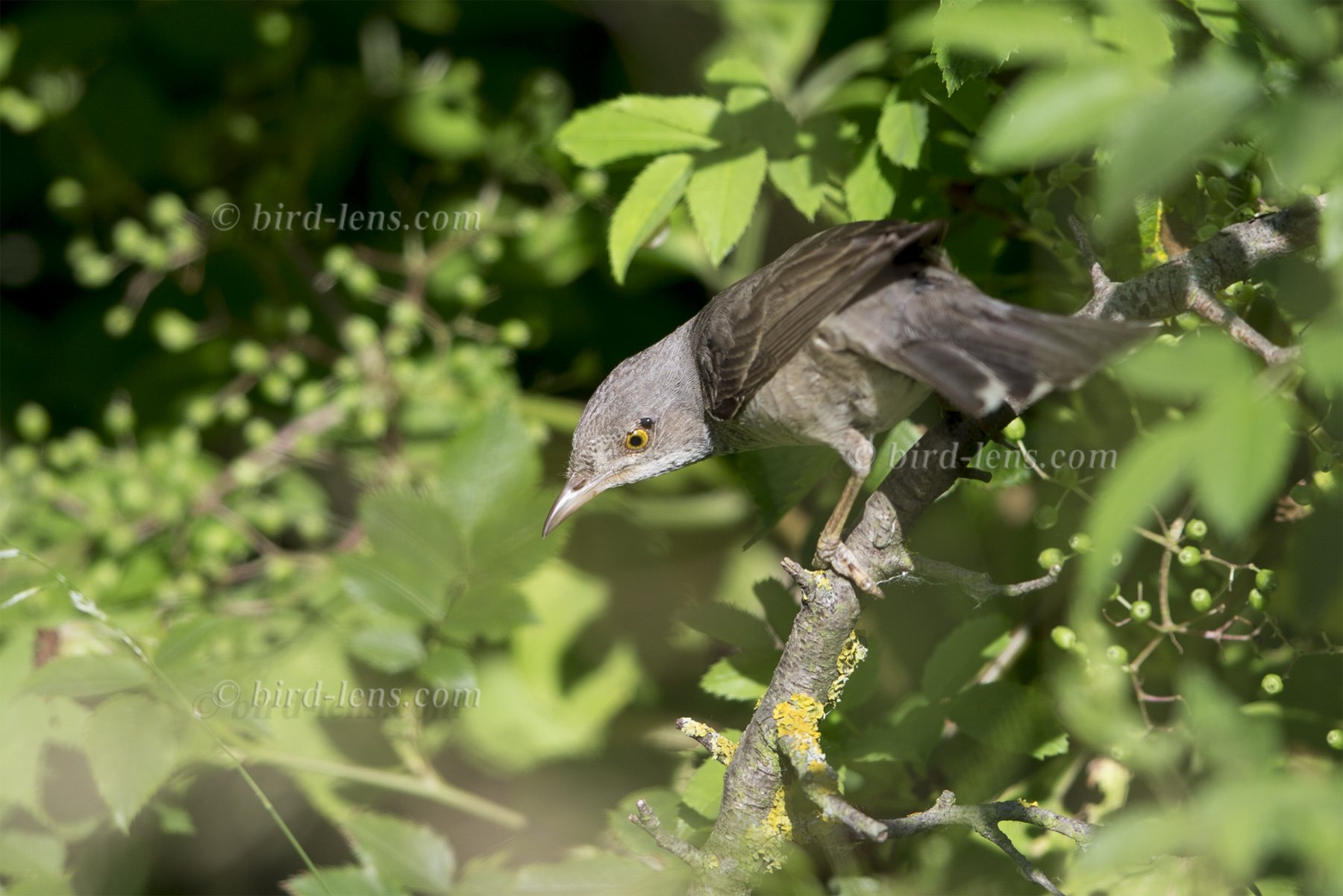
 It was one of those mornings that felt promising, with the quiet rustle of the willows and brambles on the breeze in Keem Bay on Achill Island, County Mayo. As I moved to the edge of the gulley above the stone bridge, another birdwatcher mentioned a sighting earlier that caught my attention. In a small patch of low brambles and willows, barely 15 meters away, there it was – fleeting but unmistakable – a Barred Warbler (Sylvia nisoria). Trying to track this elusive bird was no easy feat, especially with such limited habitat available, but patience paid off with more than just a brief glimpse.
The Barred Warbler, a species known for its subtlety and camouflage, was working in a predictable circuit beneath the undergrowth. My first sighting happened as it flew roughly 10 meters down the gulley, darting from the willows to disappear momentarily into the brambles (Rubus fruticosus). Not long after, I saw it again – moving up the slope in a deliberate but concealed manner. Its behavior suggested that it was foraging, moving cautiously between dense vegetation to avoid detection, typical of warblers in the genus Sylvia.
Despite the brief glimpses, a few critical features of the bird stood out. In flight, the Barred Warbler appeared relatively large for a warbler, with a pale sandy-brown plumage that contrasted slightly against the dark backdrop of the brambles. Its movement was somewhat floppy, as it flitted between branches before vanishing into cover.
On closer view, the distinctive features became more apparent. The bird perched briefly, its robust, hefty bill and a peaked crown drawing immediate attention. The wings, though somewhat untidy in appearance, showed a diffuse buff-colored wingbar on the greater coverts. Pale tips were visible on the primaries, adding to the bird’s understated elegance. One interesting detail was how it flicked its wings while perched, a behavior often noted in Sylvia species. As it lifted its tail, faint but discernible grey chevrons could be seen—a feature not always noted in field guides but surprisingly distinct in this individual.
For any birder outside the regular breeding area, encountering the Barred Warbler is a treat, not only because of its elusive nature but also for the subtle beauty that makes it stand out from other warblers. This sighting, though brief, offered just enough to appreciate the bird’s unique characteristics and behavior.
In order to meet the growing demand for top images of the rarer species of Palaearctic Bird-lens.com has specifically made trips to remote places. Additionally every chance is used, if a rare bird is around the homeground. This to do everything to ensure excellent photos of the Birds of the Western Palearctic. The yield of pictures also of rare Western Palaearctic birds is very good. There are other nice images of birds, that you will find behind the tab “Picture Shop“. Just give a notice if you need a picture of a bird which is not online.