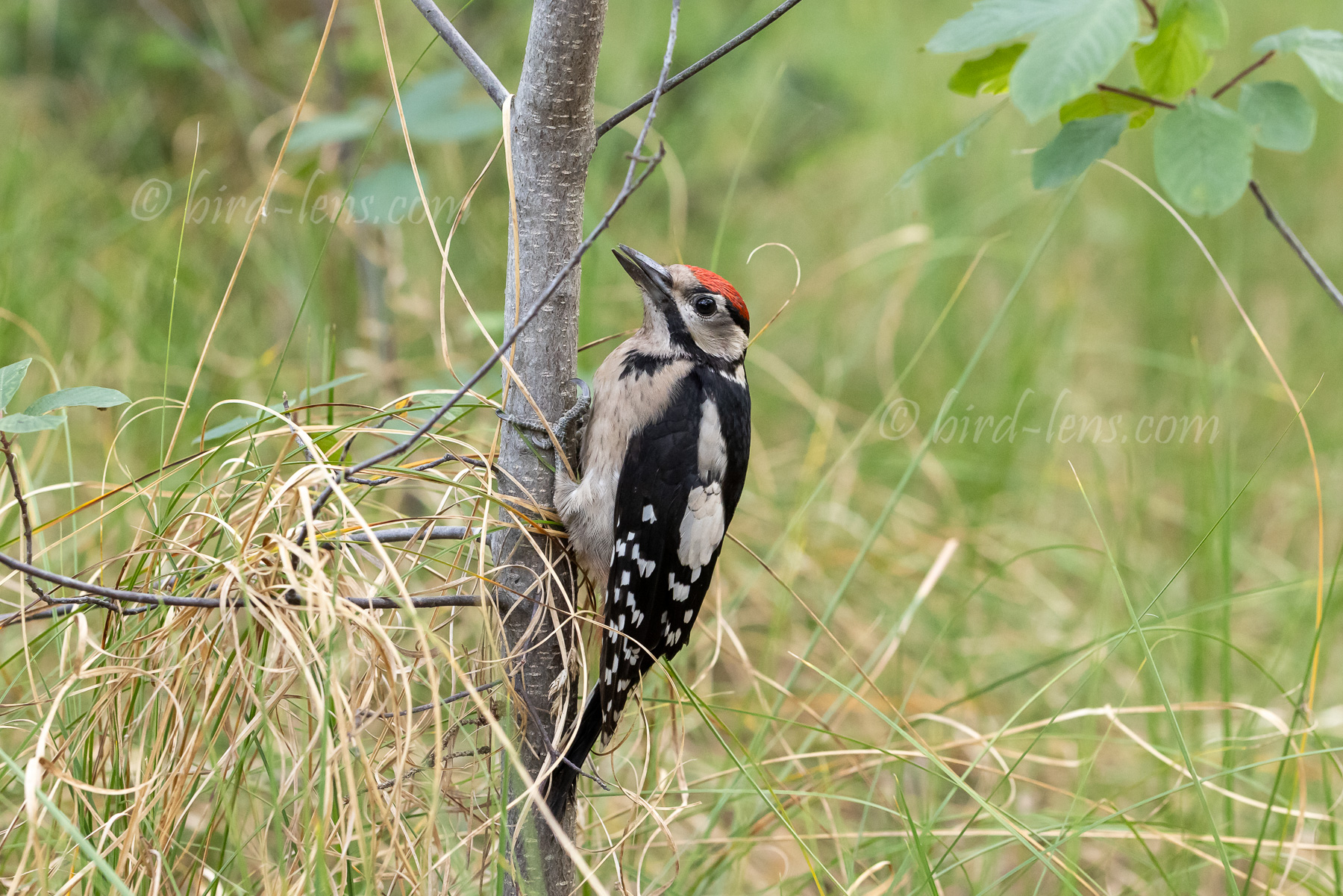
 If you’re strolling through a sparse pine forest in early summer, with a bit of luck you might witness an enchanting moment: After days of curious gazing, a young Great Spotted Woodpecker (Dendrocopos major) ventures out of its round nest hole high above the ground. Still slightly clumsy, it flutters from trunk to trunk, its feathers delicately striped, its gaze alert but uncertain. It’s its first day “out there” – and it starts off shaky.
The young Great Spotted Woodpecker, fresh from its nesting hole, displays conspicuous behavior in the first few days after fledging (pre-nesting). It stays close to the nest, prefers well-structured tree areas, and usually stays at low altitude. During this phase, its flight ability is still limited, and its muscles are not fully developed. A characteristic feature is the fluffy juvenile plumage, lacking shine and with a reddish cap in both sexes – in contrast to the sexually dimorphic characteristics of adult birds.
After some time, the woodpecker still clings to the twig. I want to take advantage of this photographic opportunity. I then use the Canon EF 100mm f/2.8 Macro USM on the Canon R 5. I initially work in Tv (aperture priority) at maximum aperture, but then switch to M (manual) due to the shallow depth of field and use aperture 5.6.
Parental care does not end with the departure of the nest. For about 10 to 14 days, the adults continue to feed their offspring, with the call between parents and young birds playing a central role. This helps the young birds to recognize food sources and imitate their first pecking movements on tree bark. Acquiring food is inefficient during this transition period, making survival heavily dependent on continued parental care.
Typical diet during this phase consists of insect larvae (e.g., from the Cerambycidae or Curculionidae families), spiders, and occasionally plant foods such as pine seeds. The pine forest provides a suitable structure for this: scaly bark patches, deadwood sections, and standing old growth trees serve as resonators for echolocation.
Only after another one to two weeks do the young birds begin to move increasingly independently, cover greater distances, and explore their own territories. Juvenile mortality is high during this phase – predation, extreme weather, and food shortages are key risk factors..
In order to meet the growing demand for top images of the rarer species of Palaearctic Bird-lens.com has specifically made trips to remote places. Additionally every chance is used, if a rare bird is around the homeground. This to do everything to ensure excellent photos of the Birds of the Western Palearctic. The yield of pictures also of rare Western Palaearctic birds is very good. There are other nice images of birds, that you will find behind the tab “Picture Shop“. Just give a notice if you need a picture of a bird which is not online.