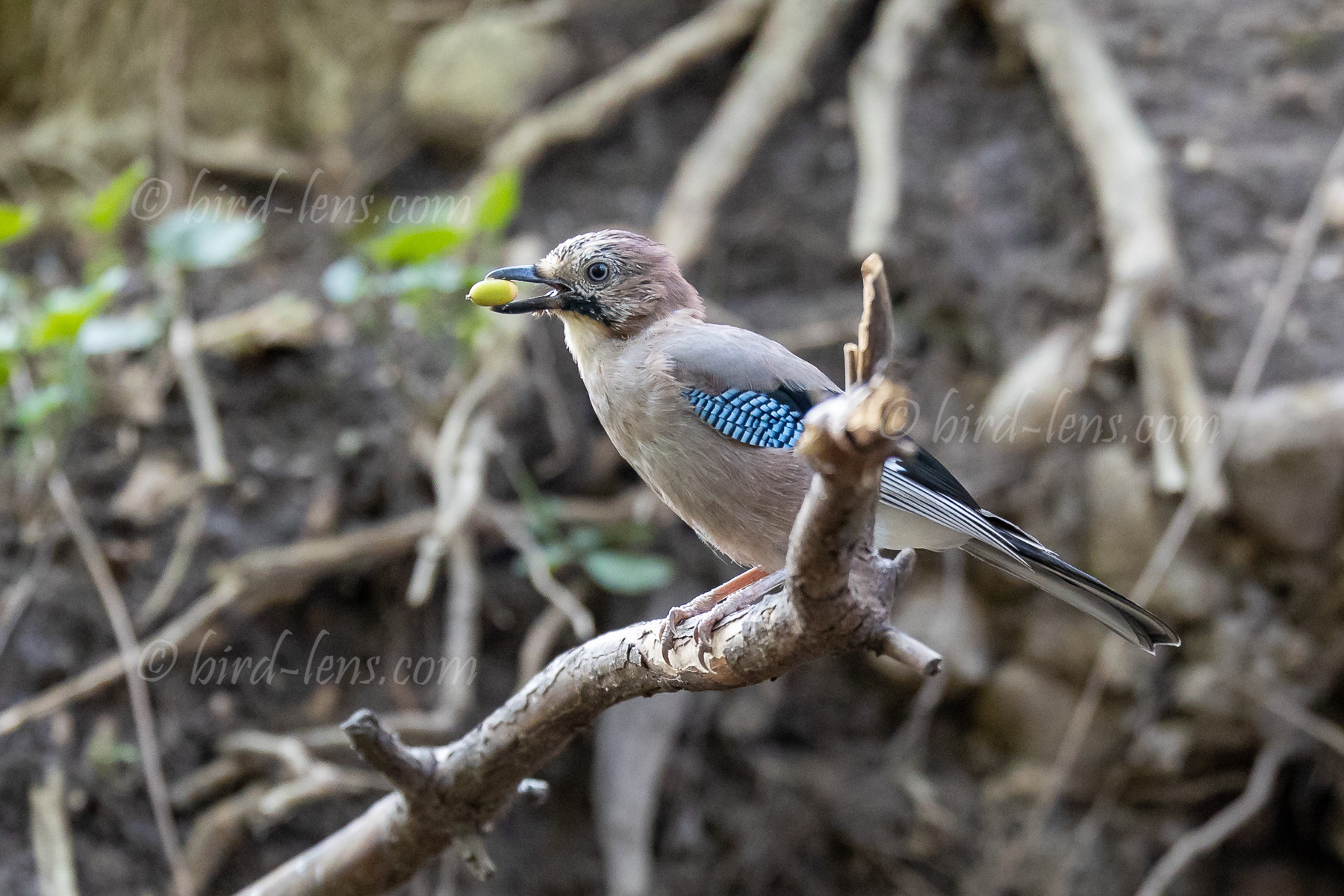
 A common and familiar sight: a Eurasian Jay (Garrulus glandarius) perches at the edge of a forest, a shiny acorn clutched in its powerful beak. With a quick leap, it disappears among the trees—perhaps to bury its find, perhaps to eat it immediately. Hardly any bird seems as busy as this one. But the jay is far more than just the guardian of the oaks.
The jay belongs to the corvid family, one of the most intelligent bird groups of all. Its name only reveals part of its feeding habits: acorns are indeed a central element of its diet, especially in the fall, when it lays up stores for the winter. It systematically collects them and hides them in the soil or under fallen leaves—a behavior that indirectly contributes to the spread of oak trees. Many of these stores are forgotten, allowing young trees to germinate in new locations.
But the Eurasian Jay is not a pure herbivore. Its diet is surprisingly broad and seasonally flexible. In addition to acorns, it eats nuts, beechnuts, berries, insects, worms, and occasionally small vertebrates such as young birds, mice, or frogs. This carnivorous diet provides valuable protein, especially during the breeding season when energy requirements are high. Studies show that during this period, the Eurasian Jay is more likely to actively hunt or stalk the nests of other species—a behavior considered opportunistic by ornithologists but ecologically functional.
The adaptability of its food selection is also reflected in its behavior. In urban areas, the jay increasingly consumes human food scraps and demonstrates a remarkable ability to learn when dealing with new food sources. Its powerful beak allows it to both crack hard shells and efficiently dismember animal prey.
It turns out that the jay is not a simple “acorn collector,” but a versatile omnivore with a highly developed memory and social behavior. Its role as a seed disperser and occasional hunter makes it an important player in the ecosystem – a bird that mediates between plant and animal life, with an intelligence that goes far beyond the stereotype.
Bird-lens is primarily a website designed to meet the growing demand for high-quality photographs of the birds of the Western Palearctic. In order to satisfy the demand for top-quality photographs of rare bird species, Bird-Lens.com has also made targeted trips to distant places. All this in order to be able to take excellent photos of birds. The yield of pictures not only of rare Western Palearctic birds is very good. The beautiful action image of the blog is only a first impression, what you can find in behind the tab “Picture Shop” very soon. Just leave a message if bird-lens.com can serve with a picture.