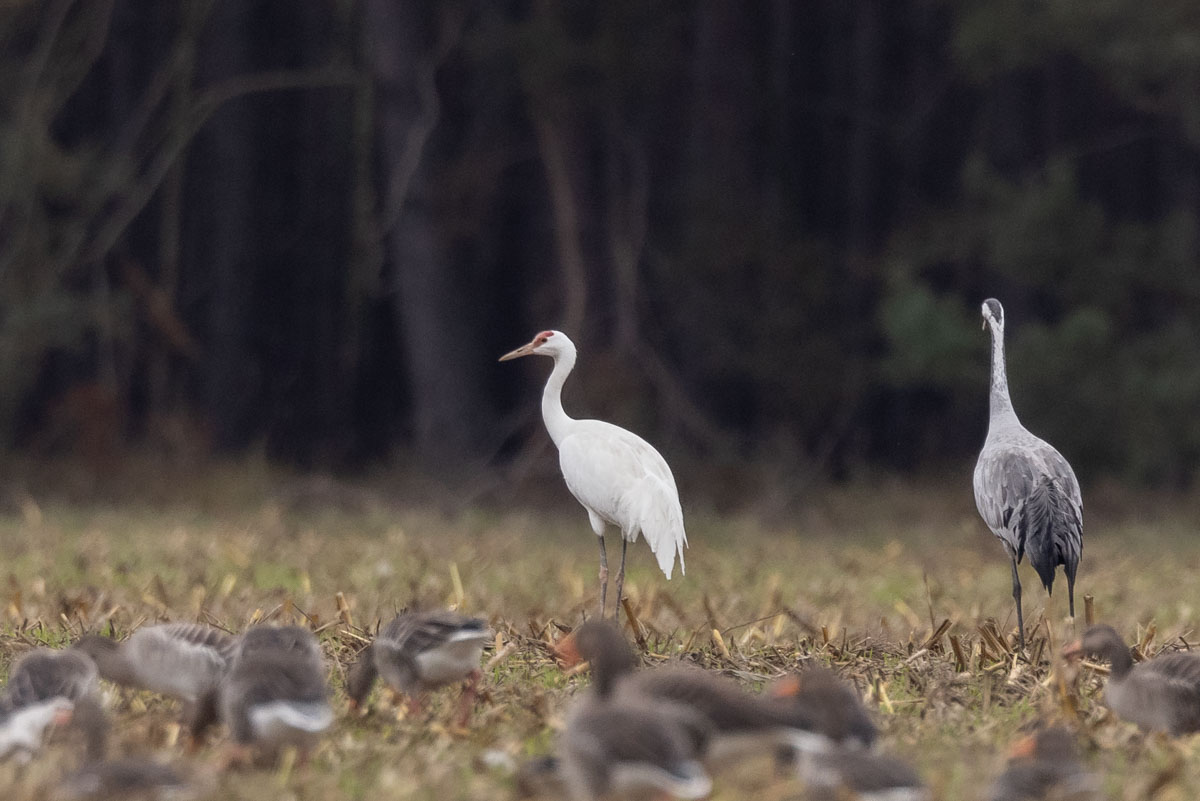
 A normal, dirty November day. In a field Common Cranes (Grus grus) are feeding on corn with Grey Geese (Anser anser). In the middle of flock, there appears a completely white bird that also seems to be larger. My heart seems to stop. There are actually only two species of crane in the world that have almost exclusively white plumage. The Siberian Crane (Leucogeranus leucogeranus or Grus leucogeranus) and the Whooping Crane (Grus americana). Grus leucogeranus in particular has become very rare. It is also native to Asia and the other white crane to North America. So it would be a great rarity to spot a white crane here in Europe. A short time later, however, when looking through the spotting scope, it is clear that the white crane in the field belongs to the native Crane species, the “normal” Crane, also known as the Grey Crane.
Specifically, it is a leucistic crane. This means that this crane lacks melanocytes (pigment-producing cells). This defect mutation means that no dark pigments can be produced. In contrast to leucism, albinos have melanocytes, but these are unable to produce the pigment melanin. Leucism is a defect mutation in animals that results in the fur (or feathers) being white and the underlying skin being pink, as the skin does not contain melanocytes (pigment-producing cells). Leucistic birds have more or less white plumage, but always have pigmentation on their eyes and legs. In albinos, pigmentation is completely lacking, which is why their eyes appear reddish and their legs and feet more flesh-colored. For a real albino, the eyes appear too dark (not reddish), while their legs and feet appear a clear, light orange.
In Europe, individuals of different species with such color deviations are observed more frequently, and bird-lens.com had already reported on a very light colored Chaffinch (Fringilla coelebs) and on a Red-backed Shrike (Lanius collurio) on migration through Cyprus. In general, however, birds with these color defects are very rare.
Research on the general frequency of albino and leucistic Red-backed Shrike, which Günter Barth and Günter Nicklaus did in the article “On the observation of a leucistic Red-backed Shrike, Lanius collurio in the Noswendeler Bruch” in Lanius 35, 2014: pp. 53-57, yielded results for the time from 1950 to 2012 a total of only twelve cases.
To cope with the growing demand for top shots of the rarer species of the Palearctic Bird-Lens is keen to enrich the range of pictures of birds you can find in the western palearctic. Trips to remote places like this one to capture images not only of rare birds of western palearctic were very successful. The nice image of the blog is only a first impression, what you will find in the gallery in the “Picture Shop” very soon. Just give bird-lens.com a message, if bird-lens.com could serve you with an image needed before the new pictures are online.