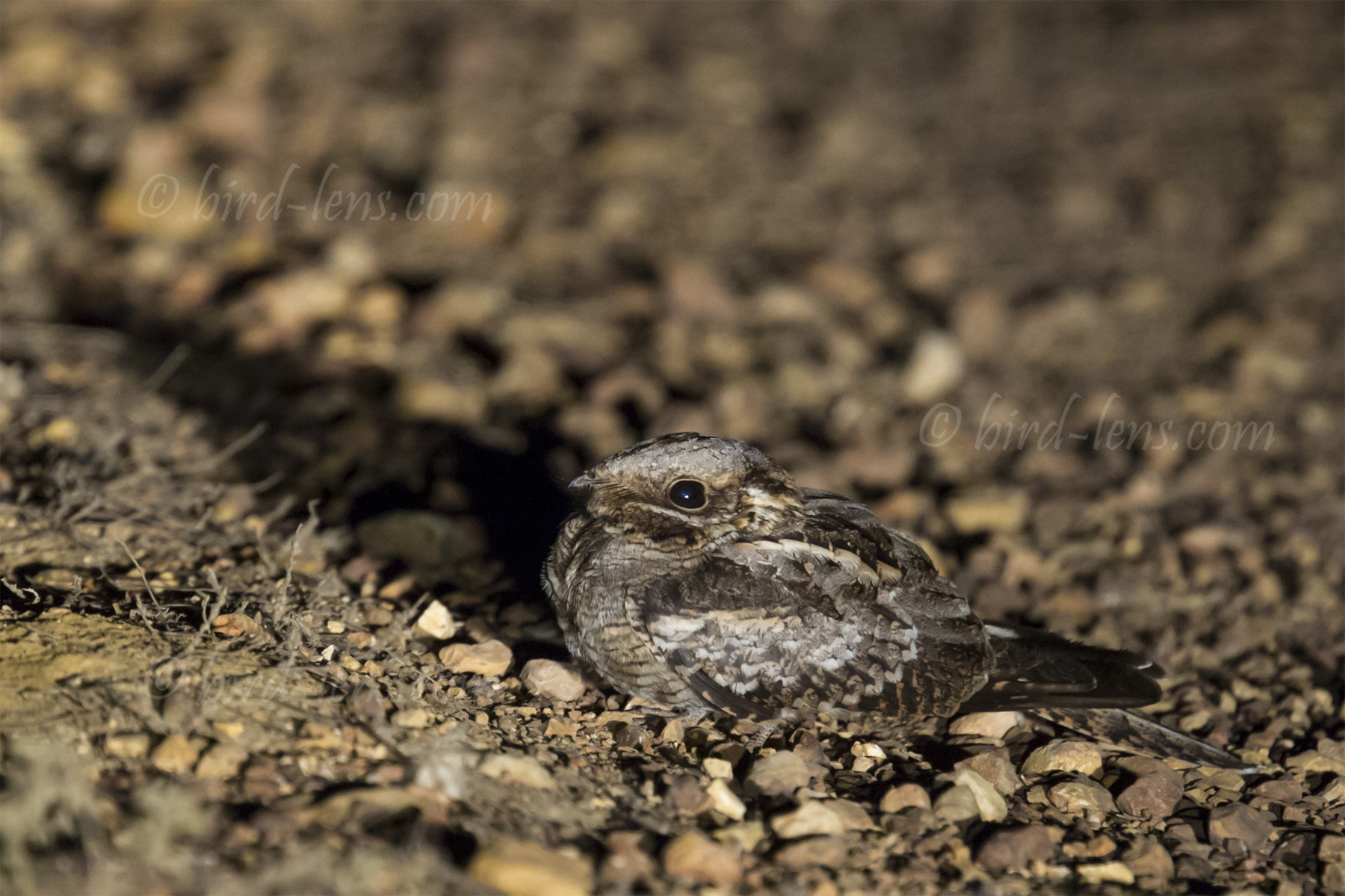
 When summer nights in the south glow and a mysterious purring echoes through the pine forests, they are never far away: the Red-necked Nightjar (Caprimulgus ruficollis) and the European Nightjar (Caprimulgus europaeus) transform the twilight into a magical setting!
The restriction of the Red-necked Nightjar to the Iberian Peninsula and Northwest Africa is explained by its extreme thermal and ecological requirements. As a thermophilic species, it requires arid to semi-arid habitats with consistently high summer temperatures and a specific supply of large flying insects. Compared to the European Nightjar—which is widespread across Eurasia and also inhabits cooler, boreal coniferous forests—the Red-necked Nightjar exhibits a much higher degree of specialization.
There are three ecological dimensions to these differences:
- Microclimate & thermal requirements (xerothermic conditions)
- Diet & prey biomass
- Habitat structure (soil substrate & vegetation)
While the European Nightjar is flexible enough to inhabit cooler, wetter, or higher-altitude areas (such as the sandy heaths of Northern and Central Europe, bog margins, or boreal coniferous forests), the Red-necked Nightjar is strictly adapted to arid Mediterranean environments. This is linked to its lower tolerance for cold. It requires consistently high summer temperatures and extremely sun-exposed, hot, dry microhabitats (such as Mediterranean matorral scrub, pine groves, olive groves, and the desert belts of North Africa). The trade-off is a reduced tolerance for cold temperatures. Cool summer days or prolonged spells of bad weather accompanied by sudden temperature drops—conditions the European Nightjar can withstand in Central Europe by entering a state of lethargy known as torpor—pose a threat to the survival of the Red-necked Nightjar.
As a larger species (wingspan approx. 60–65 cm compared to 52–56 cm for the European Nightjar), the Red-necked Nightjar also has distinct hunting requirements shaped by its morphology. It has specialized heavily in large insects. Thanks to its significantly wider gape, it prefers to hunt very large crepuscular and nocturnal insects—particularly large scarab beetles (e.g., Melolontha and Rhizotrogus species), large hawk-moths (Sphingidae), and large orthopterans (grasshoppers). A high overall insect biomass is a crucial factor here; such large insects occur in sufficiently reliable densities only in thermally favored, semi-arid ecosystems.
Its larger body size, the eponymous rusty-red collar, and its distinct, deeper call characteristics are merely secondary distinguishing features.
In the context of global climate change and the progressive warming of Central Europe, a gradual northward range expansion is theoretically conceivable. However, a rapid expansion of its range is limited by the lack of suitable habitat structures and altered insect biomass levels. Both species exhibit trans-Saharan migratory behavior. The migration period primarily spans August to October, while the return migration takes place in April and May. Their wintering grounds are located in tropical West and Central Africa. Ethological characteristics shared by both species include pronounced aposematism and camouflage provided by bark-like plumage (crypsis), rendering the birds virtually invisible during the day. Furthermore, both species utilize anthropogenic infrastructure—such as paved roads—for nocturnal thermoregulation and as open hunting grounds.
The Red-necked Nightjar requires open, sandy-to-loamy substrates with sparse vegetation cover, specifically favoring trees with an open, umbrella-like canopy (such as Pinus species or holm oaks); these provide shade during the day while allowing stored ground heat to radiate effectively onto the bird’s plumage at night.
In order to meet the growing demand for top images of the rarer species of Palaearctic Bird-lens.com has specifically made trips to remote places. Additionally every chance is used, if a rare bird is around the homeground. This to do everything to ensure excellent photos of the Birds of the Western Palearctic. The results in pictures also of rare Western Palaearctic birds is very good. There are other nice images of birds, that you will find behind the tab “Picture Shop“. Just give a notice if you need a picture of a bird which is not online.