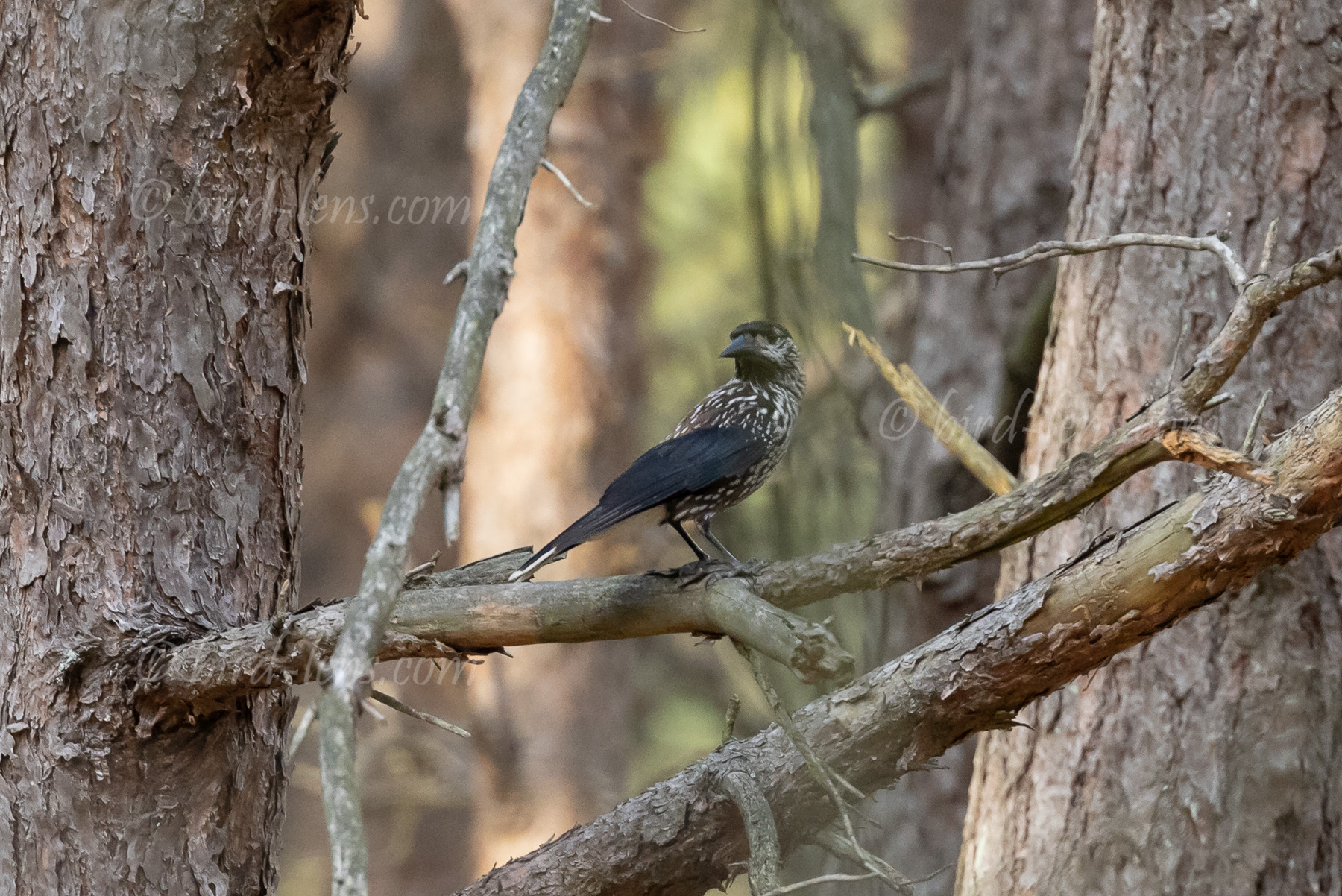
 Sometimes, the wind from the Far East blows all the way to our European shores, and when the taiga’s fate strikes with an icy hand, a small ornithological miracle occurs. Suddenly, he appears—this somber yet fascinating visitor from the Siberian wilderness: the Siberian Nutcracker (Nucifraga caryocatactes macrorhynchos), whose slender, dagger-like beak speaks of vast, boundless expanses. Anyone wandering through the fragrant coastal forests of the Polish Baltic at this time can sense the crackle in the air as autumn casts its golden veils over the dunes and the boundaries between the familiar and the foreign magically dissolve.
The appearance of this corvid species in Western Europe is primarily explained by irruptive movements triggered by the periodic collapse of food availability in Siberian coniferous forests. Its main food source—specifically the seeds of the Siberian stone pine—is subject to extreme fluctuations in crop yield. Massive crop failures lead to fierce intraspecific competition for food, followed by westward expansion. The wooded coastal stretches and spits of the Polish Baltic coast—such as the Vistula Spit or Słowiński National Park—are excellent places for observation, as the birds pause there during their migration. Such was the case in the Trzebiatów Forest near Mrzeżyno Zachód. The forest near the location formerly known as Treptow Deep is a coastal woodland that, in places, appears remarkably wild and natural. At first, all I notice in the forest is a black bird flying down to the ground. My wife also spotted a bird the size of a Eurasian jay (*Garrulus glandarius*). Then we both saw it clearly: yes, it was the Siberian nutcracker, perched on a pine branch with a morsel of food. There was no doubt. The first photo captures it taking flight, but we managed to spot it a second time as well. Fortunately, I was able to snap three photos showing it in various poses.
In terms of timing, September and October are considered the optimal months. Meteorologically, these waves of invasion are facilitated by persistent high-pressure systems over Eastern Europe; these generate strong easterly or northeasterly winds that powerfully support the birds’ purposeful, active migration over hundreds of kilometers. However, these spectacular invasions do not occur with cyclical regularity but rather erratically, as they are directly linked to the irregular fruiting patterns and crop failures in the birds’ native regions in the Far East.
When in non-native habitats, the birds exhibit remarkable characteristics regarding foraging. Since their usual conifer seeds are unavailable, the individuals rapidly adapt their feeding habits to the range of food sources found in Central Europe. They substitute their preferred food with local mast resources, making particularly heavy use of hazelnuts and acorns. Their highly specialized caching behavior—the strategic creation of food stores for the winter—remains unchanged, meaning they actively contribute to the dispersal of various tree and shrub species.
In order to meet the growing demand for top images of the rarer species of Palaearctic Bird-lens.com has specifically made trips to remote places. Additionally every chance is used, if a rare bird is around the homeground. This to do everything to ensure excellent photos of the Birds of the Western Palearctic. The results in pictures also of rare Western Palaearctic birds is very good. There are other nice images of birds, that you will find behind the tab “Picture Shop“. Just give a notice if you need a picture of a bird which is not online.