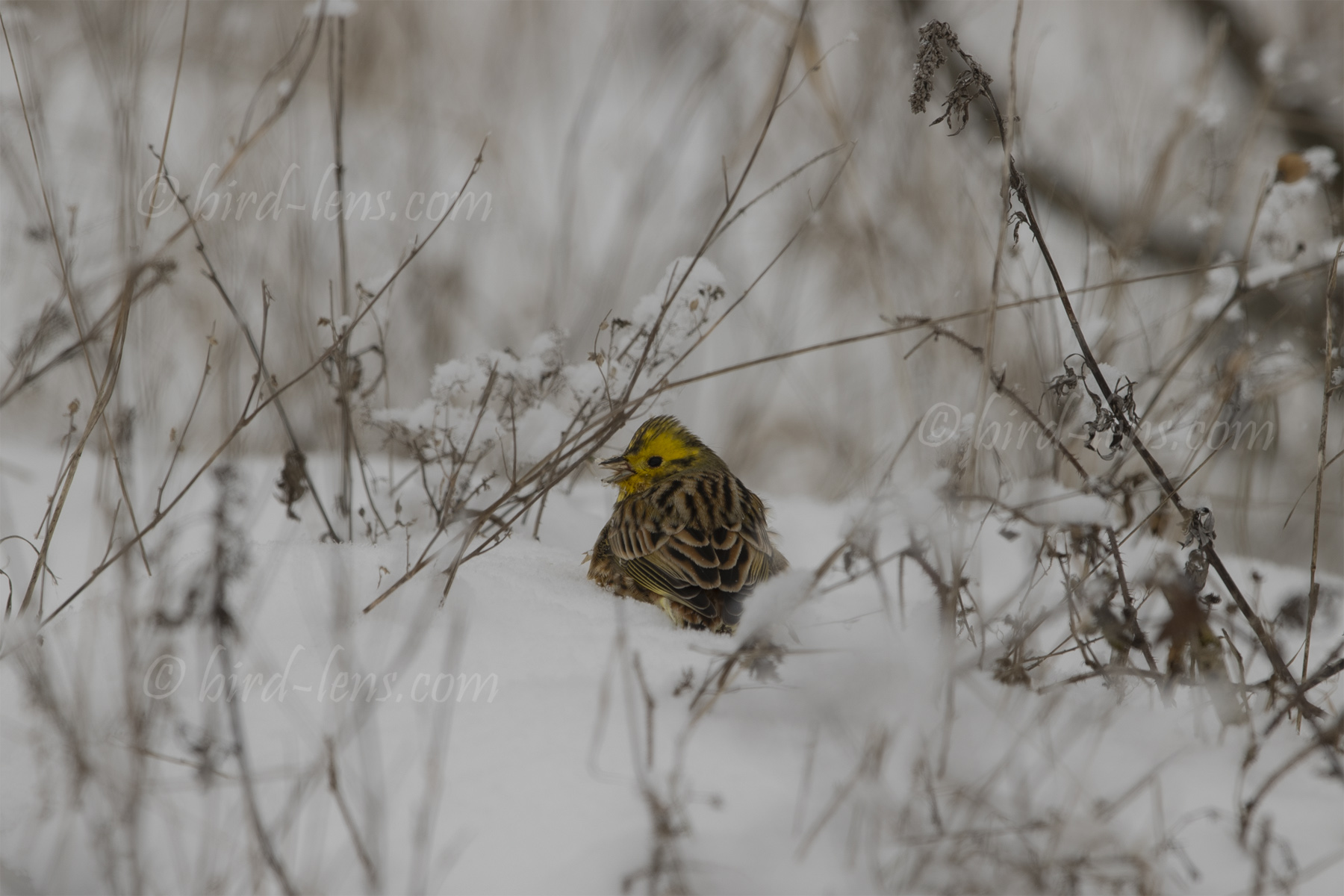
 It is bitterly cold. Snow has covered the landscape for several days. Anyone walking along a field path in Brandenburg in midwinter might suddenly come across a whole flock of small, yellow birds. They busily feed on the few remaining seeds they can find beneath the snow. In spring, by contrast, one often sees just a single male perched on a bush, singing. Both scenarios involve the same species: the Yellowhammer (Emberiza citrinella).
Reporting data from ornitho.de shows that the Yellowhammer is present in Brandenburg year-round. It is one of the most frequently reported species nationwide; in the overall ornitho.de statistics, it ranks high in the long-term dataset with around 1.4 million observations. However, these figures represent incidental sightings rather than standardized population counts. Consequently, the number of reports depends on how many people are observing, as well as when and where they do so.
In Brandenburg, their strong presence during autumn and winter is particularly notable. From October onwards, Yellowhammers often appear in larger flocks. An analysis in Brandenburg, for instance, recorded flocks of at least 100 birds in 22 areas during the first half of the year, and in 16 areas during the second half. Particularly large flocks were documented in January and February, as well as again in November and December.
The primary reason for this lies in their behavior. During the breeding season, Yellowhammers are predominantly territorial, making them more likely to be seen singly or in pairs. After breeding, however, they gather into foraging flocks. Stubble fields, fallow land, ruderal areas, and the vicinity of livestock farms provide seeds that remain available even in winter. During frosty weather, foraging may become concentrated in just a few suitable areas. Studies on agricultural land in northeastern Germany reveal a clear link between weather conditions and flock formation.
Brandenburg offers particularly suitable conditions for this. The yellowhammer inhabits open to semi-open landscapes featuring hedgerows, copses, rows of trees, and forest edges. Such structures serve as singing perches and nesting sites, while adjacent arable land and fallow areas provide foraging grounds. Consequently, recent surveys in Brandenburg record it as a widespread breeding bird.
The situation is similar nationwide, though it varies by region. While the yellowhammer remains a widespread species, it is listed on Germany’s “preliminary warning list” (a watchlist for species at risk). At the same time, monitoring programs in various regions indicate declining populations. Reports alone cannot fully capture this decline, as high levels of observation activity also increase the volume of data.
Thus, the notable feature of Brandenburg is not that the yellowhammer remains completely unaffected there; rather, it is the convergence of extensive agricultural landscapes, hedgerows, field margins, fallow land, and forest edges. This landscape structure largely explains why the yellowhammer’s characteristic song and winter flocks remain a regular sight in the area.
In order to meet the growing demand for top images of the rarer species of Palaearctic Bird-lens.com has specifically made trips not only to remote places. Additionally every chance is used, if there is a good opportunity around the homeground. This to do everything to ensure excellent photos of the Birds of the Western Palearctic. The yield of pictures also of rare Western Palaearctic birds is very good. There are other nice images of birds, that you will find behind the tab “Picture Shop“. Just give a notice if you need a picture of a bird which is not online.