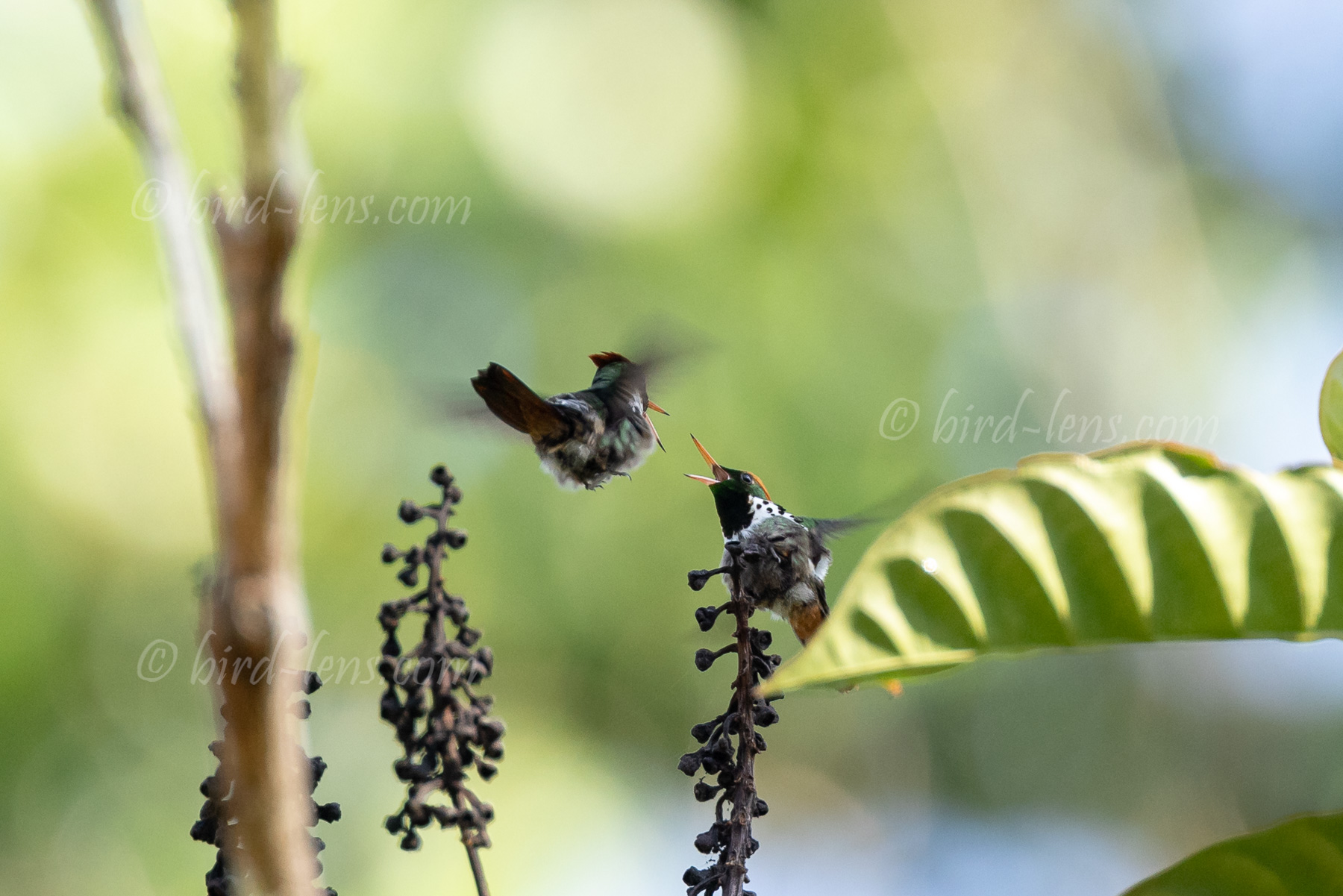
 The middy heat was just beginning to press down after a cloudy morning when we reached the edge of a new-established outskirts, in the Gunma Ecological Park near Belém. The small village here might have its charms, but the real draw for birders is far more delicate: the Dot-eared Coquette (Lophornis gouldii). I had been told that if you were lucky—and patient—you might catch a glimpse of a male on his favorite perch. Luck, it turned out, was on our side.
We were led to a clearing with a derelict housing where an exposed branch jutted out from a thin tree. “This is his spot,” our guide assured us. As if on cue, a flash of metallic green and copper appeared, settling on the branch with the poise of a performer taking the stage. The male Dot-eared Coquette sat motionless for a few moments, long enough for us to ready our cameras. He seemed aware of the attention, turning slightly to show the fine dot-like tufts of white that mark his “ears.”
By then, the day was sliding toward noon and the forest’s activity had slowed. Still, we stayed put—forty-five minutes in the dappled light, watching this tiny hummingbird’s routine. Then, without warning, another male swept into the scene. He approached low, his crest lowered in what was clearly a gesture of submission. The territorial male tolerated this for a few seconds, but the mood shifted quickly. The newcomer straightened, flicked his head, and darted forward as though testing the owner’s resolve. The response was immediate and decisive: the resident male launched into a rapid, aggressive flight toward his rival. My camera was already raised, and I caught the confrontation with a the Canon EF 400mm f/4L DO IS II USM on a Canon EOS R 5 on a monopod frame by frame—a brief but perfect sequence of midair maneuvering.
The Dot-eared Coquette is typically solitary outside of courtship, and males are highly territorial about their chosen perches. These perches are often in exposed positions, allowing them to survey the surrounding area and intercept intruders. The defensive behavior we observed—rapid aerial pursuit—matches the known pattern of aggressive territoriality in the genus Lophornis. The lowering of the crest by the second male may serve as a display to avoid direct conflict, though in this case, the challenge still escalated.
The Dot-eared Coquette is quite a very small hummingbird of the family Trochilidae, known for its ornate plumage and elaborate head feathers. Males are especially distinctive, bearing white “ear” tufts on either side of the head, metallic green upperparts, and a rufous crest. Females lack the ornamental tufts and crest, showing a more subdued appearance.
This species is found in the lowland forests and forest edges of northern Brazil, French Guiana, Suriname, and parts of eastern Venezuela. The sighting location, near Belém, lies within the species’ natural range. It is not a common bird in heavily disturbed areas, preferring semi-open habitats with nearby flowering plants. The Gunma Ecological Park offers an ideal combination of coastal forest, open patches, and nectar-rich vegetation.
The species is currently considered of Least Concern by the IUCN, but like many hummingbirds, it depends on intact forest habitat. Coastal development and deforestation can reduce suitable areas for feeding and nesting. Observations like this one underscore the importance of protected reserves such as the Gunma Ecological Park, which provide safe territories for these specialized birds.
Watching the male Dot-eared Coquette defend his perch was a reminder that even in the smallest of creatures, drama unfolds on a grand scale. For birders willing to wait, the payoff is not just a glimpse of rare beauty, but a front-row seat to the intricate behaviors that define a bird species.
In order to meet the growing demand for top images of the rarer species of Palaearctic Bird-lens.com has specifically made trips to remote places. Additionally every chance is used, if a rare bird is around the homeground. This to do everything to ensure excellent photos of the Birds of the Western Palearctic. The yield of pictures also of rare Western Palaearctic birds is very good. There are other nice images of birds, that you will find behind the tab “Picture Shop“. Just give a notice if you need a picture of a bird which is not online