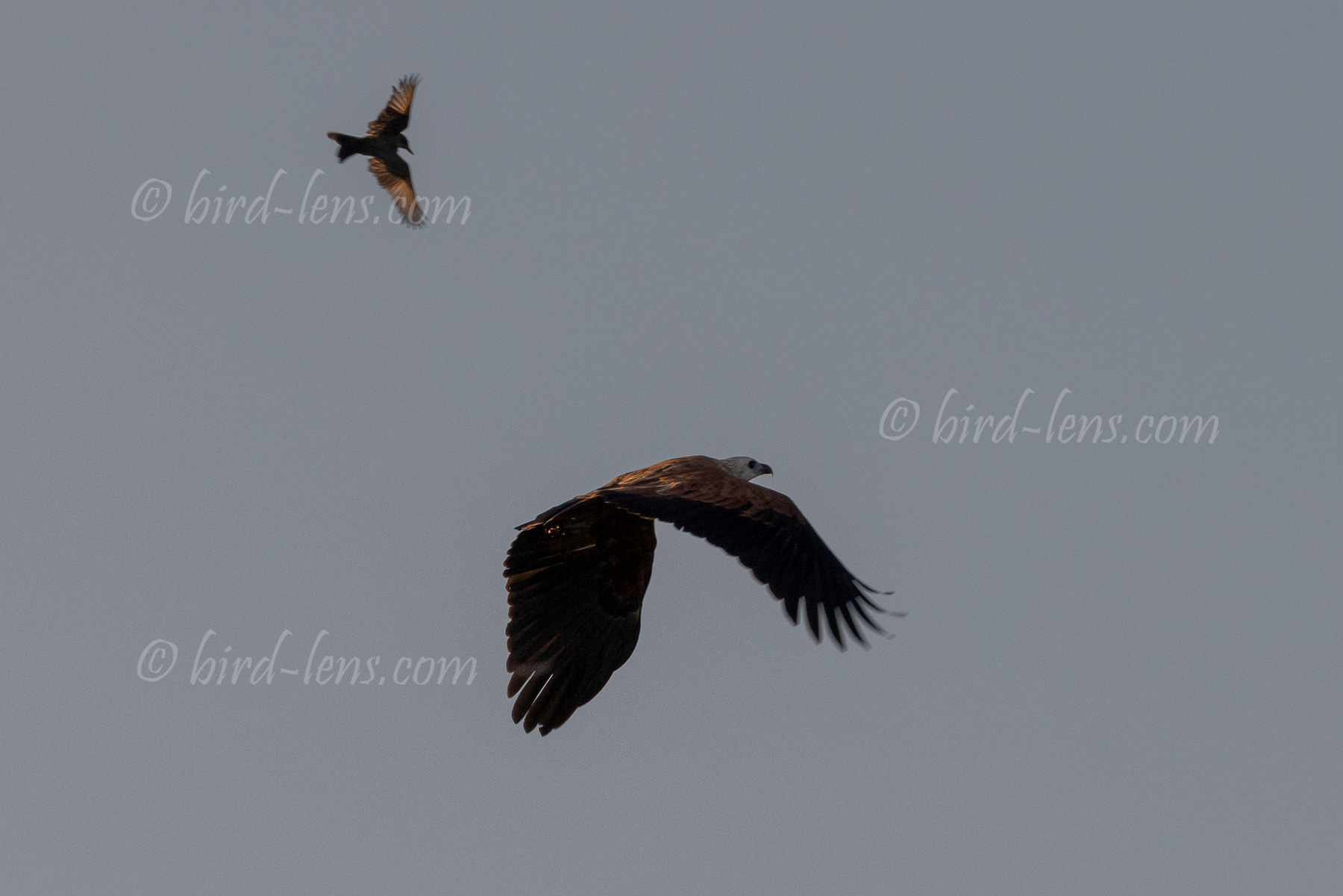
 I’m standing on the riverbank near Monte Alegre, Pará, watching the sky shift through the heavy Amazon humidity. The air smells of wet earth and fruiting trees, and everything seems to hum. Then something rufous wings over the riparian wood. A Black-collared Hawk (Busarellus nigricollis) glides low over the water, scanning for fish. Its slow, deliberate flight carries the kind of confidence that comes with owning the top of the local food chain. But that peace doesn’t last. From a nearby cecropia, a sharp, insistent call cuts through the air, followed by a smaller, gray-and-yellow blur. A Tropical Kingbird (Tyrannus melancholicus) rockets upward and begins a full-on chase.
What follows is chaos in miniature: the Black-collared Hawk veers, the Tropical Kingbird swoops and snaps, wings flicking in rapid bursts. The Kingbird’s voice is relentless, its movements precise. It dives again and again at the larger raptor until the hawk breaks its line and drifts toward the far bank. The Tropical Kingbird hovers a moment longer, issuing a few last calls that sound like victory notes before it returns to its perch.
Such aerial dramas are more than spectacle—they’re an essential part of behavioral ecology in the Neotropics. Kingbirds and other New World flycatchers (family Tyrannidae) are famous for aggressive mobbing behavior. They regularly harass birds of prey, often many times their size. These interactions are not random. They serve as territorial and defensive strategies, reducing predation risk for adults, nests, and fledglings. By driving raptors away before they even approach nesting zones, kingbirds preempt potential threats.
The targets of these assaults range widely. Records show persistent harassment directed at medium to large raptors, including hawks (Buteo spp.), White-tailed Kite (Elanus leucurus), Double-toothed Kite (Harpagus bidentatus), Plumbeous Kite (Ictinia plumbea), Savanna Hawk (Buteogallus meridionalis), Roadside Hawk (Buteo magnirostris) and even caracaras like the Southern Crested Caracara (Caracara plancus). In most cases, the smaller birds succeed in repelling the intruder, though at the cost of significant energy expenditure. The behavior is highly adaptive: mobbing intensity often peaks during breeding season, when nest defense is critical.
Interestingly, not all raptors provoke equal responses. Species that pose minimal risk to small passerines — such as Snail Kites (Rostrhamus sociabilis) or scavenging vultures like the Black Vulture (Coragyps atratus) — tend to be ignored. The hawks that specialize in birds or small vertebrates, however, trigger immediate alarm. The Black-collared Hawk, primarily piscivorous, might not actively hunt songbirds, but its silhouette and size are enough to set off instinctive defensive behavior in territorial flycatchers.
The Amazon sky may belong to the raptors—but moment to moment, the small tyrants of the tropics make sure they never forget they’re being watched.
In order to meet the growing demand for top images of the rarer species of Palaearctic Bird-lens.com has specifically made trips to remote places. Additionally every chance is used, if a rare bird is around the homeground. This to do everything to ensure excellent photos of the Birds of the Western Palearctic. The yield of pictures also of rare Western Palaearctic birds is very good. There are other nice images of birds, that you will find behind the tab “Picture Shop“. Just give a notice if you need a picture of a bird which is not online.