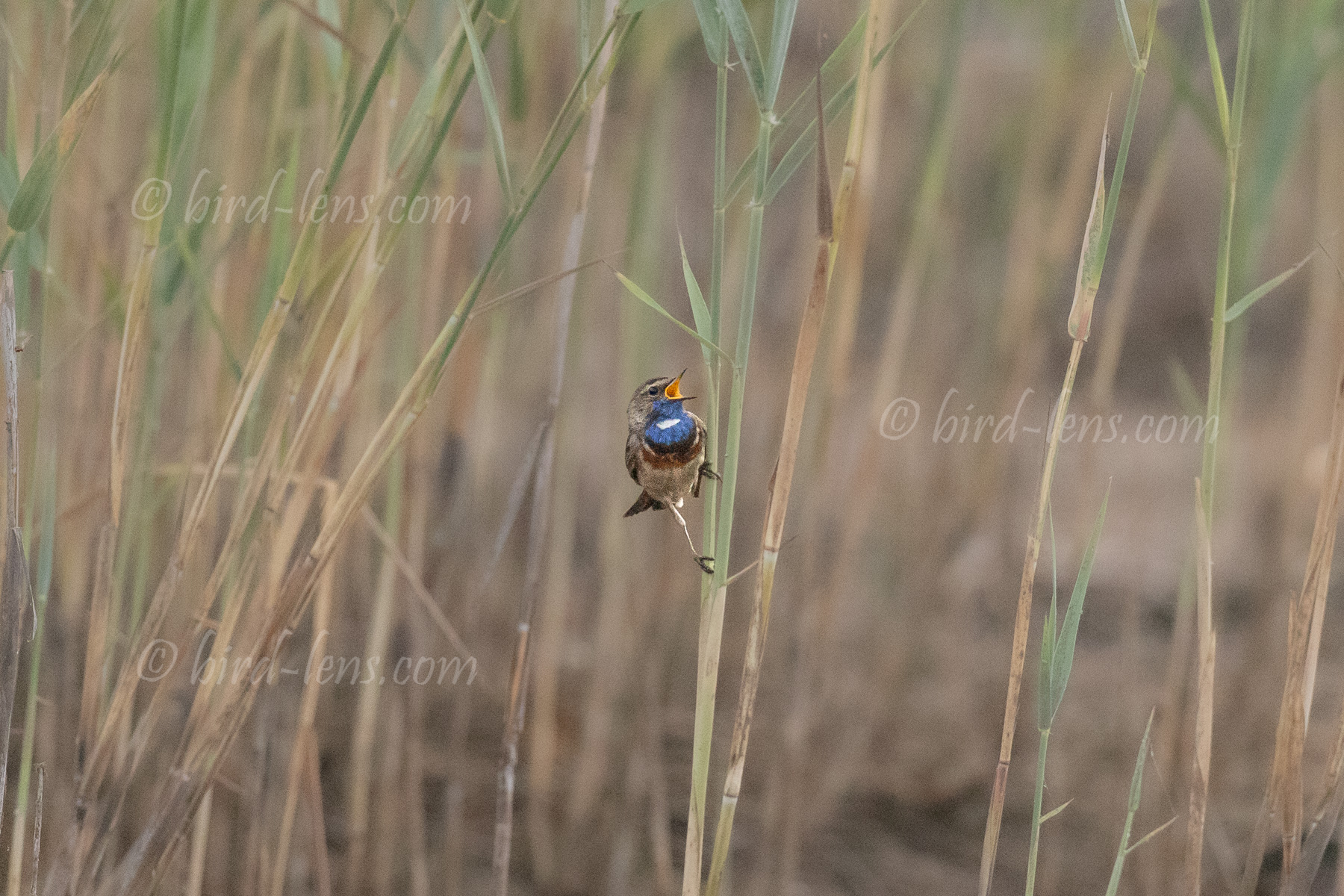
 The day is just beginning. A thick veil of mist still hangs over the marshland, with its mudflats and sparse reeds. At first, there is barely a sound—save for the early call of a cuckoo (Cuculus canorus). Then, suddenly, a soft, metallic song breaks the morning silence. A Bluethroat (Luscinia svecica)! Singing first from among the reed stalks and then from a slightly elevated perch, the male performs with impressive stamina. Stanza follows stanza—loud, varied, and full of energy. This song comes as a surprise to me in late June. Isn’t the main courtship season long over? Or is there another reason why the little singer is still defending his territory so vigorously?
In fact, an intensely singing Bluethroat in late June is by no means unusual. Although territorial singing peaks in April and May, many males remain highly vocal well into high summer. The song no longer serves solely to attract a female; instead, it continues to mark the territory and signals to neighboring males that the breeding ground is still occupied.
Another reason lies in the species’ breeding biology. Bluethroats often raise two broods a year, provided weather conditions and food availability are favorable. While the female is already incubating a second clutch or tending to young birds, the male often continues to defend the territory. Consequently, singing remains a key component of reproductive behavior even after the first brood has been raised.
As a result, the breeding season extends deep into the summer. Even in late June, eggs or nestlings of varying ages can be found in many territories. Fledged young are frequently observed as late as July. After fledging, young Bluethroats initially remain in the breeding area for several weeks, continuing to be cared for by the adult birds before gradually becoming independent. Only then do they begin preparing for migration to their wintering grounds.
However, not every instance of singing indicates an active breeding attempt. Unmated males may also sing intensely well into the summer—particularly if they are hoping for a late pairing or are re-establishing a territory after a lost clutch. Experienced breeding birds, too, respond to favorable weather conditions or the presence of rival neighbors with increased vocal activity.
The impressive singer in the morning mist thus serves as a reminder that the avian calendar is less rigid than we often assume. While many species quiet down significantly by the end of June, the Bluethroat remains true to its song. Its melody speaks not only of the spirit of spring but also of territorial defense, the possibility of a second brood, and a breeding season that is far from over in many locations.
To meet the growing demand for high-quality images of the Palearctic’s rarer species, Bird-lens.com has systematically scoured its immediate surroundings for interesting bird subjects. Targeted expeditions to remote locations have also been undertaken—all to ensure outstanding photographs of Western Palearctic birds. The resulting collection of images, including those of rare Western Palearctic species, is excellent. You can find more beautiful bird images under the “Picture Shop” tab. Please simply let us know if you require an image of a bird that is not currently listed online.