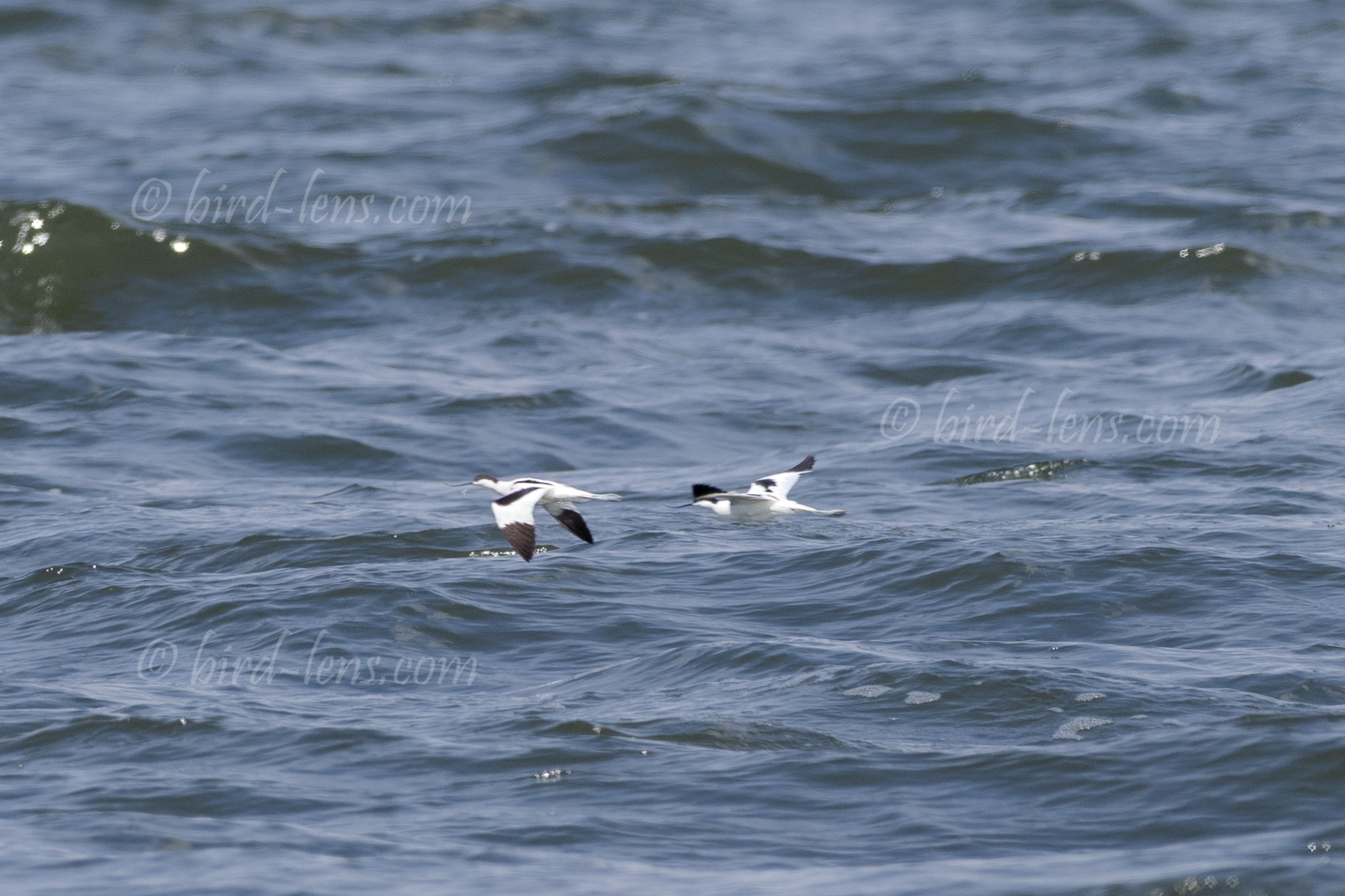
 On a windy June day along the Pomeranian Baltic coast near Dziwnów (formerly Dievenow), there was suddenly plenty to see. A strong westerly wind was blowing across the sea, and several species of ducks and waders were migrating from east to west along the narrow coastal strip. At first, 8 Northern Shovelers (Spatula clypeata) in a row caught the eye, followed by a group of 34 Eurasian Teals (Anas crecca) arriving in several waves, then eight Common Eiders (Somateria mollissima), and finally a total of 27 Eurasian Curlews (Numenius arquata) in four flocks. The real surprise, however, was two Pied Avocets (Recurvirostra avosetta) flying purposefully along the coast. Coming in the middle of June, this immediately raises the question: Is this the onset of migration away from breeding grounds, or merely local movement within the summer range?
Northern Shovelers, Eurasian Teals, and Common Eiders often show initial movements outside their breeding territories as early as early summer. Non-breeders, unsuccessful breeders, and individuals undergoing molt frequently leave their breeding areas starting in June. Such movements are well documented in Northeastern Europe and the Baltic region, serving the search for suitable molting and stopover sites. Directional migration along the coastline is not unusual in this context.
With its elongated coastline, the former Prussian province of Pomerania forms a natural corridor for migrating waterfowl. Coastlines are preferred routes because they provide navigational guidance while offering favorable stopover opportunities. Consequently, significant migratory movements can be observed even outside the classic migration seasons.
The 34 Eurasian Teals recorded here were likely not yet true autumn migrants. It is more likely that these represent early relocations or the start of the so-called “moult migration.” For many duck species, this process begins as early as June. During this time, the birds seek out areas rich in food and free from disturbance, where they remain protected while flightless during the moult.
The two Pied Avocets are particularly noteworthy. This species breeds along the coasts and saline waters of Europe and exhibits distinct post-breeding movements as early as June. It is not uncommon for adult birds to leave their breeding grounds shortly after the chicks hatch or following an unsuccessful breeding attempt, often covering considerable distances in the process. The observed directional flight along the coast suggests a purposeful migratory movement rather than local commuting flights.
Strong westerly winds likely influenced the direction of flight. When facing a headwind, many waterfowl fly at low altitudes and stay close to the coastline. Consequently, an east-to-west flight does not necessarily indicate a classic autumn migration; instead, such movements are often part of a gradual shift toward moulting or staging areas.
The two avocets, in particular, can be seen as an indication that post-breeding migrations are already underway. Mid-June marks the beginning of a phase for numerous wader and waterfowl species during which the boundaries between the breeding season and autumn migration gradually blur. The observations near Dziwnów impressively demonstrate that bird migration is not solely an autumn phenomenon; a dynamic period of relocation begins for many species as early as early summer—a process that can be tracked particularly well along the Baltic coast.
In order to meet the growing demand for top images of the rarer species of Palaearctic Bird-lens.com has specifically made trips not only to remote places. Additionally every chance is used, if there is a good opportunity around the homeground. This to do everything to ensure excellent photos of the Birds of the Western Palearctic. The yield of pictures also of rare Western Palaearctic birds is very good. There are other nice images of birds, that you will find behind the tab “Picture Shop“. Just give a notice if you need a picture of a bird which is not online.