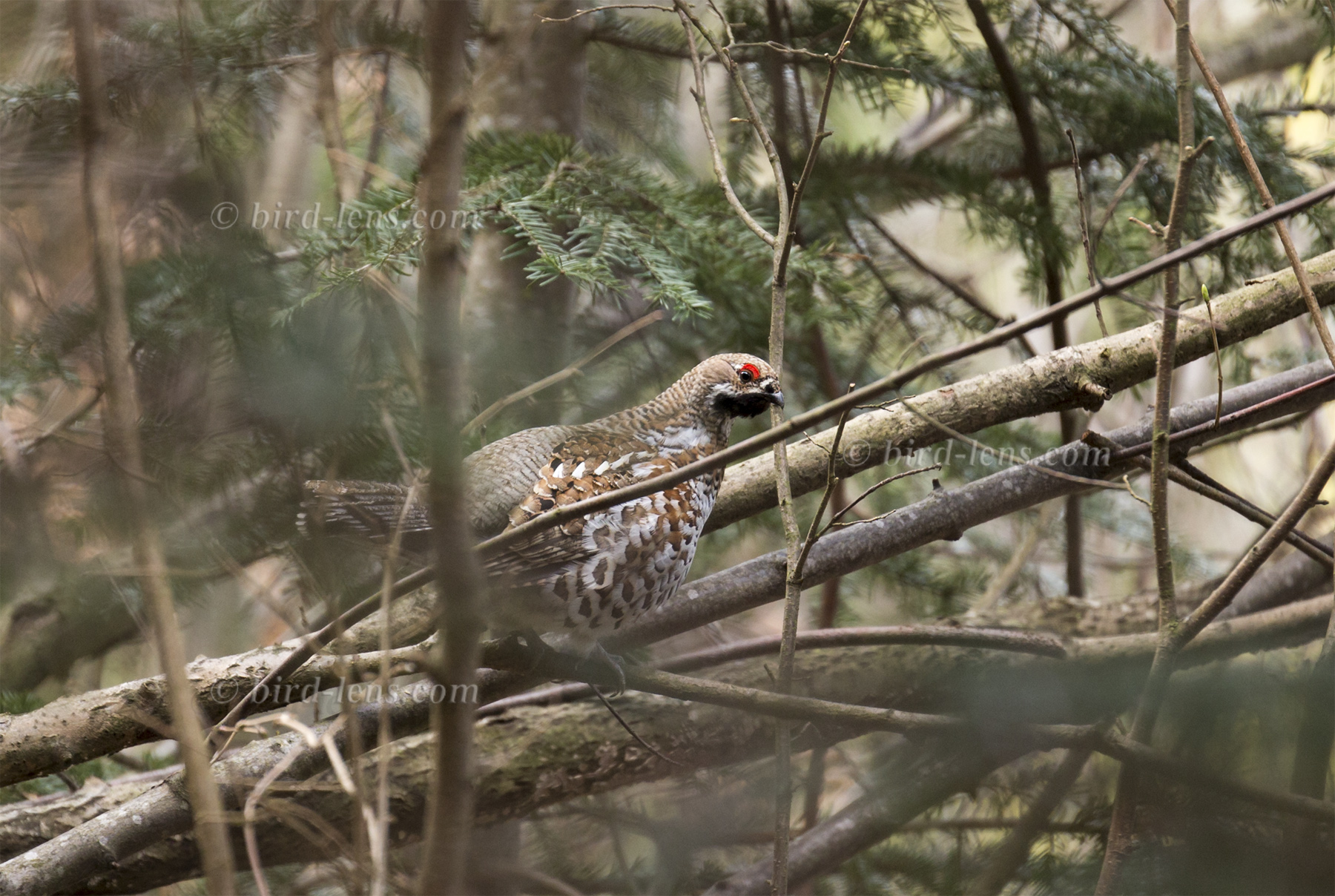
 In the spring, as I was wandering with binoculars through species-rich, moist spruce forests near Nové Hamry (Neu Hammer), about 8 km south of the German border near Breitenbach, I suddenly noticed a gentle rustling in the undergrowth. Suddenly, a buzzing sound of takeoff. A brown-gray bird began its flight from an area of low spruce trees, cranberries, and mosses, right next to an overgrown logging road. My heart rate rose. Could this really be happening? A Hazel Grouse (Tetrastes bonasia)? Here? In a region where it is supposed to have disappeared for decades?
For many bird enthusiasts, such a moment would be a small dream – and perhaps it has already become reality. A targeted species conservation program was launched in 2021 in the Czech Elbe Sandstone Mountains, the České Švýcarsko. The Hazel Grouse is in sharp decline in Central Europe, primarily due to habitat loss, forest fragmentation, and human disturbance. The National Park Administration recognizes the hazel grouse as an indicator species for near-natural, structurally rich forests – precisely the type of habitat that is promoted by natural forest development in good mountain conservation areas.
The reintroduction of the hazel grouse in the České Švýcarsko National Park and border areas of the Saxon Switzerland National Park represents a significant step for Central European species conservation. This species, considered a typical inhabitant of structurally rich, near-natural deciduous and mixed forests, disappeared from many regions of Central Europe due to intensive forestry, habitat fragmentation, and human disturbance.
The necessary planning basis for the cross-border species conservation project is being developed through a collaboration between Czech and German specialist institutions. The goal is to establish a viable hazel grouse population in the Elbe Sandstone Mountains – on both sides of the border. This includes habitat mapping, genetic comparisons of suitable source populations, and a detailed release plan.
The animals are bred in specialized facilities using genetically matched lines. Before release, they are prepared for environmental conditions, natural food, and predator avoidance in adaptation enclosures. Release takes place at carefully selected locations with diverse ground vegetation, cover, and minimal disturbance. Light forest structures with a high proportion of shrubs – classic Hazel Grouse habitats – are particularly important.
Modern monitoring methods such as GPS telemetry, wildlife cameras, and acoustic recordings are being used to monitor success. Initial results indicate good adaptability of the released animals. Individuals exhibit site-loyal behavior, and initial courtship calls have been recorded – a positive sign for the establishment of a new subpopulation. This is likely if the first individuals have already conquered a new habitat this far west.
The habitat at the time of the sighting was characterized by Spruce (Picea abies) as the typical tree, Birch (Betula pubescens), and other deciduous trees such as Aspen (Populus tremula), Black Alder (Alnus glutinosa), and Willow (Salix caprea) with a well-developed understory. The ground was covered with Cranberries (Vaccinium sp.) and mosses. The area was a rather hilly mountain landscape at an elevation of approximately 900 m above sea level.
The habitat reminded me very much to the one described in the Blog „Finding Hazel Grouse in the Carpathians“ where the image of the blog was shot. The environment was closer what is descriebed as the winter habitat with dense conifer stocks with a minimum percentage blend of Birch, Alder and Hazel.
The return of the Hazel Grouse would not only be a benefit for biodiversity, but also a sign of what is possible when nature conservation is thought of across borders – precisely planned and scientifically.
In order to meet the growing demand for top images of the rarer species of Palaearctic Bird-lens.com has made trips to remote places. Additionally every chance is used, if a rare bird is around the homeground. This to do everything to ensure excellent photos of the Birds of the Western Palearctic. The yield of pictures also of rare Western Palaearctic birds is very good. There are other nice images of birds, that you will find behind the tab “Picture Shop“. Just give a notice if you need a picture of a bird which is not online.