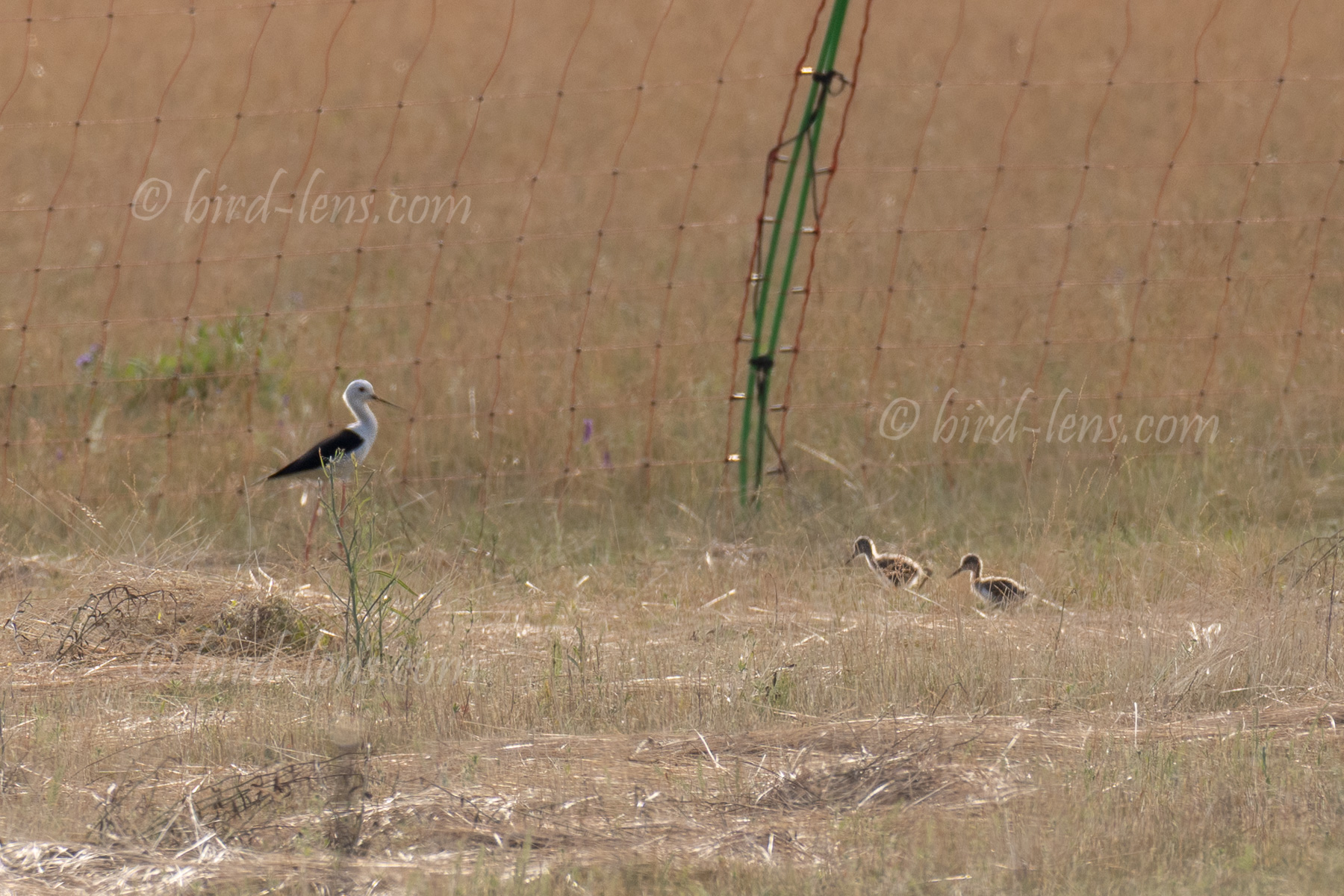
 Sometimes it pays to simply stop and observe. On a road near Blankensee, right on the border between the districts of Teltow-Fläming and Potsdam-Mittelmark, I pull over on a slight rise near the Gut Breite estate. Two Black-winged Stilts (Himantopus himantopus) fly directly toward and over me, calling loudly. To my delight, I spot four stilts about 300 meters away. Two adults are accompanying two flightless chicks, which are moving with surprising purpose across a sheep pasture where the grass has been grazed short. Loud alarm calls ring out repeatedly. The adults are evidently trying—though not always successfully—to lure the young back into taller vegetation. Several times, the adults fly in my direction, even though I am far away and barely moving. At first, this behavior seems unusual. Why would the birds leave the seemingly safe cover of the meadow and lead their young out into an open area?
In fact, this behavior is consistent with the breeding biology of the Black-winged Stilt. The chicks are precocial, leaving the nest just a few hours after hatching. They forage independently but are guided and closely guarded by both parents. During this phase, the adults are extremely sensitive to potential disturbances, defending their young with loud warning calls and targeted mock attacks against humans, mammals, or birds of prey.
Moving from dense vegetation to short-grass pastures is by no means unusual. Areas with short grass make it easier for the chicks to move around while offering better access to the small invertebrates that make up the bulk of their diet. Furthermore, the open terrain allows the adults to spot potential predators sooner. While tall vegetation offers cover, it also significantly restricts visibility and hinders communication within the family group.
The period during which the parents tend to the young usually lasts four to five weeks. During this time, the chicks grow rapidly, develop their juvenile plumage, and exercise their flight muscles. They are capable of flight at around one month of age but often remain with the family group for some time thereafter. Only then do they become increasingly independent; they frequently join small flocks later on, prior to the onset of migration.
Whether a second brood follows depends on local conditions. In Central Europe, there is typically only one brood per year. However, if an early clutch is lost—or if the first brood begins exceptionally early and food remains plentiful—a replacement clutch or occasionally even a second brood may occur. The observed family behavior therefore suggests a successful initial breeding attempt, with the primary task now being to safely guide the two young birds until they are capable of flight.
In order to meet the growing demand for top images of the rarer species of Palaearctic Bird-lens.com has specifically made trips not only to remote places. Additionally every chance is used, if there is a good opportunity around the homeground. This to do everything to ensure excellent photos of the Birds of the Western Palearctic. The yield of pictures also of rare Western Palaearctic birds is very good. There are other nice images of birds, that you will find behind the tab “Picture Shop“. Just give a notice if you need a picture of a bird which is not online.