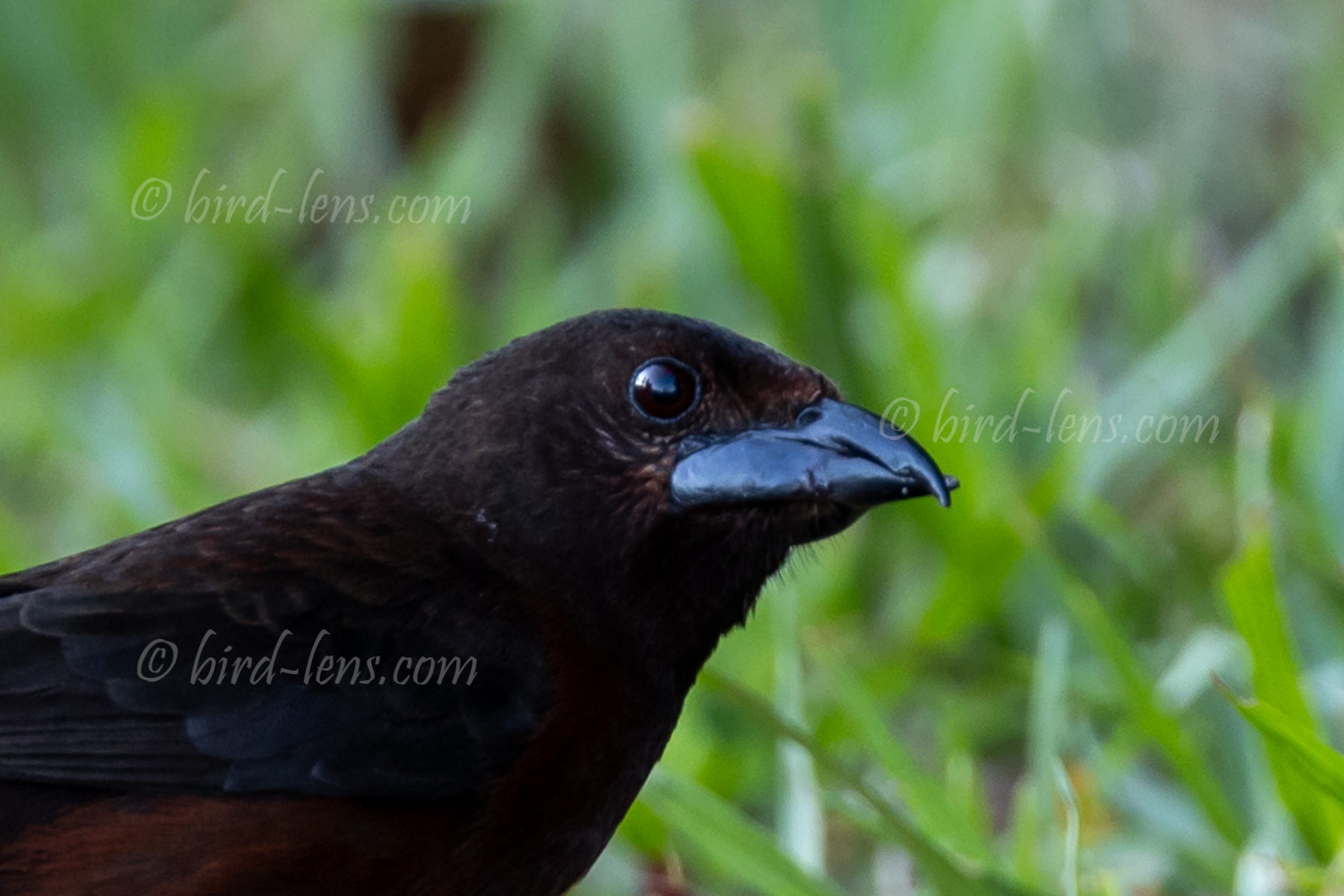
 I spot her at the edge of a forest together with Great Kiskadee (Pitangus sulphuratus). She moves with quick, precise hops along a concrete sidewalk in the mining town of Carajás, near the city of Parauapebas on the lower Amazon. At first glance, she looks like any other young female Silver-beaked Tanager (Ramphocelus carbo). The warm, reddish-brown plumage, the steady rhythm of her foraging, the faint contrast on her throat, and the absence of the white-silver beak of the adults. Then she turns her head, and her beak steals the show. The upper mandible slightly crosses the lower mandible, making her look like a crossbill. It’s unexpected, but she eats, preens, and moves as if this shape has always been part of her story.
Once the surprise wears off, the question arises. Why does a normally straight-billed bird species exhibit a crossed or twisted beak structure in adulthood?
In avian biology, beak deformities range from slight asymmetry to severe curvature or elongation. They occur in many species and can be as pronounced as in the classic crossbill, the Red Crossbill (Loxia curvirostra). In tanagers like Silver-beaked Tanagers, deformities are uncommon but known. They can result from genetic factors, nutritional imbalance during development, mechanical injury, or exposure to environmental contaminants. In some cases, pathogens such as avian keratin disorder are involved, although this condition is studied more deeply in northern passerines than in tropical species.
A crossed bill in a Silver-beaked Tanager raises questions because the species normally depends on a straight, sturdy mandible to handle fruit pulp, soft insects, and occasional seeds. A crossing of the tips can reduce the precision of grip and pressure. Even so, many birds compensate. They adjust their feeding angle, use lateral motions, or pick softer prey. The female I watch seems to manage fruit sections without issue, which suggests long term adaptation rather than recent injury.
Among avian societies, bill deformities have broader implications. Birds with altered bills may stand lower in dominance hierarchies, since bill shape affects display postures and the ability to defend feeding spots. Some studies show that individuals with deformities spend more time feeding because each item requires extra handling. This in turn reduces time for preening or nest maintenance. Despite that, there are cases where a deformed bill does not reduce reproductive success, especially when the environment provides abundant and accessible food.
For the observer, these individuals serve as reminders of the plasticity of avian behavior. A beak is not only a tool. It is a focal point for communication, foraging, and survival. When its shape strays from the norm, the bird often finds a workable path. The female Silver-beaked Tanager with her crossbilled like pattern stands as proof. She carries on with the same force of life as any textbook specimen, shaped by her own small set of pressures and responses.
In order to meet the growing demand for top images of the rarer species of Palaearctic Bird-lens.com has specifically made trips to remote places. Additionally every chance is used, if a rare bird is around the homeground. This to do everything to ensure excellent photos of the Birds of the Western Palearctic. The yield of pictures also of rare Western Palaearctic birds is very good. There are other nice images of birds, that you will find behind the tab “Picture Shop“. Just give a notice if you need a picture of a bird which is not online.