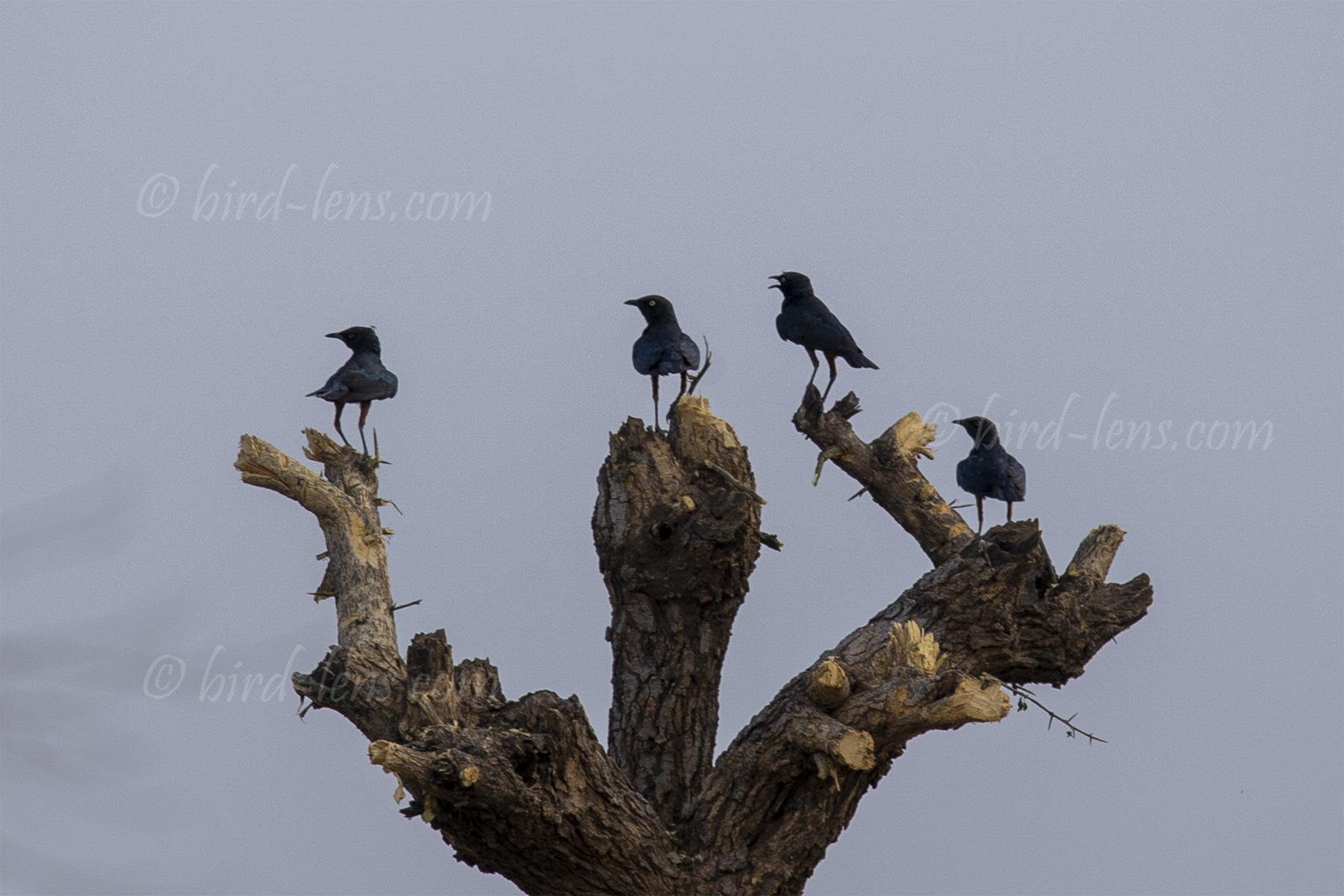
 I spend most of my birding trips in North Africa with a sense of discovery—always wondering which species will surprise me in the desert landscapes. Southern Algeria, especially the road south of Tamanrasset toward Tin Zaouatine, is one of those places where the familiar edges of the Palearctic meet the Sahel. On a recent journey in November 2024, one of these surprises turned out to be the Chestnut-bellied Starling (Lamprotornis pulcher).
Three individuals were recorded along the roadside, including an adult seen feeding a juvenile. This detail alone carries weight: the feeding behavior is strong evidence of local breeding in the area. For Algeria, this is only one oft he first documented records of the species, and for the Western Palearctic region as a whole after its discovery in 2022. In the year a bird was found in the region of Tawendert, Tin Zaouatine, near the border with Mali on 24 November 2022. This used to be the first record for Algeria and Northwest Africa.
Such observations highlight how fluid the boundaries of distribution can be in arid zones, where climate, vegetation, and human disturbance all shift the balance of habitat use.
The Chestnut-bellied Starling is typically associated with the Sahelian belt, ranging from Senegal and Mauritania across to Chad and Sudan. It thrives in open savanna, semi-desert scrub, and thornbush habitats, often favoring areas with scattered acacias. In its core range, it is a conspicuous and social bird, often moving in groups and adapting readily to human-modified landscapes such as villages and cultivated plots. The fact that individuals are establishing themselves in southern Algeria suggests that the habitat around Tamanrasset provides the same structural conditions—patchy vegetation, isolated trees, and reliable food sources—that the species requires further south.
From an ecological perspective, the observation also underlines how the Sahara is not a uniform barrier but a mosaic of microhabitats. The Hoggar region, with its slightly higher rainfall and scattered vegetation, acts as a northern outpost for several Sahelian species. Other African birds recorded here include the White-crowned Wheatear (Oenanthe leucopyga), Fulvous Babbler (Argya fulva), and African Silverbill (Euodice cantans), all of which demonstrate similar adaptations to semi-arid and human-influenced environments.
For bird enthusiasts, this kind of record is more than just a tick on a list. It reshapes our understanding of distribution limits and breeding ranges. It also invites the question of whether the Chestnut-bellied Starling is establishing a small but viable population in Algeria, or if these observations are the result of irregular movements pushed by ecological changes further south. For the sake of completeness, it should be mentioned that there is also speculation that these birds could be escaped. The Chestnut-bellied Starling in Algeria itself is currently listed as (SN – Statut Actuel Non Défini) by algerian ornithologists. Anyway, continued monitoring in the region will be key to answering this.
What remains certain is that a birding trip in southern Algeria still carries the potential for genuine discovery. The mix of Palearctic migrants, Saharan specialists, and Sahelian newcomers makes the region one of the most exciting frontiers for ornithology in North Africa.
In order to meet the growing demand for top images of the rarer species of Palaearctic Bird-lens.com has specifically made trips to remote places. Additionally every chance is used, if a rare bird is around the homeground. This to do everything to ensure excellent photos of the Birds of the Western Palearctic. The yield of pictures also of rare Western Palaearctic birds is very good. There are other nice images of birds, that you will find behind the tab “Picture Shop“. Just give a notice if you need a picture of a bird which is not online.