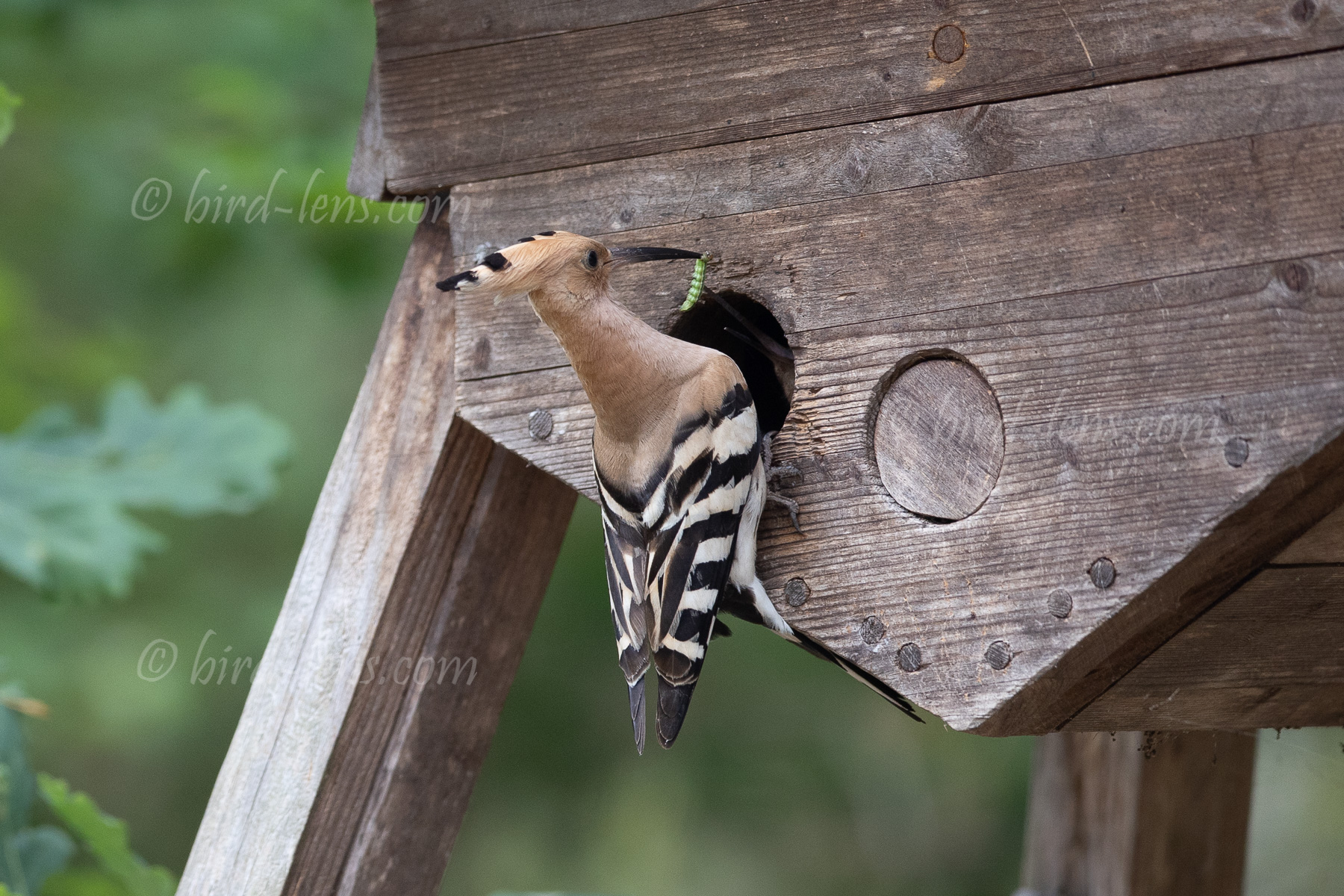
 Anyone who observes a Eurasian Hoopoe (Upupa epops) raising its young quickly notices how purposeful these striking birds are in their actions. An adult bird repeatedly returns to the nesting site with a green caterpillar in its beak. At first glance, it almost appears as though it is catching the same type of prey every time. In fact, there is strong evidence suggesting that the nestlings are being fed specifically on the caterpillars of the Berger’s Clouded Yellow (Colias alfacariensis).
The Eurasian Hoopoe is an insectivore that gathers its food primarily on the ground or amidst low-growing vegetation. During the chick-rearing period, the need for protein-rich food increases significantly, and caterpillars serve as a particularly valuable food source during this phase. If large aggregations of a specific species are found in an area, the adult birds consistently exploit this resource. This creates the impression that the same butterfly species is being caught over and over again.
This behavior can be explained by the spatial concentration of the caterpillars. The caterpillars of the Berger’s Clouded Yellow prefer to feed on Horseshoe Vetch (Hippocrepis comosa) and often occur in high densities locally. A Eurasian Hoopoe memorizes productive foraging spots and returns to them repeatedly, allowing it to gather multiple prey items in a short time with minimal energy expenditure. Such specialization is a known phenomenon among many bird species during the chick-rearing period.
However, definitive identification based solely on the green coloration is difficult. Alternative prey candidates include the caterpillars of the Large White (Pieris brassicae), Small White (Pieris rapae), Common Blue (Polyommatus icarus), or various owlet moths (family Noctuidae). Larvae of the Swallowtail (Papilio machaon) or other butterfly species could also be taken as prey. The local occurrence and seasonal availability of caterpillars are crucial factors.
The nestling period of the Eurasian Hoopoe lasts approximately 26 to 29 days. However, after fledging, the young birds remain dependent on the adults for another week to ten days. During this phase, they continue to be fed while simultaneously learning to forage for food independently. Only then does the family group gradually break up. The repeated delivery of green caterpillars is therefore an expression of a highly efficient strategy used by the parents to meet the high nutritional needs of their offspring.
To meet the growing demand for high-quality images of the Palearctic’s rarer species, Bird-lens.com has systematically scoured its immediate surroundings for interesting bird subjects. Targeted expeditions to remote locations have also been undertaken—all to ensure outstanding photographs of Western Palearctic birds. The resulting collection of images, including those of rare Western Palearctic species, is excellent. You can find more beautiful bird images under the “Picture Shop” tab. Please simply let us know if you require an image of a bird that is not currently listed online.