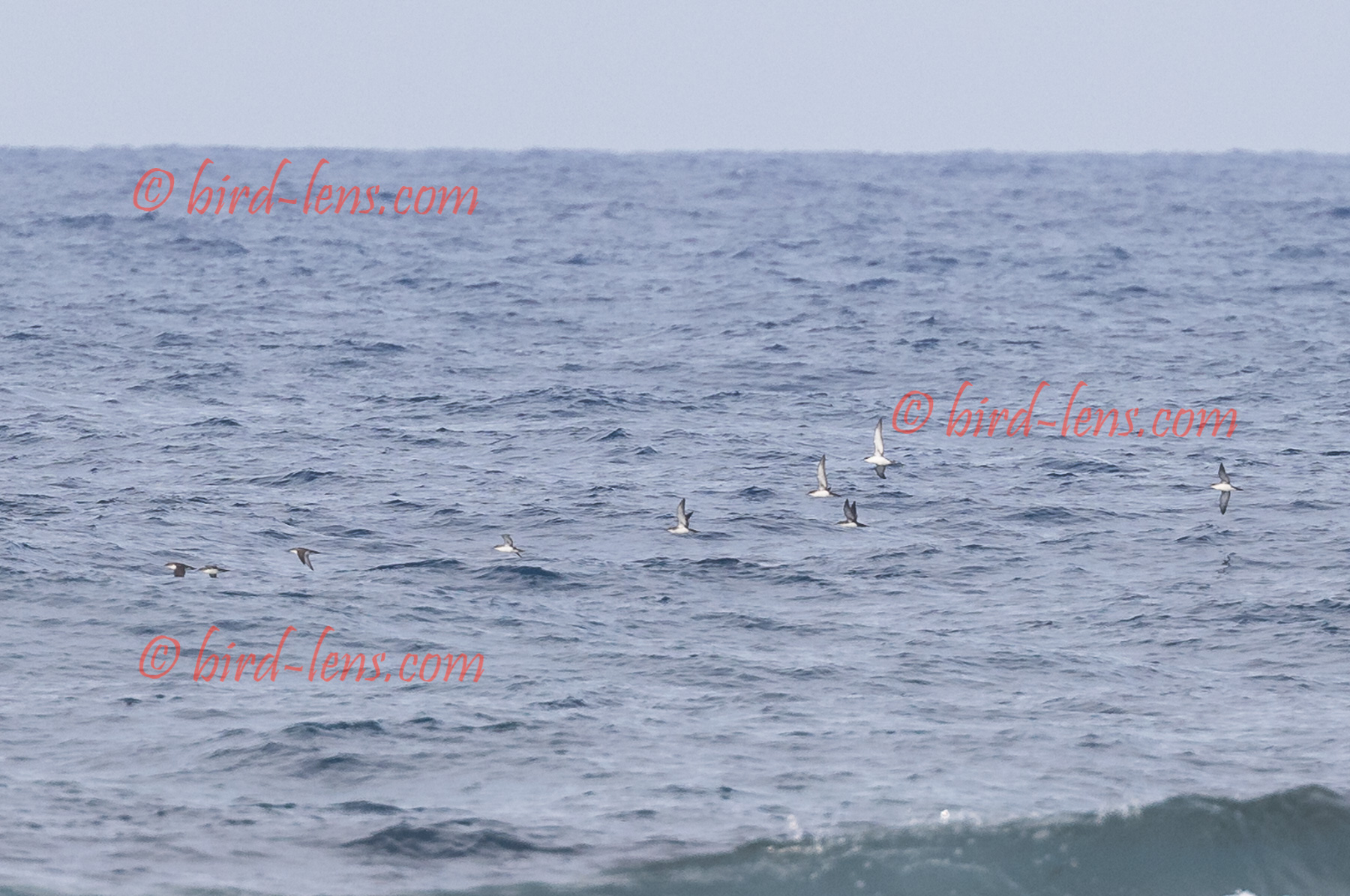
 The light over the Sicilian coast is even softer in the early morning. And the sea has only just begun to shift its hue from a deeper, metallic gray to an ever-brighter blue. I stand on a rocky headland facing the Isola delle Correnti, scanning the horizon where the boundary between water and sky blurs. For a while, nothing is to be seen save for the Yellow-legged Gulls (Larus michahellis) flying in to breed and the rhythmic movement of the waves. Then, skimming low over the water’s surface, a shearwater appears, gliding along on rigid wings in gentle arcs. Another follows. Then—after a brief delay—an entire flock follows suit. The Yelkouan Shearwater (Puffinus yelkouan) rarely draws attention to itself; yet once you have noticed its flight, it is unmistakable..
The Yelkouan Shearwater is a medium-sized seabird endemic to the Mediterranean Basin, with a distribution centered on this enclosed sea. It is closely associated with pelagic environments but depends on terrestrial sites for breeding. Morphologically, it is adapted for dynamic soaring, using wind gradients over waves to travel efficiently across large distances with minimal expenditure. Its flight is characterized by alternating glides and rapid wingbeats, typically close to the water surface. The Yelkouan Shearwater differs from the much rarer Balearic Shearwater (Puffinus mauretanicus), which nests on only a few islands in the west of the basin, by being overall smaller, feet projecting less beyond tail, usually much paler underwing and underparts, and the sharp (rather than blurred) boundary between the dark and pale colours.
In Sicily, seasonal occurrence is strongly tied to its breeding cycle. The species breeds on offshore islands and remote coastal cliffs, with peak activity around colonies occurring from late winter through early summer. During this period, individuals commute between foraging areas at sea and nesting burrows on land, often returning under the cover of darkness to avoid predation. Outside the breeding season, the species disperses more widely across the Mediterranean, and sightings around Sicily become less predictable, though still possible offshore.
The habitat of the Yelkouan Shearwater can be defined within the marine pelagic biome, particularly in oligotrophic to moderately productive waters typical of the Mediterranean Sea. These waters are generally low in nutrients compared to open oceans, which influences prey availability and distribution. The species feeds primarily on small fish, cephalopods, and crustaceans, capturing prey near the surface. Foraging often occurs in association with underwater predators or localized upwellings that concentrate prey.
Breeding habitat is markedly different from its foraging environment. Colonies are typically located on predator-free islands, steep coastal cliffs, or inaccessible rocky slopes. Nesting occurs in burrows, crevices, or cavities, often in substrates that allow excavation or provide natural shelter. This dual reliance on marine and terrestrial habitats makes the species particularly sensitive to disturbances in either domain.
For birders in Sicily, the best opportunities to observe the Yelkouan Shearwater are along exposed coastlines and from elevated vantage points overlooking open sea. Prominent locations include headlands along the eastern coasts of Sicily like Capo Murro di Porco or/and Isola delle Correnti, the southern-most tip of Sicily. Evening and early morning are optimal times, when birds are actively commuting or foraging closer to shore. Boat-based observations – as from the ferry from Marsala to Isola di Marettimo – can increase encounter rates, particularly in waters near known breeding sites. Sometimes they come quite close to the beach, maybe down to 500m as happens from the beach of Riserva Naturale Oasi di Vendica
In order to meet the growing demand for top images of the rarer species of Palaearctic Bird-lens.com has specifically made trips to remote places. This to do everything to ensure excellent photos of the Birds of the Western Palearctic. The results in pictures also of rare Western Palaearctic birds is very good. There are other nice images of birds, that you will find behind the tab “Picture Shop“. Just give a notice if you need a picture of a bird which is not online.