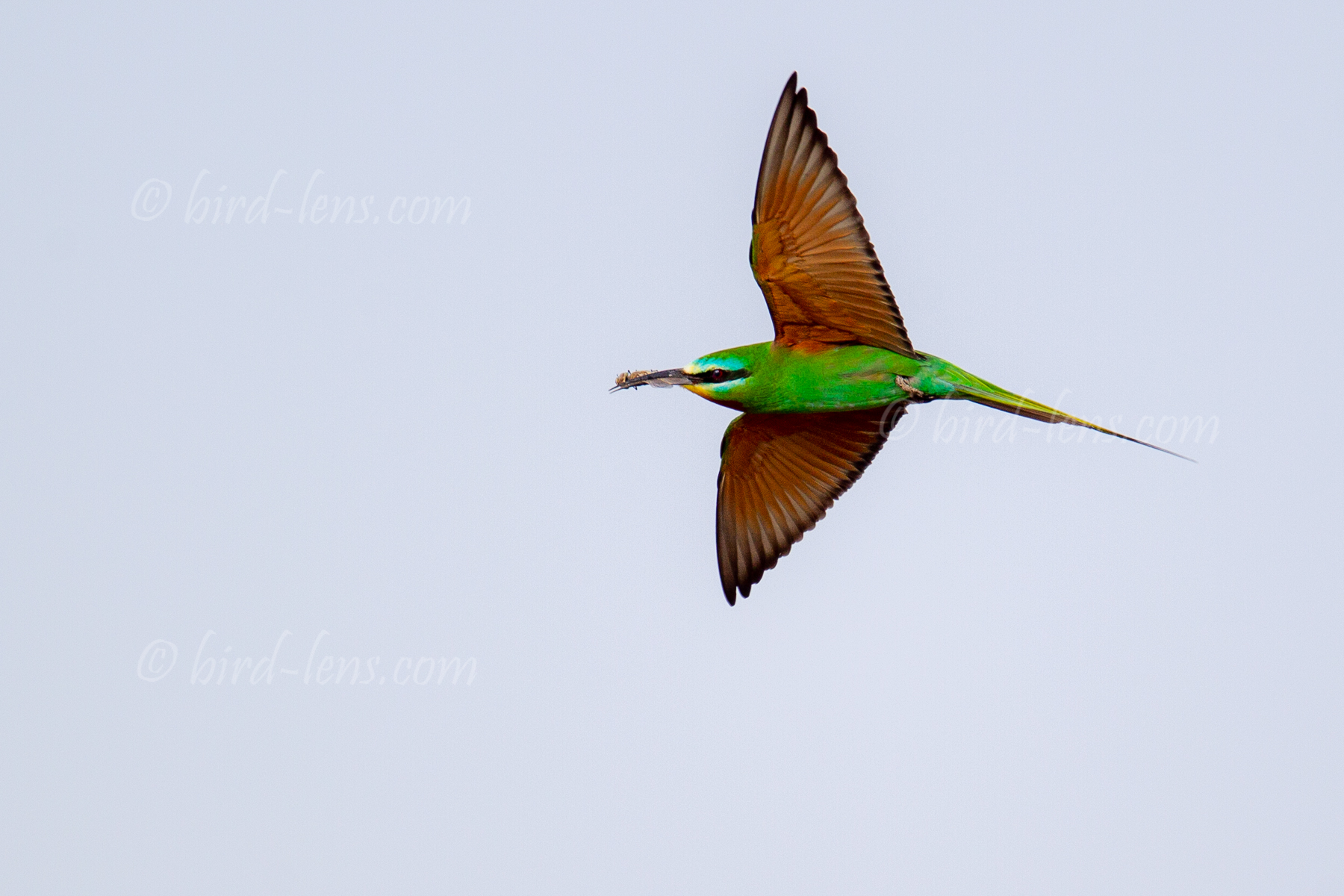
 I’m standing at Capo Murro di Porco, the southern edge of Sicily, where – quite close to Syrakus – the land gives way to open sea and the wind never really settles. I’ve come here for seawatching, scanning the horizon for shearwaters, but something unexpected pulls my attention closer. Near the parking area, a vagrant Blue-cheeked Bee-eater (Merops persicus) perches on a telephone line, repeatedly sallying out to catch insects. Watching it hunt at such close range feels almost unreal in this setting.
Capo Murro di Porco is well known among bird enthusiasts for its strategic position along Mediterranean migration routes. The observation of a Blue-cheeked Bee-eater, a species only sporadically recorded in Sicily, highlights the site’s importance as a hotspot of arrival for drift migrants, particularly during spring. The individual demonstrates typical foraging behavior, launching short aerial pursuits from an exposed perch and returning to the same vantage point.
Seawatching remains the primary focus at this location. Under steady wind conditions, several shearwater species can be observed moving along the coastline. Most regular are Scopoli’s Shearwaters (Calonectris diomedea), gliding in long arcs just above the water surface. Less frequently, Yelkouan Shearwaters (Puffinus yelkouan) appear, often in smaller groups and closer to shore. Careful observation may also reveal rarer pelagic species under favorable conditions.
Additional remarks include the occurrence of other scarce migrants during spring passage. Species such as the Pallid Harrier (Circus macrourus), Western Black-eared Wheatear (Oenanthe hispanica), Red-footed Falcon (Falco vespertinus) or occasional eastern passerines are recorded irregularly. The “best” vagrant up to now certainly is a Bar-tailed Lark (Ammomanes cincture) photographed in mid April 2012.
The Bar-tailed Lark is a lark distributed across much of North Africa and the Sahara but is not present in areas with a Mediterranean climate (Tunisia, Algeria and northern Morocco). The species is also found in vast areas between the Middle East and Pakistan. Three subspecies are known: A. c. cinctura from the Cape Verde Islands, A. c. arenicolor from Africa, the Middle East and the Arabian Peninsula, to which this individual probably could be ascribed, and A. c. zarudnyi from Iran, Afghanistan and Pakistan. Records of this species in Europe are scarce. In Spain it was reported in Mallorca in March 1998, in April 2005 near Girona and in May 2008 in Castellón.
This all is emphasizing the Capo Murro di Porco’s role as a convergence zone influenced by weather patterns and geographic positioning. These records contribute valuable data to broader studies of migration dynamics in the central Mediterranean.
In order to meet the growing demand for top images of the rarer species of Palaearctic Bird-lens.com has specifically made trips to remote places. Additionally every chance is used, if a rare bird is around the homeground. This to do everything to ensure excellent photos of the Birds of the Western Palearctic. The results in pictures also of rare Western Palaearctic birds is very good. There are other nice images of birds, that you will find behind the tab “Picture Shop“. Just give a notice if you need a picture of a bird which is not online.