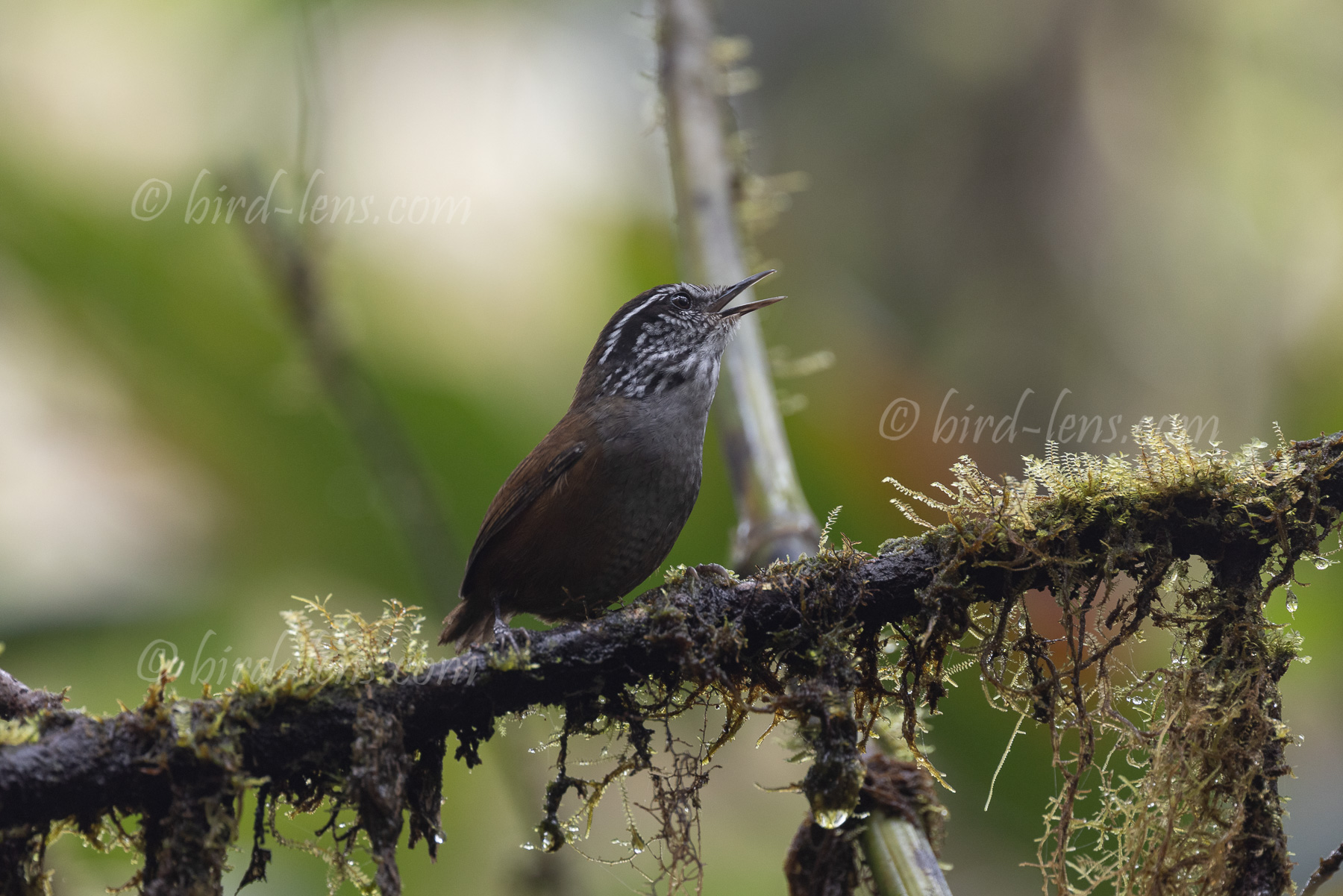
 Above a certain altitude in the cloud forest, you can hear it long before you see it. Deep from the dense undergrowth comes a sudden, sharp, rapid, and incredibly loud sound for such a small bird. Its song echoes through the vegetation as if the forest itself were speaking. Somewhere in the shadows, a Munchique Wood Wren makes its presence known. It feels provoked. But first, it hides well among all the wet leaves, mosses, and lichens. Then, however, it can no longer contain itself. It must confront its rival. So, it stands on a lichen-covered twig and belts out its song into the forest. The perfect moment for a photographic shot!
The Munchique Wood Wren (Henicorhina negreti) is a range-restricted species of the western Colombian Andes, primarily associated with humid montane and cloud forests. Like other members of the genus Henicorhina, it is secretive in appearance but conspicuous by voice. Visual encounters are often brief, limited to a flick of warm brown plumage and a cocked tail as the bird moves low through tangled vegetation.
Territory defense in the Munchique Wood Wren relies heavily on vocalization rather than physical confrontation. Males deliver loud, complex songs from concealed perches, often repeating them persistently over long periods. These songs function as acoustic barriers, advertising territory ownership and deterring rivals without the need for direct contact. In dense forest habitats where visibility is limited, sound becomes the most efficient means of communication.
Compared to its close relative, the Grey-breasted Wood Wren (Henicorhina leucophrys), the Munchique Wood Wren shows subtle but important differences. Its song is distinguished from the Grey-breasted Wood-Wren’s by being slightly lower in pitch, with flatter, less squeaky notes. The song consists of melodic phrases, typically featuring 6–12 pure notes, often with more than ten repeated phrases. Unlike the varied, rich, and often rapid, high-pitched vocalizations of the Grey-breasted Wood-Wren, the Munchique’s song lacks these high-pitched elements The song sounds quite different from the song of the Grey-breasted Wood Wren. But the call notes are mostly churrs, similar to those of its congener. Acoustic distinctions are critical for species recognition, especially in regions where ranges approach one another. Plumage differences among Henicorhina species are relatively minor, reinforcing the importance of vocal traits in maintaining reproductive isolation.
Behaviorally, the Munchique Wood Wren is strongly tied to the forest floor and lower strata, where it forages for insects among leaf litter, roots, and fallen branches. It moves with short hops and quick darts, frequently pausing to sing. The tail is often held upright, a posture common within the family Troglodytidae, but particularly pronounced in this genus.
The reliance on song as a primary defensive tool reflects both ecological and evolutionary pressures. Maintaining a territory rich in invertebrate prey is essential, and loud, persistent singing allows individuals to defend these resources while minimizing energy loss and injury. In the Munchique Wood Wren, voice is not just a signal but the foundation of its social and spatial structure.
In a forest where sight is limited and silence is rare, the Munchique Wood Wren claims its place not by force, but by sound.
In order to meet the growing demand for top images of the rarer species of Palaearctic Bird-lens.com has specifically made trips to remote places. Additionally every chance is used, if a rare bird is around the homeground. This to do everything to ensure excellent photos of the Birds of the Western Palearctic. The results in pictures also of rare Western Palaearctic birds is very good. There are other nice images of birds, that you will find behind the tab “Picture Shop“. Just give a notice if you need a picture of a bird which is not online.