 I arrive early. The wind is cold, blowing in from the sea, and my first glance across the bay reveals exactly what I expect. The long sandy beach of the spa town of Boltenhagen on the Baltic coast is bustling with tourism, even in winter. Nevertheless, I’m confident I have a good chance of spotting sea ducks, divers, and gulls. Between strollers, dogs, and steaming cups of coffee, there’s surely enough space for moments of nature if you keep your eyes open.
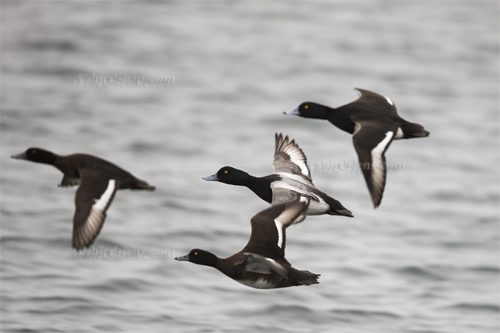
As soon as I raise my binoculars, the dynamic nature of this Baltic coast unfolds. Long-tailed Ducks (Clangula hyemalis) swim in the shallow water just before the surf. The males sport their clear winter plumage, while the females appear more compact. A little further out, Arctic Loons (Gavia arctica) dive. Their movements are serene. They rise briefly, shake water from their feathers, and glide back down. The light northeasterly wind propels them in small arcs across the waves. In winter, thousands of Greater Scaups (Aythya marila) often rest, especially near the harbor, along with numerous Common Eiders (Somateria mollissima), Red-breasted Mergansers (Mergus serrator), and Common Mergansers (Mergus merganser).
Large flocks of Common Gulls (Larus canus) and Black-headed Gulls (Chroicocephalus ridibundus) congregate along the high-tide line. They take advantage of every trace of food. Individual Herring Gulls (Larus argentatus) forcefully weave their way through the flocks. Their presence shapes the entire beach scene. The constant movement of people seems hardly to bother them. They adapt their behavior, move aside, and return after a few seconds.
The jetties are particularly fascinating. In winter, their stones act like small biotopes. Here, I search for Purple Sandpipers (Calidris maritima). This species stays close to wet rocky areas and survives the cold months by finding small crustaceans and mollusks among the seaweed. Only on closer inspection does one recognize the delicate pattern of its plumage. This species has a noticeably dark and uniform plumage in winter, with slate to charcoal upperparts that in some lighting conditions shows a faint purple sheen. When one appears, it looks like a dark speck against the gray of the stones. In summer, however, Purple Sandpipers are more colorful, with chestnut, buff, and light-brown highlights to otherwise dark back feathers. Usually quiet away from the breeding grounds, individuals are quite approachable by men in winter, and when flushed, tend to fly only a short distance, low over the water. Thus a perfect subject for bird photography.
The bird community in Boltenhagen exhibits a clear seasonal structure. Winter birds use the coast as a transitional zone where food is readily available and disturbances, while frequent, remain predictable. Sea ducks keep their distance from heavily used sections of the beach. Nevertheless, one can hope to spot a rarity like the King Eider (Somateria spectabilis). Some gulls certainly benefit from human activity. Loons, on the other hand, orient themselves strictly according to water depth and currents. Thus, every area of the beach fulfills an ecological niche.
This excursion demonstrates that even a popular resort town offers valuable observations in winter. Species such as the Long-tailed Duck, Arctic Loon or Arctic Diver, and Purple Sandpiper demonstrate how flexibly birds react to their environment. Those with patience will discover a vibrant mosaic of behavior, adaptation, and quiet presence.
In order to meet the growing demand for top images of the rarer species of Palaearctic Bird-lens.com has specifically made trips to remote places. Additionally every chance is used, if a rare bird is around the homeground. This to do everything to ensure excellent photos of the Birds of the Western Palearctic. The yield of pictures also of rare Western Palaearctic birds is very good. There are other nice images of birds, that you will find behind the tab “Picture Shop“. Just give a notice if you need a picture of a bird which is not online.