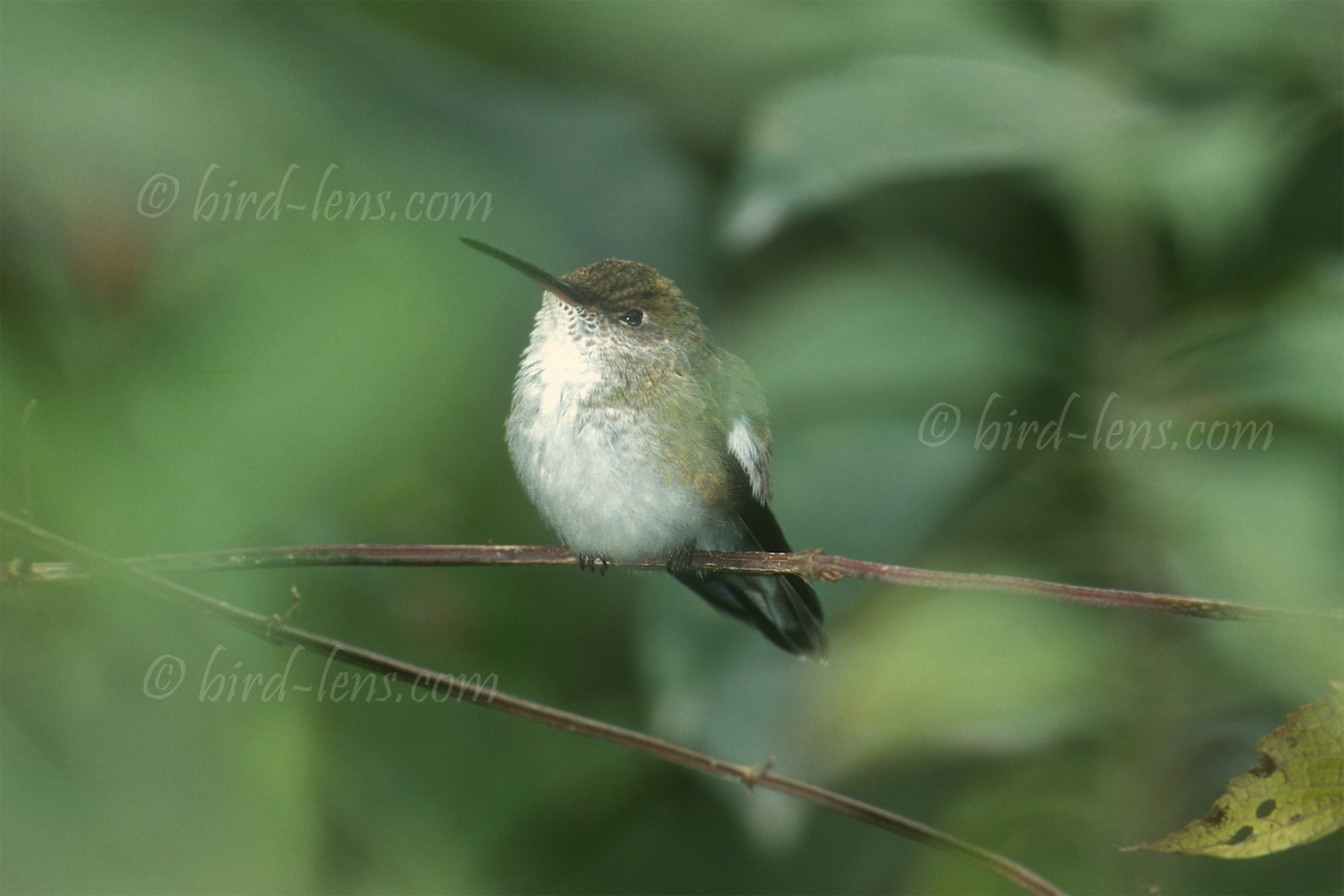
 There is a moment in the subtropical foothill forests of northwestern Argentina when the light hits the leaves just right and everything seems to vibrate with movement. If you stand still long enough, the forest begins to reveal its smaller residents. A flash of bronze, a hovering silhouette, and a brief metallic chirp often give away one of the most energetic inhabitants of these forests: the White-bellied Hummingbird (Elliotomyia chionogaster). Among its regional forms, the subspecies Yungas White-bellied Hummingbird (Elliotomyia chionogaster hypoleuca) is a particularly interesting representative of the species in the southern portion of its range. Observing it in the Yungas forest provides a glimpse into how hummingbirds adapt to complex mountain ecosystems.
The White-bellied Hummingbird belongs to the family Trochilidae, a group specialized for nectar feeding and hovering flight. The subspecies Elliotomyia chionogaster hypoleuca is characterized by its bright green upperparts, pale grayish to white underparts, and a relatively straight reddish bill with a darker tip. As in other members of the species, the tail appears dark with subtle bronzy reflections under good light conditions. Compared with some northern subspecies, it is said, that E. c. hypoleuca tends to show more cream-coloured tinge to the underparts. As I read on www.birdsoftheworld, there are particularly long-beaked specimens in northern Argentina (Salta), which have even been classified as a separate subspecies (longirostris). I get out my Nikon Nikkor AF-S 4.0/500 on the Nikon F 5 and the Metz MZ-5 flash to take photos. The hummingbird remains very photogenic even when I shoot almost two rolls of film with the Metz MZ 5 flash. This individual definitely has a long beak – remarkably long indeed.
The distribution of White-bellied Hummingbird extends across the southern part of the species’ range in South America. In Argentina it occurs primarily along the eastern slopes of the Andes within the Yungas forest, a humid montane ecosystem that stretches from southern Bolivia into northwestern Argentina. Within this region the subspecies is recorded mainly in the provinces of Salta, Jujuy, and Tucumán. The Yungas are characterized by steep elevational gradients, dense vegetation, and high humidity, creating a mosaic of habitats that support a remarkable diversity of birds.
In the Argentine Yungas, the White-bellied Hummingbird is generally associated with forest edges, secondary growth, and clearings where flowering plants are abundant. It typically occurs between roughly 800 and 2,000 meters above sea level, although local movements may occur in response to seasonal flowering patterns. This flexibility allows the species to track nectar resources across different elevations.
The behaviour of the (Yungas) White-bellied Hummingbird reflects the energetic demands common to hummingbirds. Individuals spend much of the day moving between flowering shrubs, epiphytes, and understory plants, extracting nectar with their elongated bills and extensible tongues. In addition to nectar, they regularly capture small arthropods in flight or glean them from foliage, an important source of protein.
Territorial behaviour is frequently observed around particularly productive flower patches. A single bird may defend a feeding area against other hummingbirds, including both conspecifics and different species. These interactions often involve rapid chases, aerial displays, and high-pitched vocalizations. Despite their small size, White-bellied Hummingbirds display remarkable agility during these encounters.
Breeding biology in the southern range of the species remains incompletely documented, but it likely follows patterns typical of the genus Amazilia. The female constructs a small cup-shaped nest using plant fibers, moss, and spider silk, usually placed on a slender horizontal branch or in dense foliage. Two small white eggs are typically laid, and the female alone performs incubation and chick rearing.
From an ecological perspective, the (Yungas) White-bellied Hummingbird contributes to pollination networks within the Yungas ecosystem. By visiting a wide range of flowering plants, the bird acts as an effective pollinator, facilitating gene flow among plant populations. In this way, the presence of the White-bellied Hummingbird reflects not only the diversity of hummingbirds in the Andes but also the intricate ecological relationships that sustain the Yungas forest.
In order to meet the growing demand for top images of the rarer species of Palaearctic Bird-lens.com has specifically made trips to remote places. Additionally every chance is used, if a rare bird is around the homeground. This to do everything to ensure excellent photos of the Birds of the Western Palearctic. The results in pictures also of rare Western Palaearctic birds is very good. There are other nice images of birds, that you will find behind the tab “Picture Shop“. Just give a notice if you need a picture of a bird which is not online.