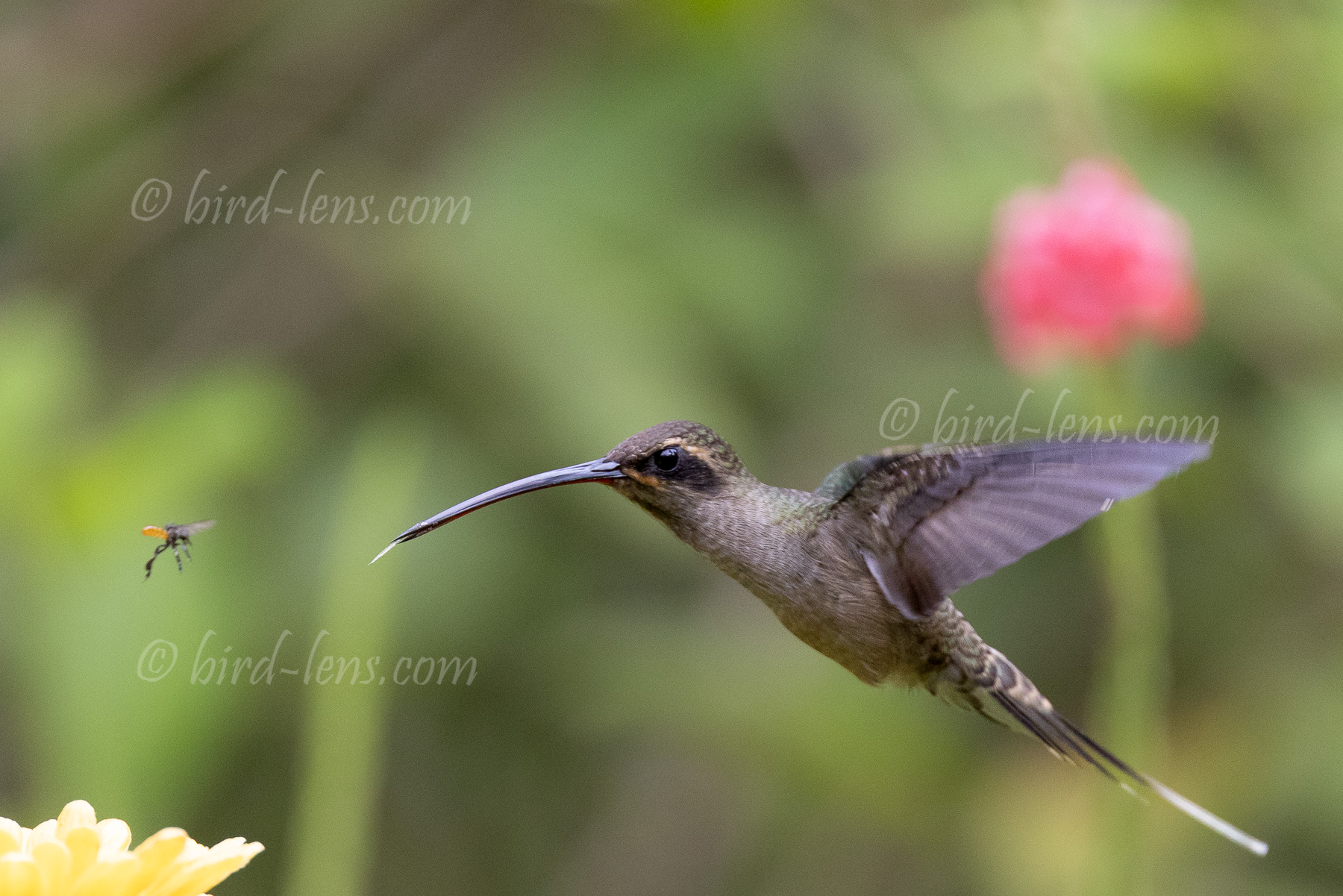
 In the afternoon, the sky clouded over. A thunderstorm was brewing. Despite this, the air in the Gumna Reserve on the outskirts of Belém, Brazil, was still teeming with life – chirping, buzzing, and the rustling of wings in the humid air. I sat on a plastic chair in front of a flowering bush, where a simple plastic hummingbird feeder is placed in front of. The plastic feeder was utterly hideous. But that does not deter a hummingbird. A flash of bronze and cinnamon swoops in. The visitor is a Long-tailed Hermit (Phaethornis superciliosus), one of the most elegant nectar-feeding specialists of the lower Amazon rainforest. Its long, downward-curving beak dipped precisely into the opening of the feeder, its slender tongue darting in and out so quickly it was almost invisible.
But then, another player enters the scene. A Honeybee (Apis mellifera) hovers nearby, drawn by the same sugary scent. It approaches cautiously, then lands at the edge of a feeding port, its tiny legs trembling with anticipation. The hummingbird pauses, hovers, and gives a quick side tilt—half curiosity, half irritation. For a few seconds, both hang in the air together, feeding from the same artificial bloom.
This quiet moment of coexistence is more complex than it looks. Nectar-rich resources—whether natural flowers or artificial feeders—serve as hotspots for both birds and insects. In tropical ecosystems, competition and overlap between hummingbirds and bees are common. The Long-tailed Hermit, like many members of the genus Phaethornis, typically feeds on long, tubular flowers such as those of Heliconia and Costus species. Its bill is finely adapted to these corolla shapes, giving it access to nectar sources that most bees cannot exploit efficiently. Yet feeders, designed for general access, flatten this natural barrier and invite encounters that rarely occur at forest blossoms.
At such feeding stations, behavior becomes a balance between tolerance and defense. Hermits and other hummingbirds often display territoriality—chasing away intruders to secure reliable feeding spots. However, bees operate under different rules: they arrive in numbers, and their persistence often discourages birds from defending feeders for long. The result is a subtle ecological negotiation, where both taxa exploit the same energy source through different strategies.
This overlap also influences pollination dynamics. In natural settings, hummingbirds act as primary pollinators for many tropical plants, transferring pollen as they probe deep into flowers. Bees, especially when abundant, can interfere with this process by robbing nectar or damaging floral structures, sometimes reducing the availability of nectar for legitimate pollinators. Conversely, their presence can alter hummingbird foraging behavior, pushing birds to visit a wider range of plants and inadvertently diversifying pollination networks.
Back at the feeder, the bee finally lifts off, satisfied, while the hermit resumes feeding with a faint hum. In that shared instant, both species demonstrate how tropical nectar systems operate—not as rigid hierarchies, but as fluid, dynamic interactions shaped by competition, adaptation, and sheer persistence. Even a simple plastic feeder becomes a stage for evolution in action.
In order to meet the growing demand for top images of the rarer species of Palaearctic Bird-lens.com has specifically made trips to remote places. Additionally every chance is used, if a rare bird is around the homeground. This to do everything to ensure excellent photos of the Birds of the Western Palearctic. The yield of pictures also of rare Western Palaearctic birds is very good. There are other nice images of birds, that you will find behind the tab “Picture Shop“. Just give a notice if you need a picture of a bird which is not online.