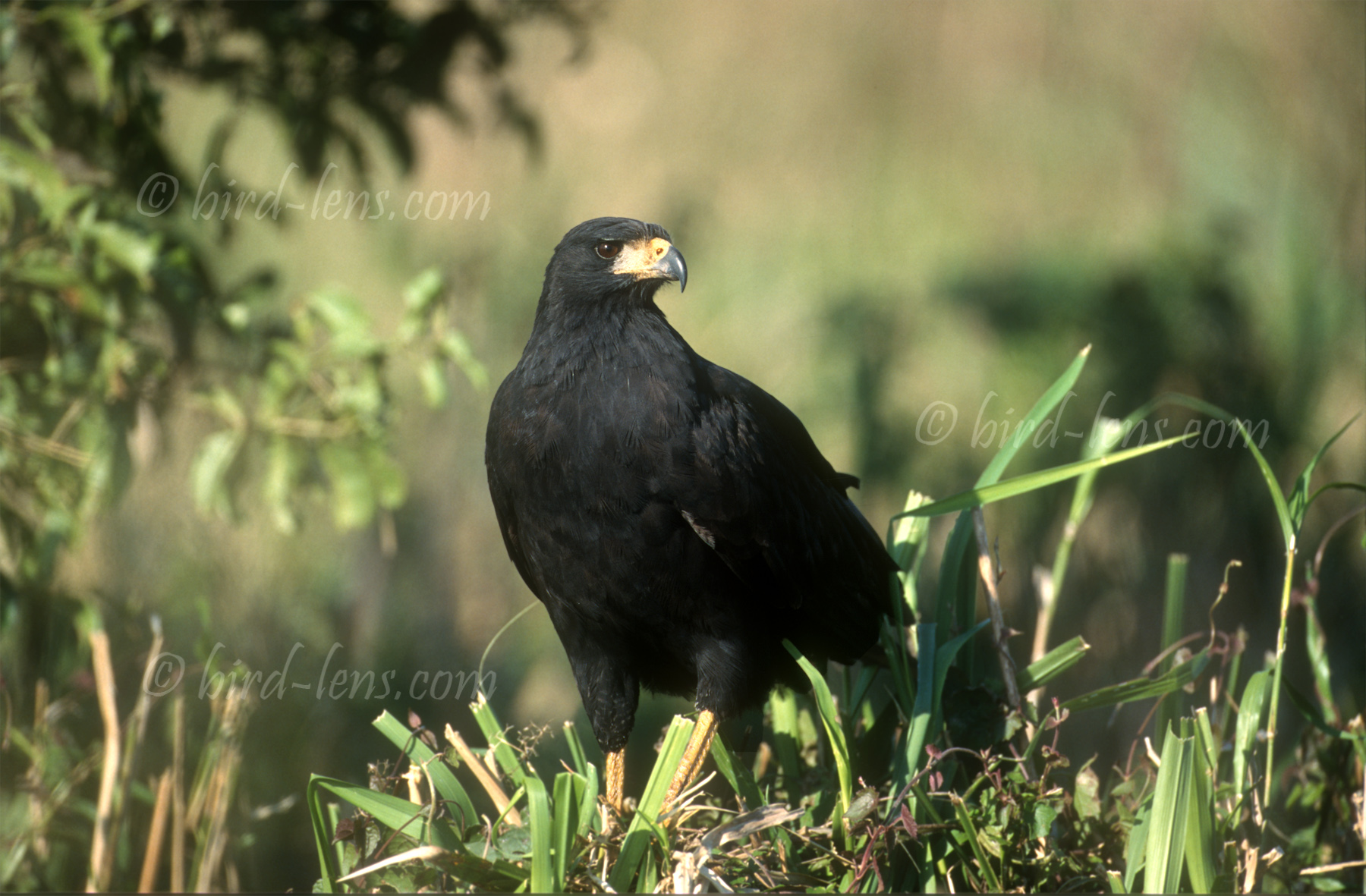
 Morning mist rises slowly from the wetlands of Iberá Wetlands in Argentina. Capybaras (Hydrochoerus hydrochaeris) move along the edges of floating vegetation, herons stalk the shallows, and somewhere above the marsh a dark raptor circles with deliberate wingbeats. At first glance it appears almost entirely black against the pale sky. Then the tail flashes white with a bold black band. For birdwatchers exploring Iberá, this moment often signals the presence of one of the region’s characteristic predators: the Great Black Hawk (Buteogallus urubitinga).
The Great Black Hawk belongs to the Neotropical genus Buteogallus, a group of medium-to-large raptors generally associated with wetlands, river systems, and flooded forests. Within this genus, the species stands out for its size and overall dark plumage. Adults appear almost entirely black, with contrasting white at the base of the tail and a broad terminal band. The bill is heavy and strongly hooked, while the long legs suggest adaptation for capturing prey in shallow water or along muddy banks. The Great Black Hawk often forages on the ground, in vegetation, or even in shallow water, pursuing prey on foot or with short flights.
In comparison with closely related species, several distinctions become apparent. The Common Black Hawk (Buteogallus anthracinus), distributed from the southwestern United States through Central America, is smaller and more strongly tied to coastal mangroves and river corridors. The Savanna Hawk (Buteogallus meridionalis), widespread in open grasslands of South America, differs markedly in coloration with rufous plumage and longer legs suited for terrestrial hunting. The Great Black Hawk, by contrast, occupies a more forested and wetland-dominated ecological niche and exhibits broader wings adapted for soaring over river basins and marsh landscapes.
The species’ geographic distribution extends from Mexico southward through much of tropical South America to northern Argentina. In Argentina its presence concentrates primarily in the northeast, where large wetland systems such as Iberá provide suitable habitat. These southern populations occur near the limit of the species’ range, making observations in this region particularly valuable for monitoring range stability and habitat use.
Wetlands play a central role in the ecology of the Great Black Hawk. The species favors environments with abundant shallow water, slow rivers, and flooded vegetation. Such habitats support a diverse prey base including fish, amphibians, reptiles, crustaceans, and occasionally small mammals or birds. Unlike many forest raptors that rely heavily on aerial ambush, the Great Black Hawk frequently hunts by watching from exposed perches along water edges before dropping onto prey below. Its relatively long legs allow it to grasp animals in water or mud without fully submerging its body.
The wetlands of Iberá therefore provide ideal conditions: extensive marshes, seasonal flooding, and high prey density. From an ecological perspective, the Great Black Hawk functions as a mid-to-upper level predator within this aquatic food web. Its presence often indicates healthy wetland ecosystems where amphibians, reptiles, and fish populations remain intact.
For bird enthusiasts visiting Iberá, the silhouette of a soaring Great Black Hawk represents more than a striking sight. It reflects the deep connection between raptor ecology and wetland landscapes across the Neotropics.
In order to meet the growing demand for top images of the rarer species of Palaearctic Bird-lens.com has specifically made trips to remote places. Additionally every chance is used, if a rare bird is around the homeground. This to do everything to ensure excellent photos of the Birds of the Western Palearctic. The results in pictures also of rare Western Palaearctic birds is very good. There are other nice images of birds, that you will find behind the tab “Picture Shop“. Just give a notice if you need a picture of a bird which is not online.