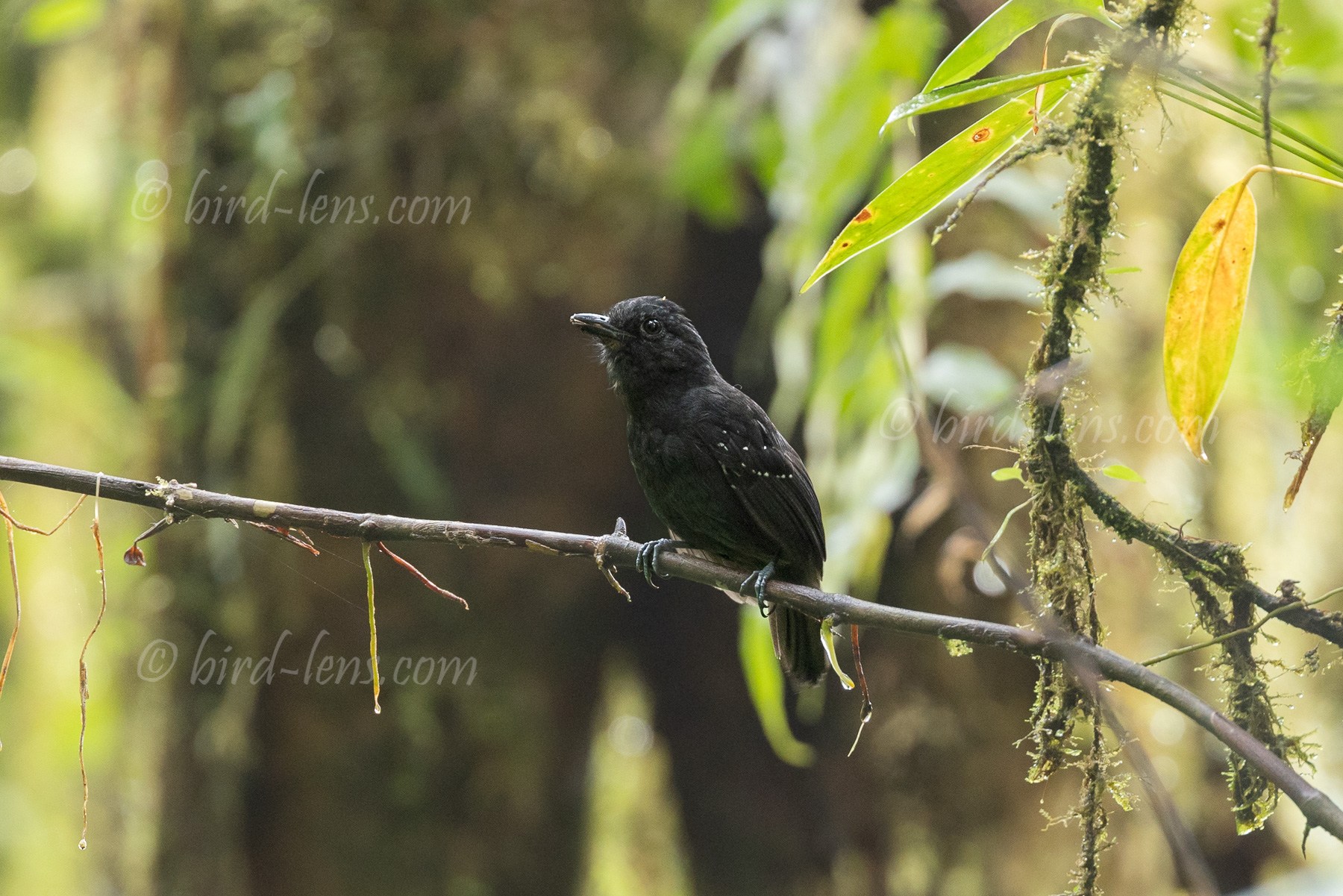
 I am not expecting it. The morning along the edge of Tatamá National Natural Park in Risaralda is already generous with tanagers and mixed flocks moving through the mid-elevation forest. Then a dark shape shifts quietly inside a dense tangle of bamboo. At first it is just movement and shadow. When the bird turns, the faint white speckling on the black wing coverts catches the light. One of the small Antshrikes, I supposed first. But then the bird reveals a the rare male Bicolored Antvireo (Dysithamnus occidentalis). Here, near the forest edge, it feels like a small privilege.
The Bicolored Antvireo is one of the lesser-known members of the family Thamnophilidae. Its distribution is fragmented, occurring in western Colombia, eastern Ecuador, and northern Peru. Across this range, at least three subspecies are recognized, reflecting geographic isolation along the Andean slopes. The species primarily inhabits the subtropical zone at middle elevations, typically between roughly 900 and 2,200 meters asl, where humid montane forest transitions into cloud forest.
A strong ecological association exists with Chusquea bamboo, which forms dense understory thickets in Andean forests. These bamboo stands create a structurally complex habitat with abundant arthropod prey. Like other antbirds, Bicolored Antvireo is primarily insectivorous, gleaning small invertebrates from foliage, thin branches, and bamboo leaves. It often moves deliberately through the mid-level understory, pausing briefly before making short, precise sallies to capture prey. Although not an obligate army-ant follower, it may join mixed-species flocks, particularly where bamboo patches intersect with forest edges.
Sexual dimorphism is pronounced. The male appears largely uniform dark grayish-black. Close observation reveals subtle white tips on the wing coverts, forming neat rows of small pale dots across the folded wing. In low light these markings are understated, but at the right angle they become diagnostic. The female presents a contrasting pattern: slaty gray on the underparts, warmer brown above, and a distinctly brighter chestnut crown. This crown coloration is often the first feature that draws attention in the field.
In parts of eastern Ecuador, the range of Bicolored Antvireo likely approaches that of the White-streaked Antvireo (Dysithamnus leucostictus). The males of these two species are superficially similar. However, the Bicolored Antvireo generally occupies slightly higher elevations. Females are more easily distinguished. Female White-streaked Antvireo show bold white streaking across the face and underparts, a feature absent in female Bicolored Antvireo, whose plumage is comparatively plain aside from the chestnut crown.
Vocalizations provide additional, though geographically variable, clues. In Ecuador, two principal sounds are documented: a rapid, sharp “ji-ji-jerrr” and a softer, mellow “tew.” In northern Peru, however, the species gives a more characteristic antvireo song, consisting of a descending sequence of clear whistles that accelerate toward the end, rendered as “wee-wee-wee-wu-wuwuwu.” Interestingly, this Peruvian song type has not been conclusively recorded in Ecuador, suggesting regional variation that may reflect subspecific differentiation.
Observing this individual at the margin of Tatamá National Natural Park highlights both the species’ discreteness and its specialization. Bicolored Antvireo is not a conspicuous bird. It favors shadowed understory and dense vegetation, where careful listening often precedes visual confirmation. Its presence here reinforces the importance of bamboo-rich montane habitats, which continue to shape the distribution and ecology of many Andean forest specialists.
In order to meet the growing demand for top images of the rarer species of Palaearctic Bird-lens.com has specifically made trips to remote places. Additionally every chance is used, if a rare bird is around the homeground. This to do everything to ensure excellent photos of the Birds of the Western Palearctic. The results in pictures also of rare Western Palaearctic birds is very good. There are other nice images of birds, that you will find behind the tab “Picture Shop“. Just give a notice if you need a picture of a bird which is not online.