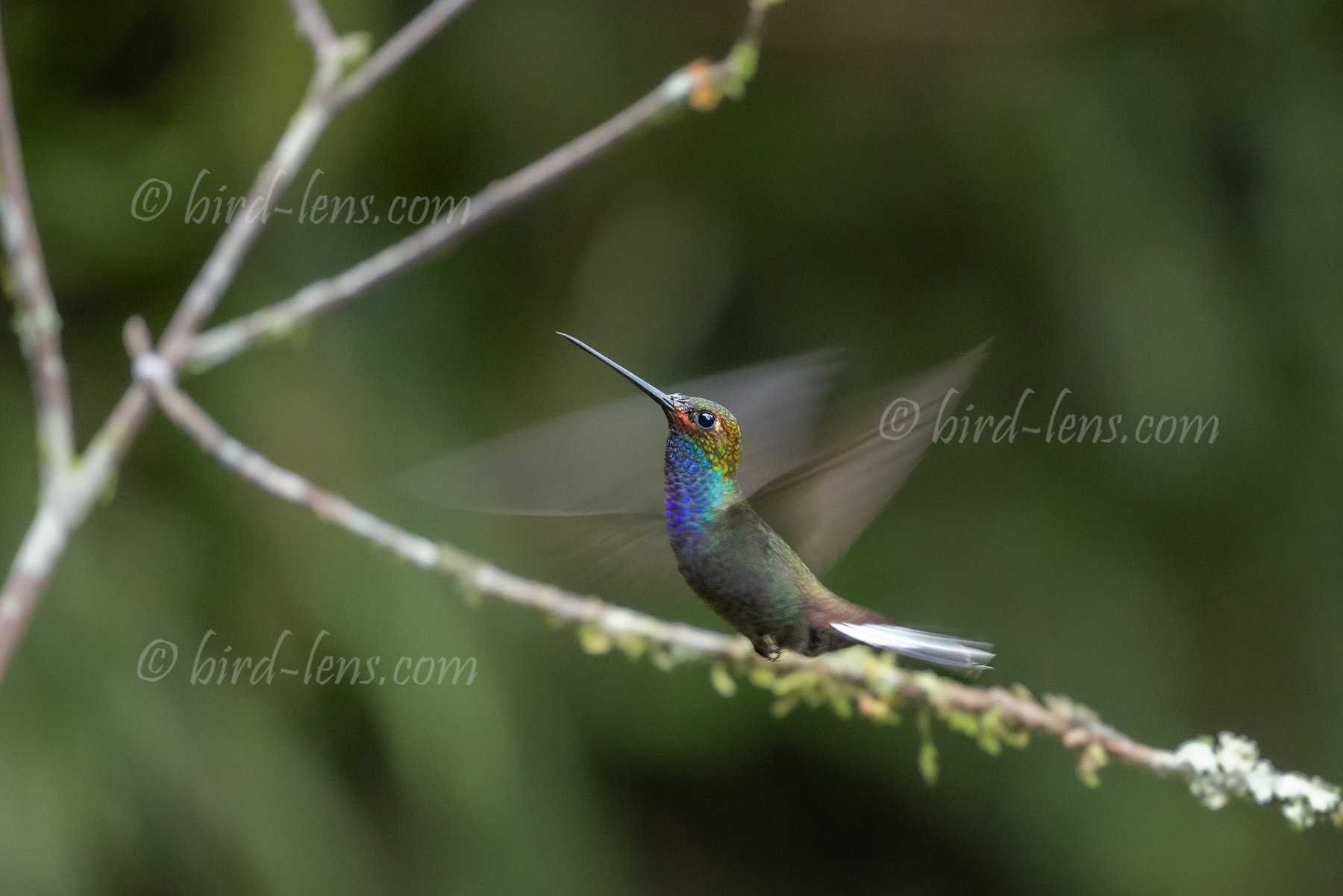
 It is hovering right in front of me, close enough that I can hear the thin, insect-like buzz of its wings. For a second I forget the camera in my hands. The Rufous-gaped Hillstar (Urochroa bougueri) seems suspended in the fresh Andean air of the late evening, facing me directly, its breast a combination of coppery green and iridescent blue. I press the shutter release; at that time only at 1/160 of a second, knowing well that the wings will blur. They’re simply too fast. Yet the body remains perfectly still in the center of the rotating halo of light. The body appears crispy sharp. In the image, movement and stillness merge.
The Rufous-gaped Hillstar is a large, dark colored, long-billed hummingbird of the northern Andes. Both sexes are dark coppery green above, with a blue throat and breast and a gray belly. The English name “Rufous-gaped” refers to the conspicuous rufous submoustachial stripe. The tail also is extensively white, although a pair of rectrices are dark. The two species of Urochroa hillstars are not closely related to the Oreotrochilus hillstars, and also differ in habitat preferences. The species of Oreotrochilus occupy puna and paramo grasslands above tree line, whereas Rufous-gaped and Green-backed (Urochroa leucura) Hillstars occur in humid forest on the lower slopes of the Andes..
Hummingbirds (family Trochilidae) possess one of the most specialized flight mechanisms among birds. Their wings rotate at the shoulder joint in a near 180-degree arc, allowing them to generate lift on both the downstroke and the upstroke. This figure-eight wingbeat pattern distinguishes them from most other birds, which produce lift primarily on the downstroke. Wingbeat frequency varies by species and size, but many hummingbirds exceed 40 beats per second. At 1/160 sec., a single exposure captures multiple wing positions, producing the translucent blur visible in my photograph.
The body, however, appears stable because hovering hummingbirds maintain remarkable head and torso control. Studies using high-speed videography show that while the wings oscillate rapidly, the head remains relatively fixed in space, minimizing visual motion and stabilizing gaze. This stabilization is crucial for precise nectar extraction. The long, slender bill of Rufous-gaped Hillstar is adapted to tubular high-Andean flowers, and its extensible tongue uses capillary action and rapid lapping movements to draw nectar efficiently.
Flight in hummingbirds is energetically expensive. Mass-specific metabolic rates during hovering are among the highest recorded in vertebrates. To sustain this, hummingbirds consume nectar rich in simple sugars and supplement it with arthropods for protein. Behaviorally, hummingbirds are often territorial, especially around reliable nectar sources. Males typically defend feeding patches through aerial chases and vocal displays. In high-altitude species, territories may be larger due to sparse floral distribution. Rufous-gaped Hillstar forages on nectar and aerial insects in the under- and midstory of humid montane forest edge and forest clearings, often near water. Insects are caught above streams or in forest openings by hawking. The Rufous-gaped Hillstar occurs quite regularly at hummingbird feeders around the Montezuma Rainforest Lodge near the edge of Tatamá National Natural Park in Risaralda, Colombia.
The blurred wings in my photograph are not a technical flaw but a biological signature. They testify to the mechanical limits of avian muscle contraction and aerodynamic control. The sharply focused body reflects another trait: extraordinary neuromuscular precision. In that fraction of a second, the bird is not merely hovering. It is balancing energy intake, territorial awareness, and environmental challenge.
Standing there at Montezuma Rainforest Lodge, watching Rufous-gaped Hillstar in real time, I am reminded that hummingbird flight is not just rapid movement. It is a finely tuned compromise between physics and physiology, visible even at 1/160 of a second.
In order to meet the growing demand for top images of the rarer species of Palaearctic Bird-lens.com has specifically made trips to remote places. Additionally every chance is used, if a rare bird is around the homeground. This to do everything to ensure excellent photos of the Birds of the Western Palearctic. The results in pictures also of rare Western Palaearctic birds is very good. There are other nice images of birds, that you will find behind the tab “Picture Shop“. Just give a notice if you need a picture of a bird which is not online.