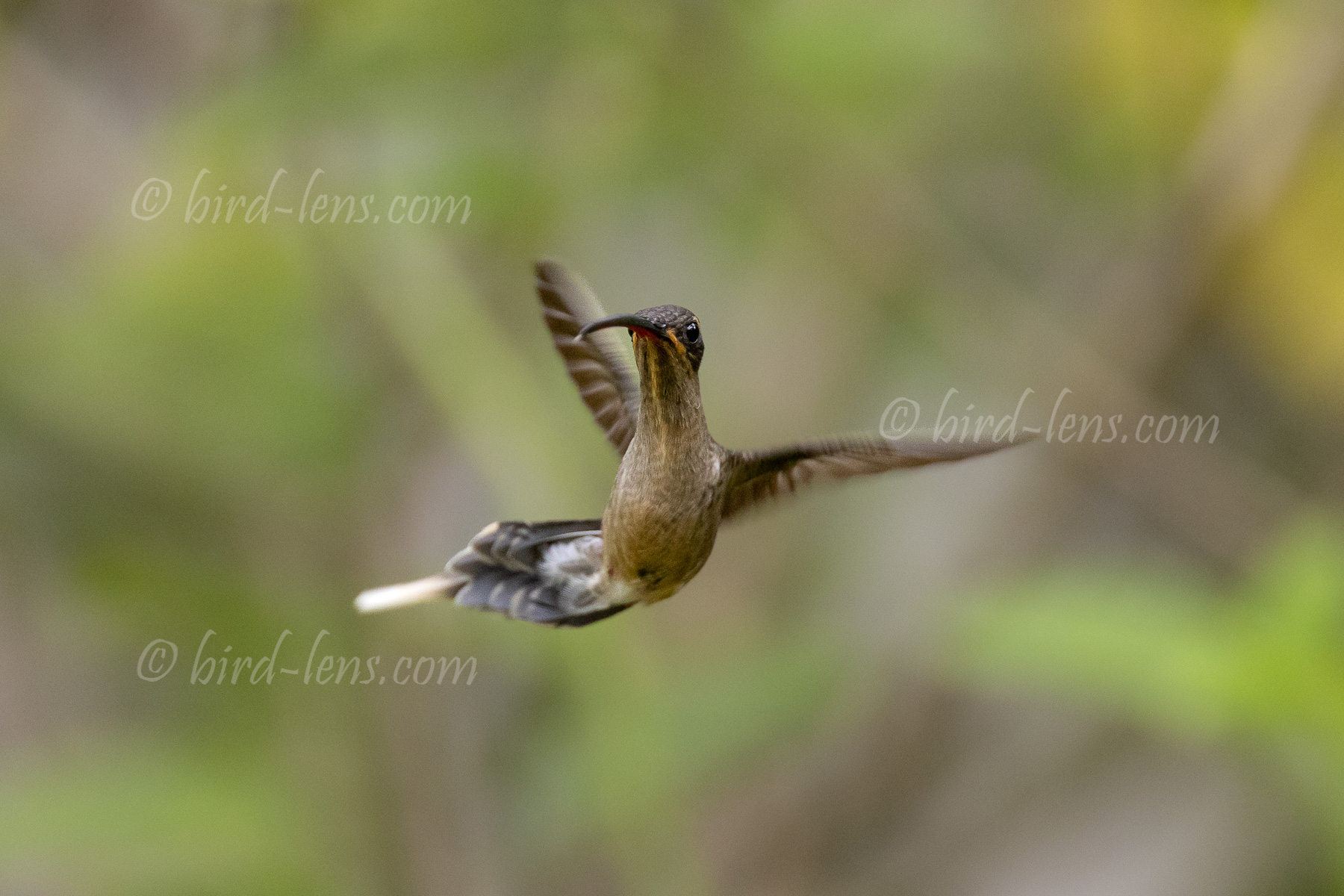
 The morning air in the forest clearing feels alive with motion. Over a patch of Heliconia blooms, a small shape darts, hovers, and pivots in midair as if the world has no gravity. It’s the Long-tailed Hermit (Phaethornis superciliosus), one of the Amazon’s most acrobatic nectar-feeders. Its long central tail feathers flick like twin pendulums as it traces perfect arcs around the flowers. Every movement seems choreographed—an aerial dance of precision and intent.
Unlike many hummingbirds that zip restlessly from bloom to bloom, the Long-tailed Hermit performs with purpose. Males establish lekking arenas—small, shaded clearings where they display to females through rapid flight loops and hovering poses. Their dances are both competitive and communicative, accompanied by sharp, repeated calls. A successful male might defend a feeding route that includes dozens of flowering plants, memorizing their nectar renewal times down to the hour.
Ecologically, Long-tailed Hermit is a vital pollinator. It specializes in flowers with long, curved corollas such as Heliconia, Costus, and Psychotria, perfectly matched to its decurved bill. When it hovers to feed, pollen collects on its forehead and bill base, ensuring cross-pollination as it moves between plants. This intricate partnership between bird and flower represents coevolution at its finest—the shape of one mirrored in the other.
The secret behind the Long-tailed Hermit’s remarkable aerial control lies in its flight mechanics. Hummingbirds (family Trochilidae) are unique among birds in their ability to generate lift on both the upstroke and downstroke. Their wings beat in a figure-eight pattern, rotating nearly 180 degrees at the shoulder. High-speed muscle contractions, supported by an enormous pectoral mass (nearly 30% of body weight), allow them to hover indefinitely and even fly backward. This precision comes at a metabolic cost—hummingbirds maintain among the highest energy turnover rates of any vertebrate, requiring them to feed almost continuously throughout daylight hours.
Comparatively, larger species like the Long-tailed Hermit exhibit slower wingbeats than their smaller relatives, trading speed for endurance. This makes their flight appear more fluid, almost lazy in rhythm, yet just as controlled. Their hovering is less about frantic vibration and more about fine-tuned balance—each wingbeat an act of muscular choreography.
Watching a Long-tailed Hermit perform over the flowers is to witness physics, physiology, and beauty converge. The display is both courtship and survival, art and engineering—proof that evolution, when given enough time, can turn necessity into grace.
In order to meet the growing demand for top images of the rarer species of Palaearctic Bird-lens.com has specifically made trips to remote places. Additionally every chance is used, if a rare bird is around the homeground. This to do everything to ensure excellent photos of the Birds of the Western Palearctic. The yield of pictures also of rare Western Palaearctic birds is very good. There are other nice images of birds, that you will find behind the tab “Picture Shop“. Just give a notice if you need a picture of a bird which is not online.