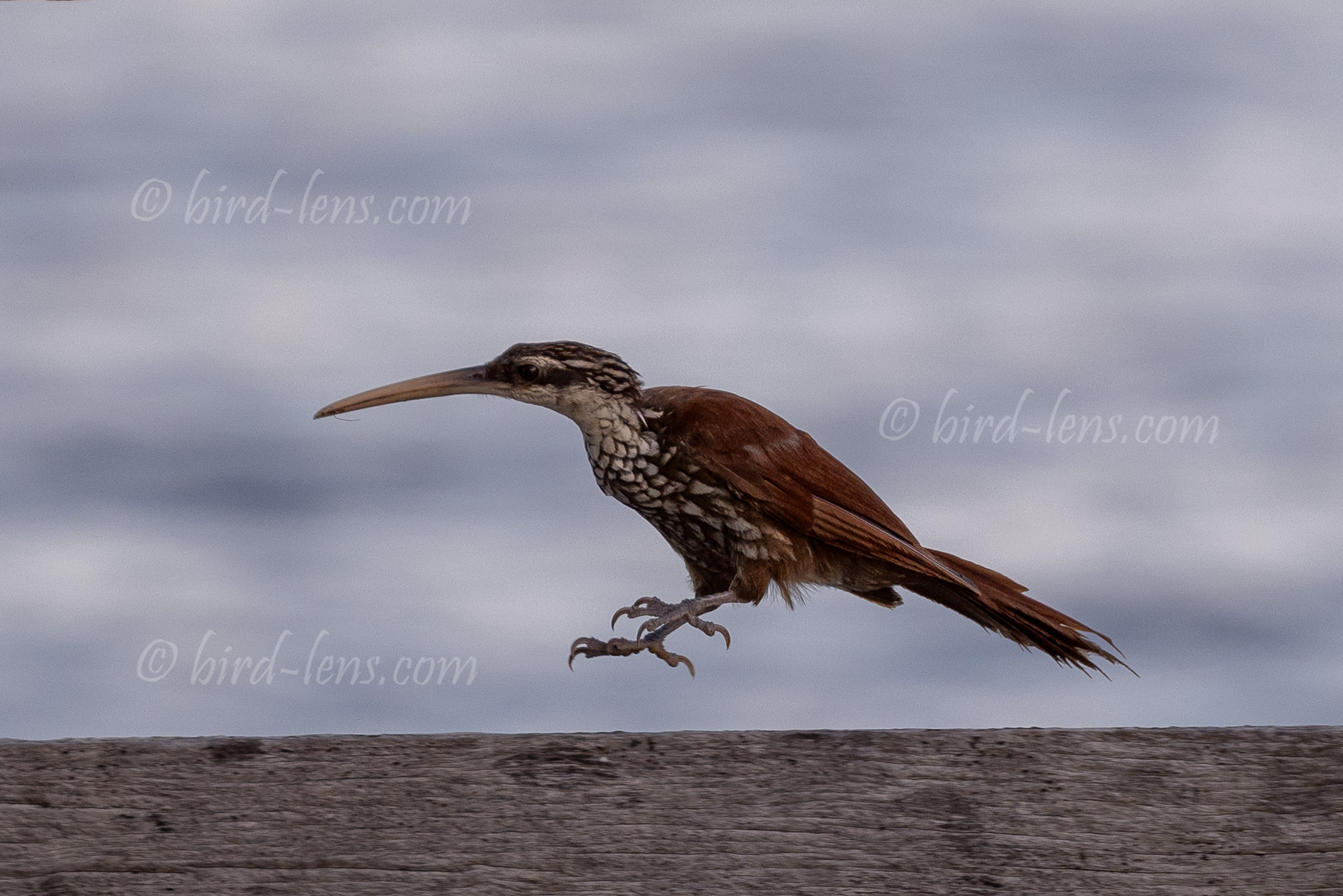
 The river is high again, swallowing the forest edges and turning the lower branches into reflections. Along the flooded shore, a flicker of movement catches my eye — long, chestnut brown, with a bill like a gentle scythe. It’s a Long-billed Woodcreeper (Nasica longirostris), emerging curiously from the semi-submerged forest to inspect a line of old wooden fences that now stand knee-deep in the slow current. It hops from post to post, probing cracks and crevices with its remarkable bill, as if testing this strange man-made structure for hidden insects. For a species that usually keeps to dense riverine canopy, it’s an almost comical sight — a forest bird exploring human boundaries during the season of water.
The Long-billed Woodcreeper inhabits lowland Amazonian floodplain forests, especially várzea and igapó zones that are periodically inundated. Its elongated, decurved bill is a highly specialized adaptation for extracting arthropods and small vertebrates from bark fissures and epiphyte tangles. During the flood period, much of its foraging substrate becomes submerged, prompting individuals to descend closer to the water or, as in this case, to investigate emergent structures along the river margins. This behavioral flexibility allows the species to maintain feeding efficiency in a habitat defined by seasonal transformation.
Compared with other woodcreepers of the region, N. longirostris occupies a distinctive ecological niche. While species such as the Straight-billed Woodcreeper (Dendroplex picus), Zimmer’s Woodcreeper (Dendroplex kienerii) or Buff-throated Woodcreeper (Xiphorhynchus guttatus) remain largely tied to terra firme or more stable forest strata, the Long-billed Woodcreeper is strongly associated with riparian and seasonally flooded environments. Its range extends across the Amazon Basin, following major tributaries of the Amazon River from eastern Ecuador and Colombia to Pará in Brazil, but it is notably absent from drier interfluvial forests.
The species’ dependence on flooded forest systems also explains its relative scarcity in areas undergoing hydrological alteration. Changes in flood timing, sediment load, or shoreline vegetation can directly affect the invertebrate communities it relies upon. In contrast, more generalist congeners adapt readily to secondary forest or edge habitats. The Long-billed Woodcreeper’s specialization thus reflects both its evolutionary success in a dynamic habitat and its vulnerability to human-induced changes.
As the waters rise, this bird moves in synchrony with the pulse of the Amazon, redefining its feeding territory with each season. Watching it pause on a fence post, the river lapping just below its feet, one is reminded that even in one of the world’s most intricate ecosystems, curiosity and adaptability remain key to survival.
In order to meet the growing demand for top images of the rarer species of Palaearctic Bird-lens.com has specifically made trips to remote places. Additionally every chance is used, if a rare bird is around the homeground. This to do everything to ensure excellent photos of the Birds of the World. The yield of pictures is very good. There are other nice images of birds, that you will find behind the tab “Picture Shop“. Just give a notice if you need a picture of a bird which is not online.