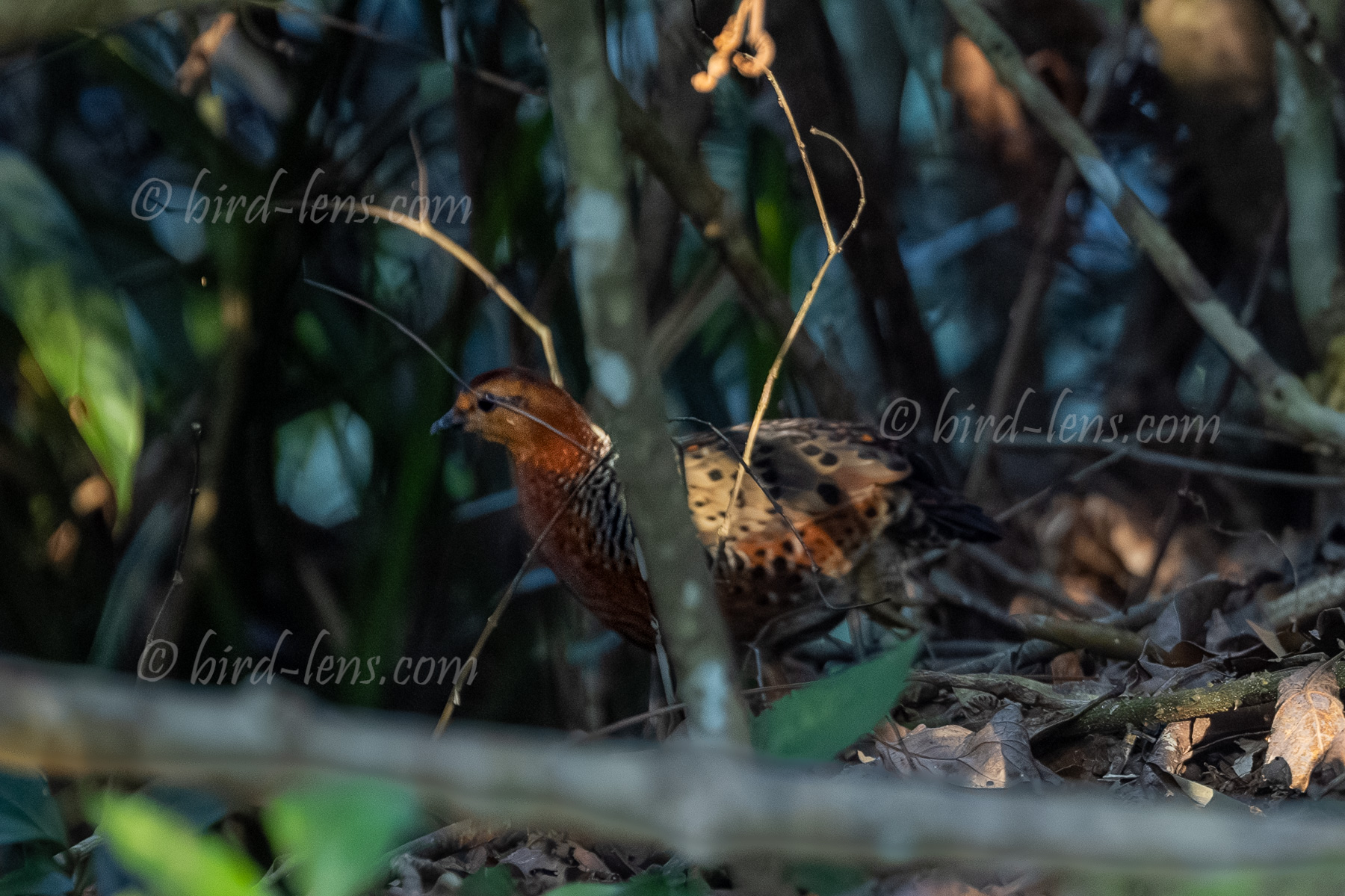
 A local guide growls at me, asking if I’ve already scattered anything edible. I don’t understand him at first. Yes, I say: but only mealworms. Then he scatters grain. Then we take a seat. Half of his group stands at the net further up. The other guests are very nice and readily tell me that they were there yesterday morning and that the Mountain Peacock-Pheasant appeared at 7:30 sharp. The guide plays calls the whole time. I just don’t know which bird. But it turns out that the calls are supposed to attract the Ferruginous Partridge (Caloperdix oculeus). And that’s exactly what happens. It’s slowly getting light. A shadow appears in a “window” in the jungle. The shadow quickly scurries past. No chance for a picture. The Ferruginous Partridge is actually characterized by its bright reddish-brown head and underside, its black mantle and flanks with white arches, and its olive-brown wings with large black spots. It looks very striking in pictures. But in the shadow of the forest edge it is difficult to capture.
I am counting on the Ferruginous Partridge to come forward again and set the camera resp. the Sigma 120-300 f 2.8 APO EX DG OS HSM to manual and observe the action via the Cannon Connect app, i.e. via a mobile phone remote control. This way I am always ready to shoot. And actually, it works. The Ferruginous Partridge is always so fast that even with the electronic shutter you can only take 3-5 pictures at a time. Then the bird has disappeared again. A little later the Ferruginous Partridge appears even deeper in the shadow of the forest. The guide calls the other clients so that they can see it too, because – although they are much closer – they have not had a chance to see the Ferruginous Partridge. The quality of the sightings of the Ferruginous Partridge is clearly decreasing. It may only come 4-5 times in total and then disappears.
Suddenly a much larger bird can be seen in the background. Yes, that’s the Mountain Peacock-Pheasant (Polyplectron inopinatum). Great, but this is another story.
2 hours before: At 6:00 I was already up at the car park of the Japanese Garden in Bukit Tinggi. I position myself with all my photo equipment on the eastern side of the hide. The sun should be behind there. It’s now 6:20. And actually still too early. But I definitely wanted to avoid having to hide in one of the last spots if other photographers might appear.
In order to meet the growing demand for top images of the rarer species of Palaearctic Bird-lens.com has specifically made trips to remote places. Additionally every chance is used, if a rare bird is around the homeground. This to do everything to ensure excellent photos of the Birds of the Western Palearctic . The yield of pictures also of rare Western Palaearctic birds is very good. There are other nice images of birds, that you will find behind the tab “Picture Shop“. Just give a notice if you need a picture of a bird which is not online.