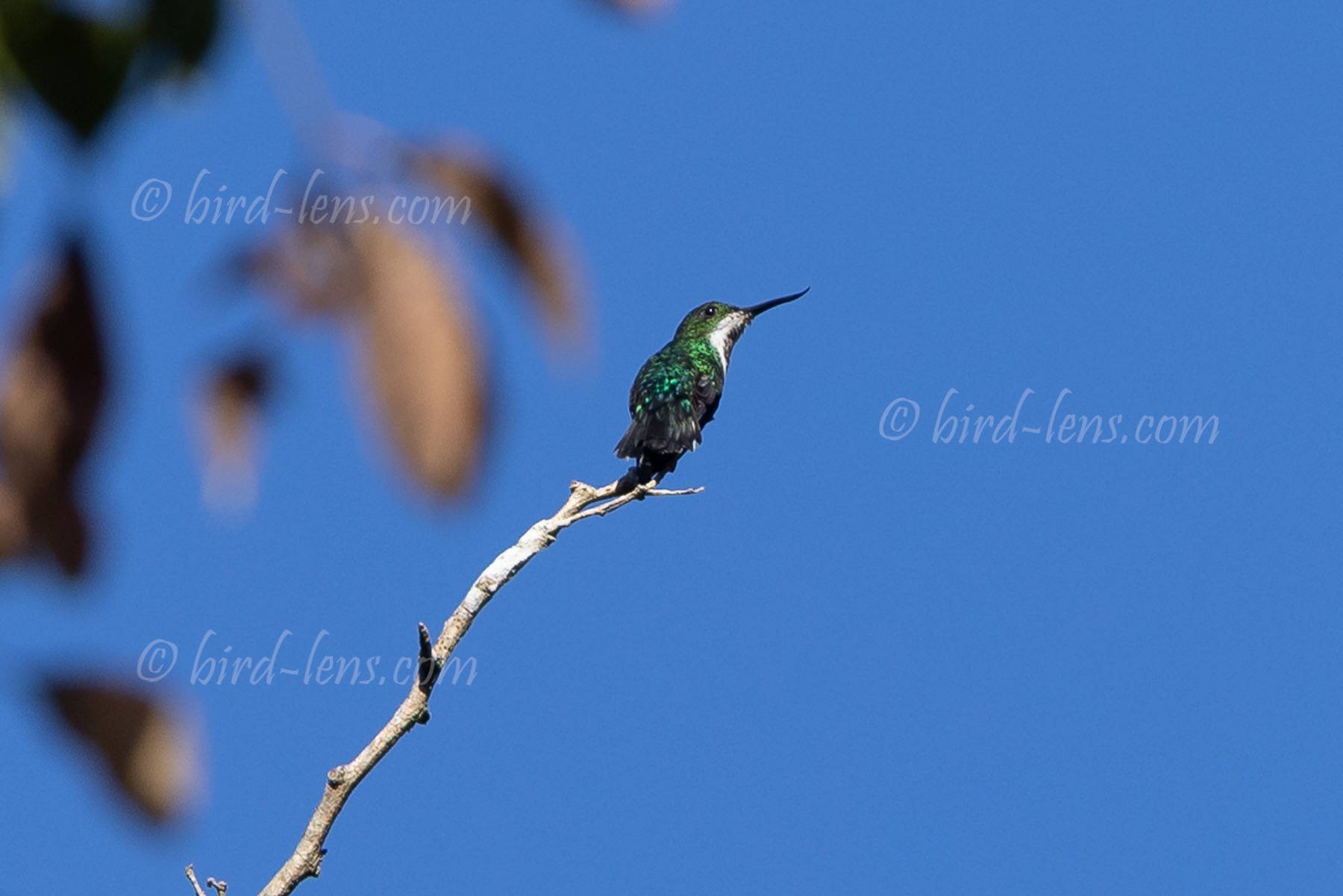
 Early in the morning, when the first light breaks over the canopy, I catch sight of a Fiery-tailed Awlbill (Avocettula recurvirostris). The bird perches quietly on a slender branch, its long, slightly upturned bill catching the glow of the rising sun. For a moment, the metallic green plumage shimmers, and the fiery tones of the tail seem almost aflame. It is a fleeting impression, but powerful enough to make the group pause and watch in silence.
The Fiery-tailed Awlbill is a hummingbird species of South America, and its peculiar bill has long attracted attention. Unlike the straight or gently curved bills of many other hummingbirds, its structure shows a distinct upward curvature near the tip. This adaptation allows the bird to exploit a specific ecological niche. The awl-shaped bill is especially suited for probing flowers with recurved corollas, from which straight-billed hummingbirds may have difficulty extracting nectar. At the same time, the Fiery-tailed Awlbill uses its tongue, an extendable structure lined with lamellae, to efficiently draw nectar deep from the floral tube.
Field observations show that the Fiery-tailed Awlbill frequently visits flowers of genera such as Erythrina, Hamelia, and Inga, all of which present corollas well matched to the curvature of its bill. Species of Costus (spiral gingers) and certain Heliconia are also utilized, further illustrating the strong link between bill morphology and floral architecture. While nectar is the primary energy source, the species also captures small arthropods in flight or by gleaning them from vegetation. This dietary flexibility, typical of hummingbirds, ensures a balanced intake of proteins and other nutrients essential for feather growth and high metabolic activity.
The range of the Fiery-tailed Awlbill extends broadly across northern and central South America. It occurs from eastern Colombia and Venezuela through the Guianas and into northern Brazil, as well as in parts of Ecuador and Peru. The species inhabits forest edges, secondary growth, and open woodland with flowering shrubs, showing a preference for habitats where nectar plants are abundant. Fiery-tailed Awlbills are most often recorded at low to middle elevations, generally below 1,200 meters above sea level.
Habitat requirements reflect the bird’s dependence on flowering plant communities. Areas with continuous floral resources, whether natural or maintained by human cultivation, are particularly important. Because the Fiery-tailed Awlbill readily visits gardens and disturbed areas rich in nectar-bearing plants, it shows a certain adaptability, though large-scale deforestation can limit available foraging sites. The persistence of suitable habitat mosaics is therefore essential for sustaining local populations.
Observing a Fiery-tailed Awlbill in the quiet moment of sunrise highlights both the beauty and the ecological significance of this species. Its radiant tail, peculiar bill, and finely tuned relationship with its environment underline the intricate connections that hummingbirds maintain within tropical ecosystems.
In order to meet the growing demand for top images of the rarer species of Palaearctic Bird-lens.com has specifically made trips to remote places. Additionally every chance is used, if a rare bird is around the homeground. This to do everything to ensure excellent photos of the Birds of the Western Palearctic. The yield of pictures also of rare Western Palaearctic birds is very good. There are other nice images of birds, that you will find behind the tab “Picture Shop“. Just give a notice if you need a picture of a bird which is not online.