 Low tide. The sun is barely rising over the mangroves near Salinópolis, painting the mudflats gold. The air is fresh from the rain yesterday. Wind has ceased after the windy weather the day before. That lifts up bird activity.
A Yellow-crowned Night Heron (Nyctanassa violacea) as well as a young Rufescent Tiger Heron (Tigrisoma fasciatum) use the mangrove roots as a perch to look for prey. Standing-still is the hunting-technique.
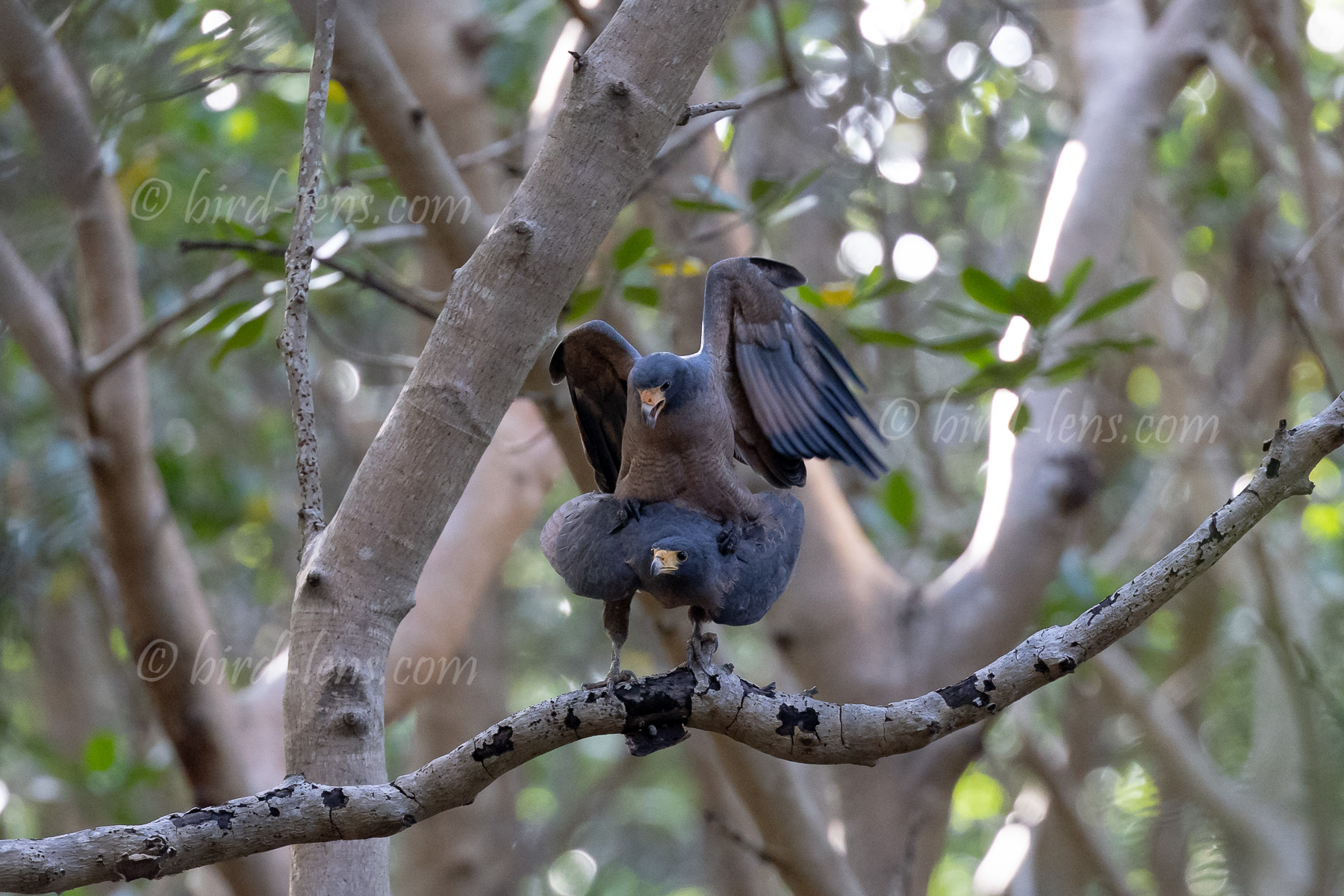
Although said to be ubiquitous I did not encounter any Rufous Crab Hawk (Buteogallus aequinoctialis) yet. This must change. So, I play the somewhat strange call with the help of a loudspeaker. The reaction is fast. From under the canopy of the tree in front of me, someone is calling. But I cannot see the bird. Suddenly, after another call from the tape a bird flies with elegance between the branches of the canopy and lands on the other side of the concrete bridge through the mangrove jungle. Immediately I see, there is another raptor on a thick branch of a mangrove tree. I see them—two large raptors perched close together, tails fanned, wings slightly lifted. One leans in. A quick display. Then they lock in a synchronized bow. The Rufous Crab Hawk is in courtship.
A very special moment. Seeing a pair in copula—on their breeding territory in the tangled green maze of mangroves—is really electrifying.
The Rufous Crab Hawk is a coastal specialist. It inhabits lowland mangrove forests along the Atlantic coast of South America, with strongholds in Brazil, including the estuarine zones around Salinópolis, in Pará. Its presence signals healthy tidal forests. Unlike most raptors, the Rufous Crab Hawk is almost exclusively tied to mangroves and adjacent brackish wetlands, feeding largely on crabs—especially Ucides cordatus, the massive Swamp Ghost Crab.
The Rufous Crab Hawk is medium-sized, stocky, and striking. Adults show deep rufous plumage across the body and underwings, with contrasting blackish upperparts and a distinctive single white tail band. The legs are bright yellow, strong and adapted for snatching prey from muddy creeks or mangrove roots.
The habitat near Salinópolis is textbook. Broad stretches of Rhizophora mangle and Avicennia germinans dominate the coastline. Intertidal mudflats weave through the mangroves, creating rich hunting grounds for the hawks. Nesting sites are typically built on sturdy branches above tidal flow—safe from flooding and predators.
This time of year, the The Rufous Crab Hawks enter breeding mode. Courtship begins with vocal duets, aerial displays, and mutual perching. Copulation, as observed, is usually brief and often repeated. The pair bond appears strong, with shared duties in territory defense and later, nest attendance. The male often brings food—fresh crabs or small fish—to the female during courtship, reinforcing the pair bond.
Despite its reliance on a very specific ecosystem, the Rufous Crab Hawk remains relatively under-studied. Its range is fragmented and populations are patchy, which has led to its classification as Near Threatened by the IUCN. Habitat loss—especially mangrove clearing for shrimp farms and tourism infrastructure—poses the greatest risk.
For birders, patience and timing are key. Low tide offers the best views, as hawks often perch near open mudflats or along mangrove edges, watching for movement. Morning is prime—cooler temperatures and active feeding behavior make them easier to spot. Approach slowly and keep low; they spook easily.
To witness courtship behavior, like I did near Salinópolis, is to see a glimpse of a complex life lived mostly out of view. The Rufous Crab Hawk doesn’t just survive in the mangroves—it embodies them. Its rituals, feeding habits, and breeding life are bound tightly to the pulse of the tide and the roots of the forest.
In order to meet the growing demand for top images of the rarer species of Palaearctic Bird-lens.com has made trips to remote places. Additionally every chance is used, if a rare bird is around the homeground. This to do everything to ensure excellent photos of the Birds of the Western Palearctic. The yield of pictures also of rare Western Palaearctic birds is very good. There are other nice images of birds, that you will find behind the tab “Picture Shop“. Just give a notice if you need a picture of a bird which is not online.