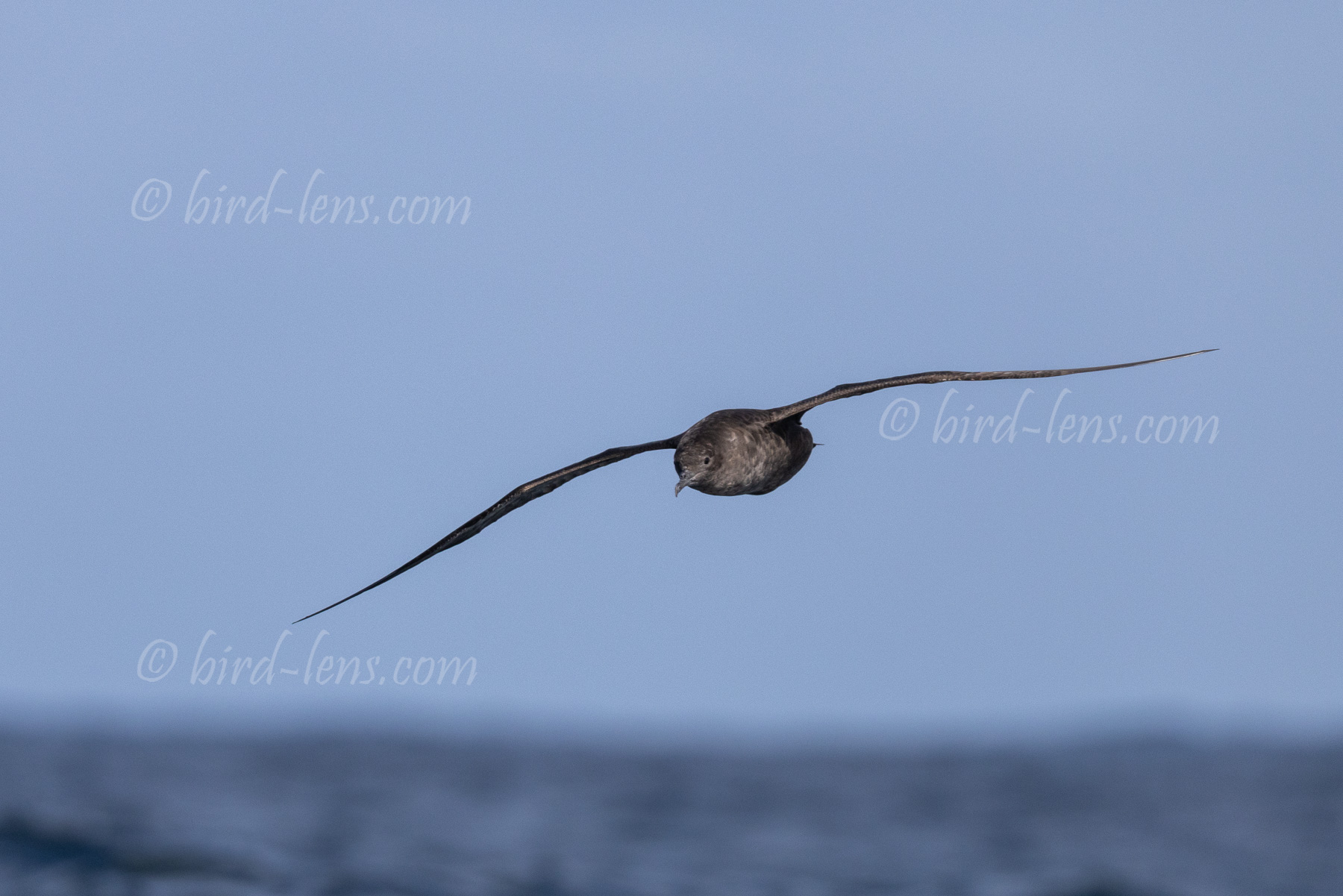
 Imagine standing on deck with the salty spray in your face, when suddenly this breathtaking seabird shoots past: A Sooty Shearwater (Ardenna grisea) glides in a perfect search flight just above the water’s surface! The bird carves its path right in the center of view with widely spread wings, cutting effortlessly through the air currents. Its plumage shimmers predominantly in deep dark brown and black tones, while the underwings and belly exhibit a distinctly lighter coloration. Below, the Irish Sea stretches out with a gently rippled surface, while a clear, blue sky provides surprisingly calm weather conditions. From this low perspective, the curved wings and aerodynamic silhouette of this ocean flyer appear exceptionally imposing.
In the Irish Sea, the Sooty Shearwater occurs as a regular, albeit numerically fluctuating, passage visitor and summer guest. Its primary presence spans from July to October, when subadult and non-breeding individuals push into North Atlantic waters. The pelagic density in this marginal sea is largely determined by local accumulations of macrozooplankton and small schooling fish, which are brought to the surface by oceanographic front systems.
The defining characteristic of this species lies in its extreme long-distance migration, which represents one of the most extensive migratory journeys in the entire animal kingdom. Annually, these birds complete a trans-equatorial figure-eight loop of up to 64,000 kilometers between their breeding and wintering grounds. During the Southern Hemisphere summer, from November to April, populations concentrate along the steep cliffs and islands of the Southern Hemisphere, primarily around New Zealand and southern Chile. There, these strictly colonial birds nest in deep soil burrows and exhibit strictly nocturnal behavior at their landing sites to evade predation.
Foraging is executed through spectacular wing-propelled dives that reach depths of over 60 meters. Following the completion of the reproductive phase, the birds utilize global wind systems to relocate to the nutrient-rich upwelling zones of the North Atlantic before the annual cycle recommences.
In order to meet the growing demand for top images of the rarer species of Palaearctic Bird-lens.com has specifically made trips to remote places. Additionally every chance is used, if a rare bird is around the homeground. This to do everything to ensure excellent photos of the Birds of the Western Palearctic. The results in pictures also of rare Western Palaearctic birds is very good. There are other nice images of birds, that you will find behind the tab “Picture Shop“. Just give a notice if you need a picture of a bird which is not online.