 For bird enthusiasts visiting the lowland rainforests along the Madre de Dios River in eastern Peru, experiencing an army ant swarm is one of the most exciting spectacles. Following a raiding column of Burchell’s Army Ant (Eciton burchellii) not only reveals the fascinating behavior of these relentless predators but also provides a rare opportunity to observe a diverse assemblage of ant-following birds in action.
To find a swarm, you must first identify the right habitat. The forests of Tambopata National Reserve and Manu National Park provide prime conditions for army ant activity. Early morning is the best time to search, as swarms typically begin their raids shortly after dawn. Instead of looking for the ants directly, it is more effective to listen for the calls of obligate ant-following birds, such as the Ocellated Antbird (Phaenostictus mcleannani) and the Bicolored Antbird (Gymnopithys bicolor), which rely on the swarms to flush out insects.
Tracking a swarm requires patience and attention to bird behavior. The most dominant species, including the White-throated Antbird (Gymnopithys salvini) and the Bare-crowned Antbird (Gymnocichla nudiceps), position themselves at the leading edge of the swarm to capture the most abundant prey. Other specialists, such as the White-plumed Antbird (Pithys albifrons), forage slightly behind the front line, taking advantage of insects that escape the initial assault. Opportunistic species like the Spotted Antbird (Hylophylax naevioides) and Rufous-capped Antthrush (Formicarius colma) often follow at a distance, picking off stragglers.
Once you locate a swarm, positioning is crucial. Standing too close may disrupt bird activity, while stepping into the ants’ path can lead to painful bites from their aggressive soldiers. These Eciton burchellii defenders use powerful mandibles to subdue prey and will not hesitate to latch onto anything they perceive as a threat. Wearing long pants and being mindful of your footing will help avoid unwanted encounters.
Understanding the ants’ behavior increases your chances of success. Eciton burchellii colonies alternate between raiding and stationary phases, with active hunting lasting up to two weeks before transitioning into a bivouac. Arriving during the stationary phase may yield little more than a cluster of resting ants and no bird activity.
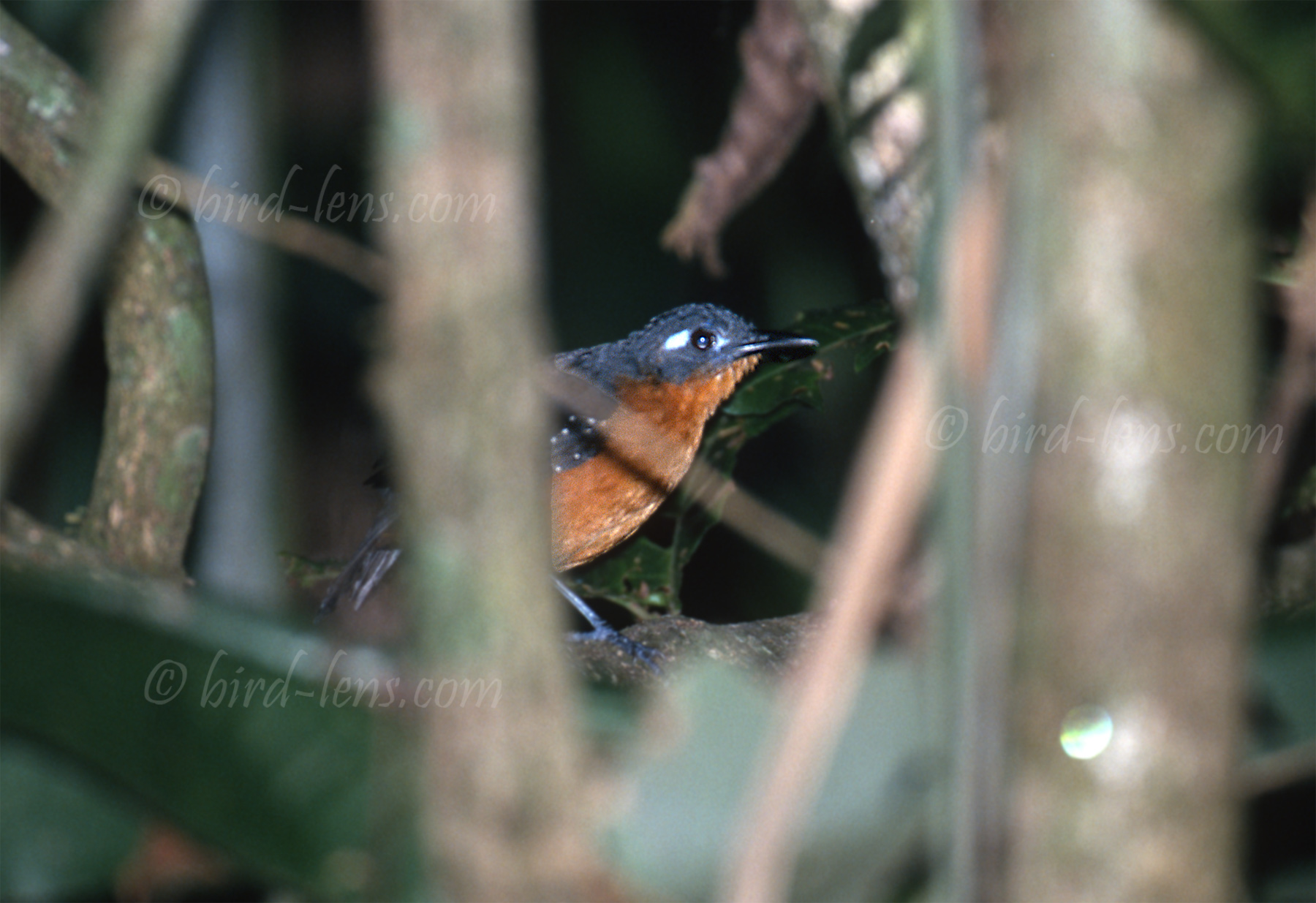
Occasionally the Plumbeous Antbird (Myrmelastes hyperythrus) follows army-ant swarms in pursuit of prey flushed by the ants. Prey usually perch-gleaned by reaching up, out or down with quick stabs of the bill. Observed to pick large larvae 5–8 cm long from fallen tree trunks; in order to consume these, pecked off pieces a third the size of the bill, sometimes biting pieces off ends.
Experiencing an army ant swarm along the Madre de Dios River offers an unparalleled look into the intricate relationships that define tropical ecosystems. The interplay between ants, birds, and fleeing insects is a dynamic and unforgettable spectacle, rewarding those who take the time to observe and appreciate it.
In order to meet the growing demand for top images of the rarer species of Palaearctic Bird-lens.com has specifically made trips to remote places. Additionally every chance is used, if a rare bird is around the homeground. This to do everything to ensure excellent photos of the Birds of the Western Palearctic. The yield of pictures also of rare Western Palaearctic birds is very good. There are other nice images of birds, that you will find behind the tab “Picture Shop“. Just give a notice if you need a picture of a bird which is not online.
I haven’t checked this web for years. I’m pleased I found it in a link.
Good advice written above.
You also can use Cinnamon oil / cinnamon powder as ants repellent. So, you can pour pure cinnamon powder circle around you on the ground while waiting for antbirds.
Madre Dios and Manu National Park (Peruvian Amazon) have many interesting looking birds to watch.
😀 knowing what they eat is the key to a successful birdwatching journey 👍
Hi Karina, nice to see a comment on my blog. Nice remark, to use Cinnamon oil or cinnamon powder as ants repellent. Up, to now, I was not so lucky to anticipate army ants circle around the cinnamon you while waiting for antbirds. In the meanwhile I had been in Colombia….
Lucky you bastard!
Australian swear a lot, haha. I like Colombia.
Have you ever seen the Santa Marta Screech -owl or the Blue- bearded Helmetcrest in the wild?
I did see the owl in cautivity 24 years ago. He was in a local country market. 😢
No, I did not see. have not been in the north of Colombia. But this will come………
Before I forget. You must watch on YouTube “Lex Friedman podcast/Paul Rosolie interview.” -Never before seen footage of contacted tribe – warriors Peru.-
They are the “Mashco piros” I’d seen them a couple of times 1989 ( Tambopata) as I have Spanish- French relatives farmers there. ( used to spend a lot of time there)
I also saw them with a group of tourist in 2003 ( no far from blanquillo- Manu National park)
We thought the loggers and narcos got rid of them as they are in their way and also are very wild nomad people. Yes, they fish ( use “curare” poison plants on their sharp spears “ They don’t use hooks as some foreigners people expect them to do.
The other tribes matshiguenkas , piros are contacted. These ones are also the best birdwatchers guides ( they speak a bit of Spanish and maybe English ( perhaps, the ones working with travel agencies, no as a guides.
Guess what …. Yes, my dear friend we were close by where the Mashcopiros appeared the first time for the Peruvians cameras during the Covid lockdown ( Puerto Maldonado ) 2020 Do you remember “ la Isla de los monos” in Puerto Maldonado- Madre de Dios ?
The mashco piros have been seen near by the farmers places near the river banks. They like to steal food, rope, machetes from farmers around the region. They have no concept of private land…. Who blame them!
They are protected specie by the Peruvian constitution. The flu can kill them. Etc etc
The Fridman Podscadt / Paul Rosolie reported it a few weeks ago as a “ Never before seen….,.,etc. “ good they got footage of them.
“New tribes” , maybe new bird species too. Who knows. 🤔
I always was curious about the stripe antshrike we saw in Madre de Dios. Do you think it was a Bamboo Antshrike? Was its eyes dark- brown? You took a picture of it from memory.
What was its eye color and the tip of its stripe tail.?