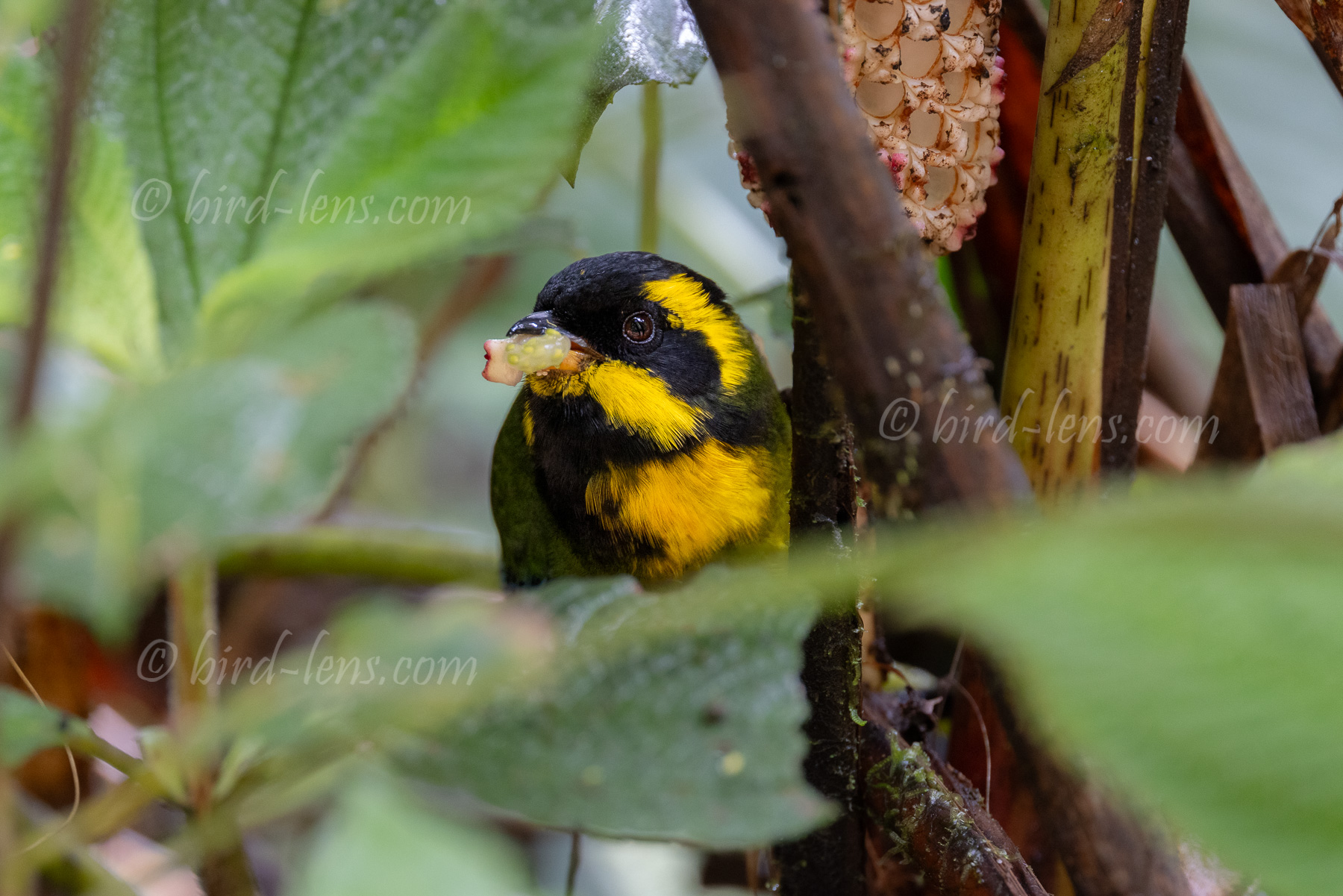
 The first time you notice it, it almost feels unreal. A small bird moves through the subcanopy, and suddenly a flash of gold catches the eye. For a moment it looks like a ray of sunlight caught in feathers. When the bird turns again, the pattern becomes clearer: a dark body, contrasted by striking golden markings that form a ring-like pattern along the head and breast. It disappears just as quickly as it appeared, melting back into the forest foliage. Encounters like this make the Gold-ringed Tanager (Bangsia aureocincta) feel almost mythical to birdwatchers who explore the forests of Colombia.
The Gold-ringed Tanager belongs to the family Thraupidae, one of the most diverse groups of Neotropical passerines. The Gold-ringed Tanager is notable for its contrasting plumage pattern, which consists of predominantly black, dark green, and yellow colors. Most of the body plumage is dark green, with a mainly black head, and a yellow ring formed by the supercilium, which curves behind the auriculars and joins the broad yellow submoustachial. Finally there is a black throat (green in subadults) and yellow central breast patch. The distinctive coloration gives the species its common name and distinguishes it visually from many other tanagers that typically exhibit more complex combinations of green, blue, and yellow. As in many members of the family Thraupidae, sexual dimorphism is minimal, and males and females appear largely similar in plumage.
Within its genus, the Gold-ringed Tanager shows several characteristics that allow comparison with related species such as the Blue-and-Gold Tanager (Bangsia arcaei), the Moss-backed Tanager (Bangsia edwardsi), the Black-and-gold Tanager (Bangsia melanochlamys) and the Golden-chested Tanager (Bangsia rothschildi) has occasionally been compared with other Bangsia species due to its bright coloration patterns. Species of the genus Bangsia generally share compact bodies, short bills, and a preference for humid montane or foothill forests. However, the Gold-ringed Tanager is particularly distinctive due to the clear, band-like golden marking, whereas relatives such as the Blue-and-Gold Tanager display more diffuse color transitions and a brighter blue body. The Moss-backed Tanager, in contrast, shows a more subdued olive and green coloration adapted to dense forest environments.
Behaviorally, the Gold-ringed Tanager resembles other Bangsia species in its tendency to move through the forest canopy in small mixed-species flocks. These flocks often include flycatchers, woodcreepers, and other tanagers. The species forages primarily for insects and small fruits, gleaning food from leaves and branches. Like many canopy-dwelling passerines, it is often detected more easily by movement than by vocalizations, which are relatively soft compared to other tropical birds.
The distribution of the Gold-ringed Tanager is notably restricted. The species is endemic to the western slopes of the Andes in Colombia, where it inhabits humid montane forests in the Chocó rainforest center of endemism, in the vicinity of Cerra Tatamá typically between approximately 1,200 and 2,200 meters above sea level. The bird is most common at elevations above 1,700 m asl. Within this range, it shows a preference for mature forest habitats with dense canopy structure. This limited distribution contrasts with several related tanagers that occupy broader ranges across Central and South America. As a result, the Gold-ringed Tanager is considered of conservation concern, largely due to habitat loss caused by deforestation and land conversion in Andean regions.
From an ecological perspective, the species plays a role in both insect population control and seed dispersal within its habitat. Like many tanagers, its mixed diet contributes to forest ecosystem dynamics. The restricted distribution and specialized habitat requirements make the Gold-ringed Tanager an important indicator species for the health of Andean cloud forest ecosystems.
In order to meet the growing demand for top images of the rarer species of Palaearctic Bird-lens.com has specifically made trips to remote places. Additionally every chance is used, if a rare bird is around the homeground. This to do everything to ensure excellent photos of the Birds of the Western Palearctic. The results in pictures also of rare Western Palaearctic birds is very good. There are other nice images of birds, that you will find behind the tab “Picture Shop“. Just give a notice if you need a picture of a bird which is not online.