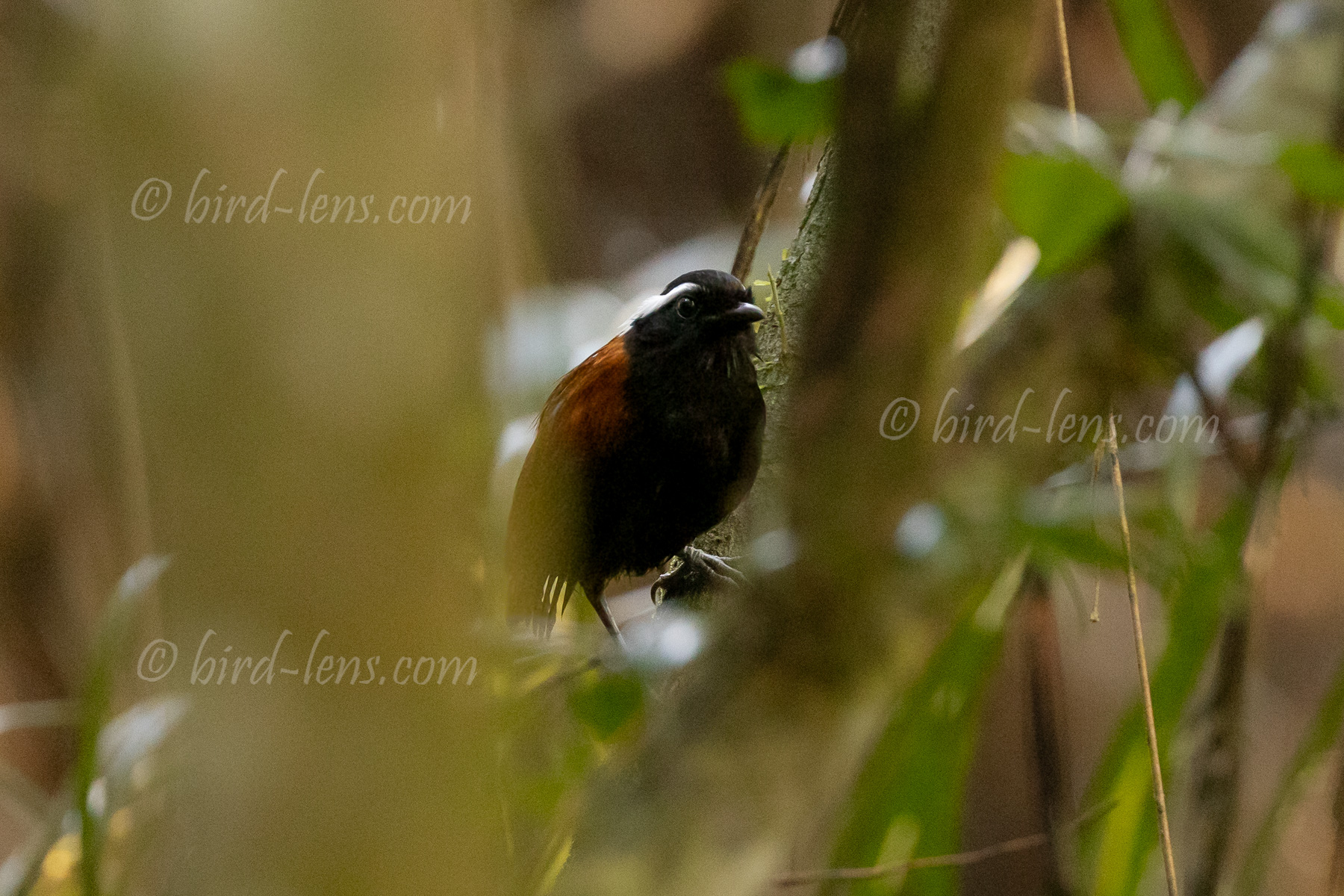
 The afternoon light in the Carajás forest feels golden and slow, filtering through the canopy like dust through a lens. The forest hums softly—cicadas, the buzz of wings, a distant rustle of leaves. On a narrow perch beside the trail, a Black-bellied Gnateater (Conopophaga melanogaster) sits almost motionless. It’s small and round-bodied, with a dark belly and chestnut-toned sides, the white ring around its eye glowing faintly in the dappled light. The strikingly plumaged Black-bellied Gnateater is the largest member of the genus Conopophaga. The large white postocular tufts of the male can be flared at 90º to the head and are starkly contrasted against the velvety black head and underparts. Every few seconds, it flicks its tail or shifts its weight, watching the understory for movement.
This is classic behavior for Black-bellied Gnateater, one of the Amazon’s most secretive insectivores. It belongs to the gnateater family (Conopophagidae), a group adapted for life close to the ground in dense forest. The Black-bellied Gnateater moves deliberately through the lower vegetation, gleaning insects from leaves and twigs or darting briefly to capture prey on the wing. It depends on shaded, humid forest interiors—habitats that provide both shelter and a steady supply of arthropods. When disturbed, it often retreats quietly into cover rather than flying off, relying on camouflage and stillness.
The species’ range is relatively limited. It occurs mainly in the southeastern Amazon Basin, from the Tocantins River eastward through Pará, including the Carajás region. Within this area, Black-bellied Gnateater favors terra firme forest—those ancient upland tracts untouched by seasonal flooding. It is considered a local specialty of Carajás, where its population remains stable thanks to the region’s extensive protected areas. Outside these refuges, deforestation and mining expansion threaten its habitat, making the preservation of Carajás all the more critical.
The Floresta Nacional de Carajás (FLONA Carajás) itself is exceptional. Covering over 400,000 hectares, it forms one of the largest continuous blocks of conserved forest in eastern Amazonia. The terrain is striking—rolling plateaus of ironstone (canga) rising above the canopy, interspersed with valleys of rich tropical forest. This mix of geological and ecological zones supports extraordinary biodiversity. More than 600 bird species have been recorded here, from the Harpy Eagle (Harpia harpyja) soaring above the ridges to the tiny gnateater flicking through the gloom below.
FLONA Carajás is also a paradox: a national forest established both for conservation and sustainable mining. The iron-rich soils beneath it contain some of Brazil’s most valuable mineral deposits, yet strict management has preserved vast tracts of intact forest. In these shaded corridors, species like the Black-bellied Gnateater continue to thrive, indicators of an ecosystem that, at least for now, still balances extraction and protection.
As the light fades deeper into amber, the gnateater hops down from its perch, vanishing into the thick green undergrowth. Its brief appearance leaves behind that quiet thrill every birder knows—the sense of having seen not just a bird, but a living piece of the forest’s intricate rhythm.
In order to meet the growing demand for top images of the rarer species of Palaearctic Bird-lens.com has specifically made trips to remote places. Additionally every chance is used, if a rare bird is around the homeground. This to do everything to ensure excellent photos of the Birds of the Western Palearctic. The yield of pictures also of rare Western Palaearctic birds is very good. There are other nice images of birds, that you will find behind the tab “Picture Shop“. Just give a notice if you need a picture of a bird which is not online.