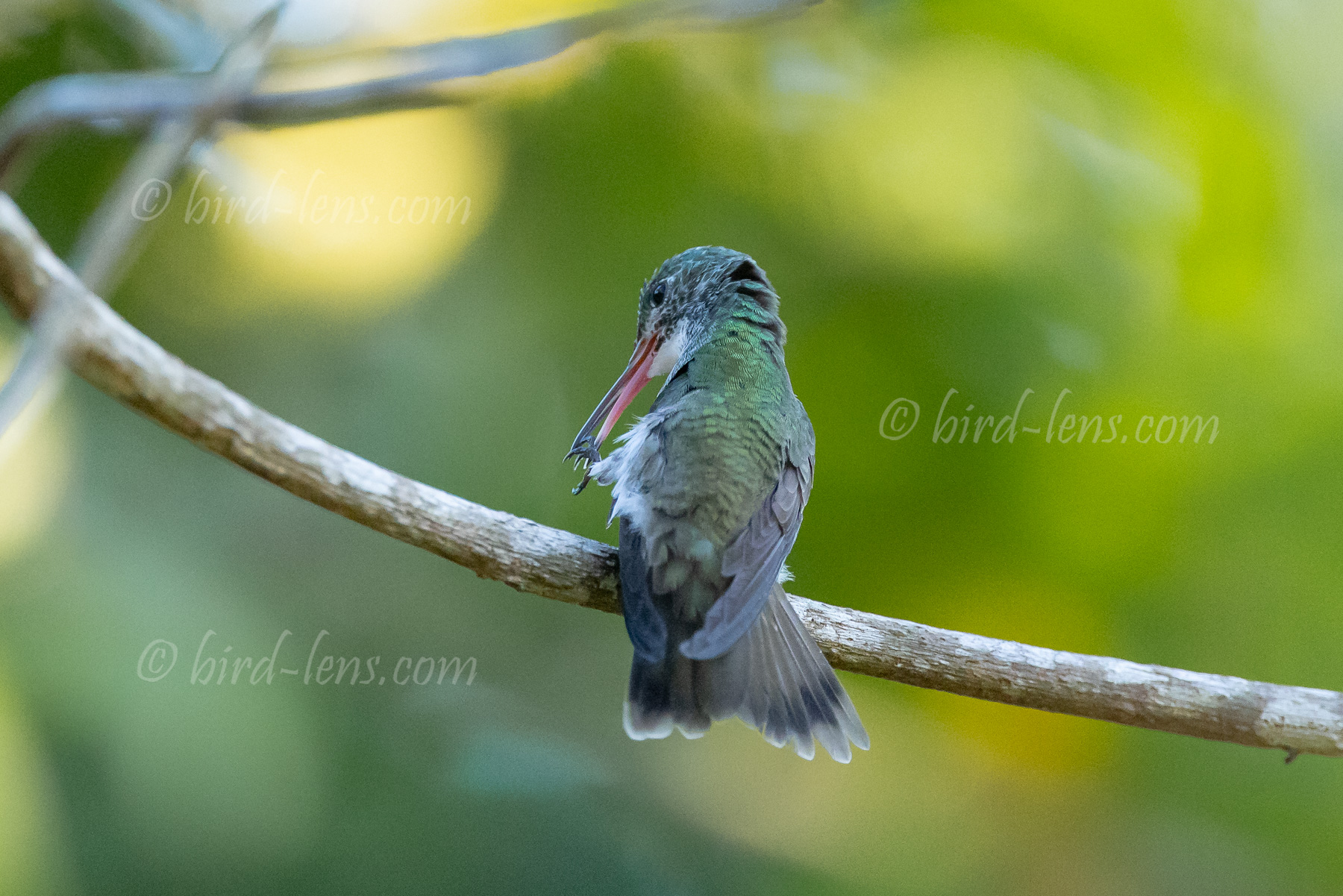
 This morning, in front of the shaded veranda of a small pousada just outside Manaus, the rainforest decided to offer me a front-row seat to a private grooming session. Perched barely three meters away on a low branch was a Versicolored Emerald (Chrysuronia versicolor), resting as if the world had slowed just for him. His plumage caught the filtered light—greens shifting from emerald to bronze—and for a few quiet minutes, he allowed me to watch his meticulous preening ritual.
He began by giving his feathers a vigorous shake, loosening any stray bits of debris. Then, with an agility that made the motion seem almost playful, he used one small foot to scratch and clean the base of his beak. After that came the most deliberate part: drawing each feather through his bill, one by one, smoothing the vanes and aligning them with precision. The process was unhurried, repeated across his wings, chest, and tail until every contour of his body seemed newly polished. Only then did he pause, head tilted, ready for flight once more.
The Versicolored Emerald is a small hummingbird belonging to the family Trochilidae, distributed widely across tropical and subtropical South America. Its range includes eastern Colombia, Venezuela, the Guianas, much of Brazil, and parts of Bolivia and Paraguay. In the Amazon Basin, it is a familiar yet never mundane presence, often seen at forest edges, riverbanks, gardens, and open woodlands. Although not confined to pristine habitats, it thrives in environments where flowering plants are abundant, making pousadas with nectar-rich gardens ideal places for close observation.
Its diet is dominated by nectar from a variety of native and ornamental plants, supplemented by small insects for protein. The species plays an important role as a pollinator, moving pollen between flowers while feeding. This mutualistic relationship between hummingbirds and plants is a cornerstone of tropical rainforest ecology, ensuring the reproductive success of numerous flowering species.
Behaviorally, the Versicolored Emerald is known for its adaptability and tolerance to human presence. Individuals will often return to the same perches and feeding spots, making them reliable subjects for study or photography. The preening I observed is more than vanity—it is a critical maintenance behavior. Proper feather alignment reduces drag during flight, maintains insulation, and preserves the fine structure needed for maneuverability. For a bird whose survival depends on rapid, precise aerial movements, such attention to feather condition is as essential as feeding itself.
In the humid air of the Amazon morning, my encounter lasted only minutes, but it was enough to glimpse the discipline behind the beauty. Watching Chrysuronia versicolor prepare itself for the day’s work was a reminder that even the smallest rainforest inhabitants are finely tuned to the demands of their environment—quiet perfection in motion.
In order to meet the growing demand for top images of the rarer species of Palaearctic Bird-lens.com has specifically made trips to remote places. Additionally every chance is used, if a rare bird is around the homeground. This to do everything to ensure excellent photos of the Birds of the Western Palearctic. The yield of pictures also of rare Western Palaearctic birds is very good. There are other nice images of birds, that you will find behind the tab “Picture Shop“. Just give a notice if you need a picture of a bird which is not online.