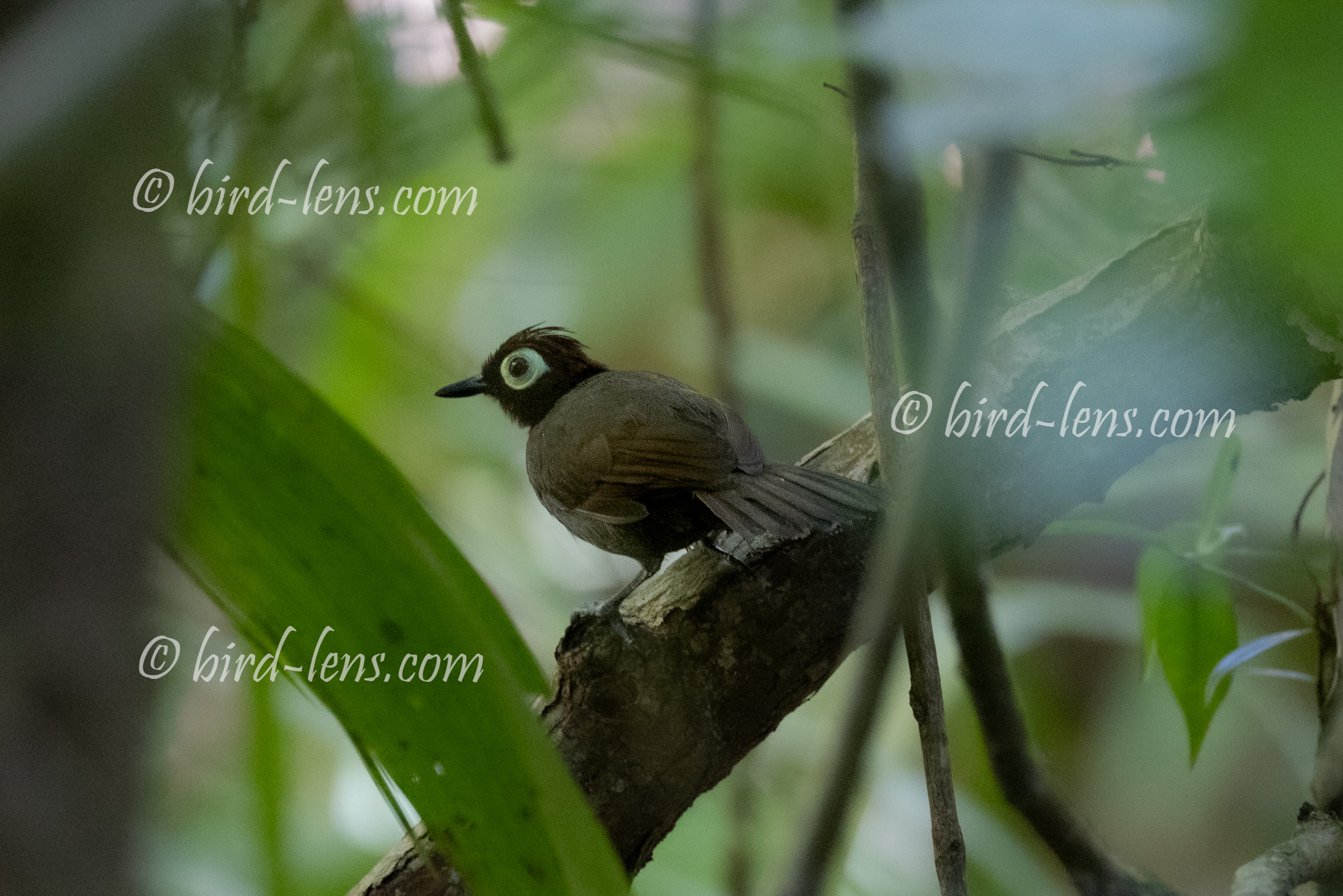
 The group is pushing through low vines already the whole morning, the air dense with the perfume of rotting leaves and flower sap. A distant rustle betrays something moving just off the trail. The leader stop. Wait. The silence thickens. Then—there it is.
Indeed. Suddenly, a Harlequin Antbird (Rhegmatorhina berlepschi) clings to a hanging vine. Then it settles properly on a thicker branch. I first shoot with one-shot AF, but then switch to manual focus and use the magnifying glass on the Canon R5 for fine adjustment.
Capturing this moment is no accident. The PN da Amazônia—Parque Nacional da Amazônia—is a hotspot for this elusive species. Found primarily in the dense understory of the Brazilian rainforest, the Harlequin Antbird thrives in areas rich with ant swarms and tangled vegetation. Its range is tightly confined, and while it’s not yet endangered, habitat loss makes each sighting feel like a small triumph.
This bird is an obligate ant-follower, which means it relies almost exclusively on army ants to flush out prey. Where the ants go, so does the antbird. That behavior makes tracking it possible but unpredictable. You don’t find the bird—you find the ants and hope the antbird is near. Although in this case we found a pair and lured it in with its sounds; army ant, we did not recognize.
Habitat-wise, the PN da Amazônia offers exactly what Harlequin Antbird needs: dense terra firme forest, low elevation, minimal human disturbance, and vast ant-rich foraging grounds. The thick canopy and deep shadows mean the antbird lives most of its life in the understory or at ground level. It rarely comes into the open, which makes both observation and photography a technical challenge.
Photographing the Harlequin Antbird is not only about gear—it’s about patience, method, and knowing your subject’s rhythm. The bird darts between perches, pauses briefly, then drops into the leaf litter after insects. Autofocus often fails in the clutter of vines, trunks, and shifting light. That’s why, after my first shots with one-shot AF, I switch to manual focus and rely on the Canon R5’s magnifying feature. It allows precision adjustment through the dense foliage. I shoot at 1/60 sec and am glad I have the monopod with me. Otherwise, I wouldn’t be able to fine-tune the depth of field at all.
Light is another constant obstacle. Even in the morning, the jungle floor is dark. A fast lens (f/4.0 or wider) and a high ISO tolerance are essential. The shutter speed must be above the standard 1/125 second for sharpness, especially when the bird settles between branches. Image stabilization is helpful, but a monopod is even more useful despite the obstacles in this terrain.
The key is anticipation. If you find army ants and anticipate the path of the army ant swarm, it’s obviously easier. Position yourself well at the expected start of the swarm. Then wait for the antbird to arrive and photograph it in the brief moments it settles. Don’t follow it. That’s the recipe.
The Harlequin Antbird is not just another entry on a checklist. It’s a symbol of the Amazon’s layered complexity.
In order to meet the growing demand for top images of the rarer species of Palaearctic Bird-lens.com has made trips to remote places. Additionally every chance is used, if a rare bird is around the homeground. This to do everything to ensure excellent photos of the Birds of the Western Palearctic. The yield of pictures also of rare Western Palaearctic birds is very good. There are other nice images of birds, that you will find behind the tab “Picture Shop“. Just give a notice if you need a picture of a bird which is not online.