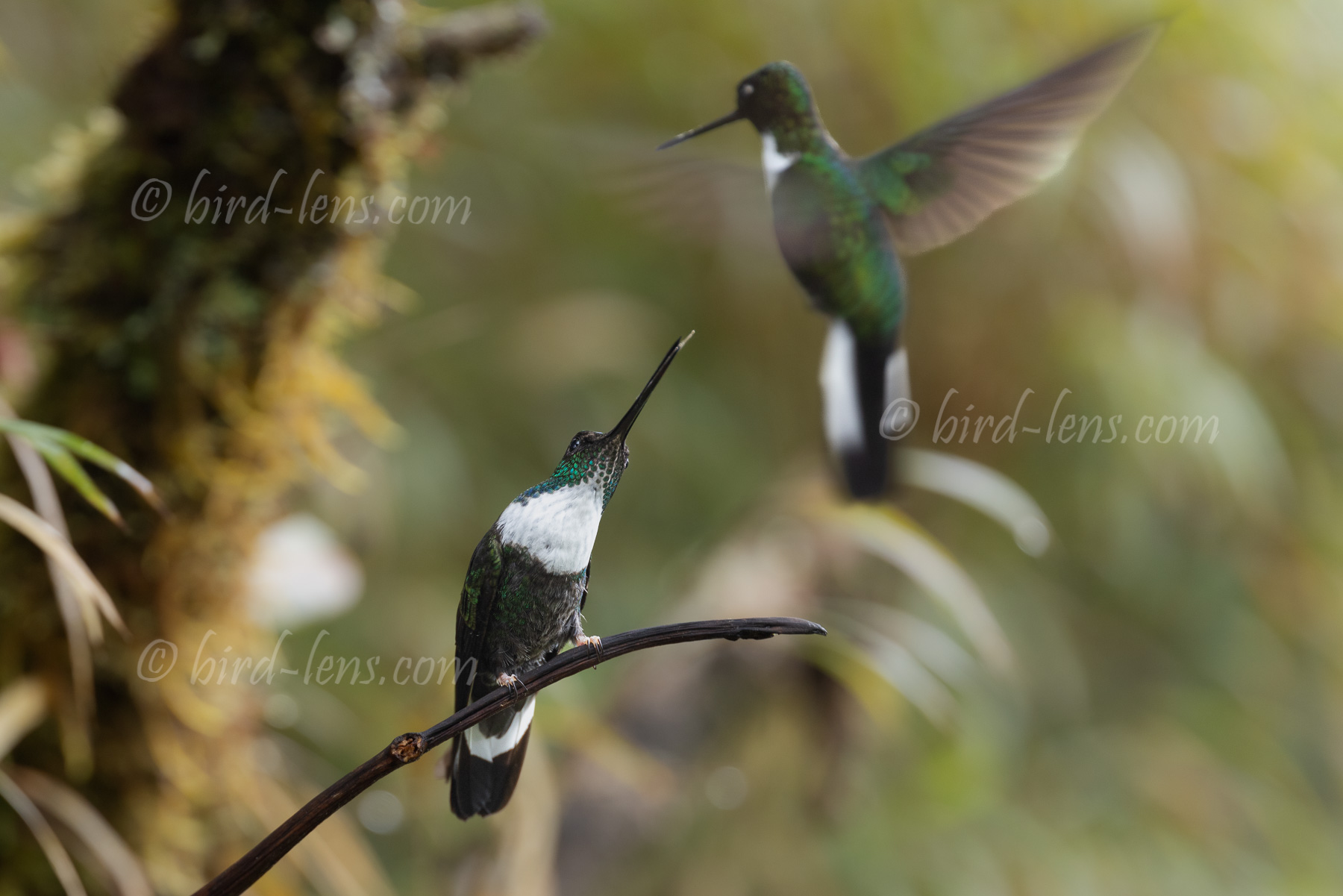
 Mist has settled once again over the western slopes of the Andes in Tatamá National Park. At the highest point, near the entrance to the Montezuma military base, the low-lying forest of Paramo-style hums silently, its sound interrupted only by the sharp, metallic beat of wings. A flash of green and blue cuts through the air. White tail tips and the white collar stand out. What initially appears to be a chase escalates abruptly. A collared hummingbird swoops down on an adversary perched on a lookout. The attacked bird is instantly alerted, stretches to an impressive height, and extends its remarkably long beak toward the assailant. Its nervousness is evident in the darting tongue. The entire action lasts only seconds.
The Collared Inca (Coeligena torquata) is a robust hummingbird of humid montane forests. In Tatamá, it frequents forest edges, clearings, and flowering shrubs near human structures, including the Base Militar Montezuma. Its size and strong bill already suggest a species built for dominance, and its behavior confirms it. The Collared Inca is among the larger hummingbirds of the Andean cloud forests. In flight, its size is immediately apparent. The wings beat powerfully but not frantically, producing a low-pitched buzz compared to smaller trochilids. Its flight style alternates between direct, purposeful movement and short hovering bouts at flowers, where control and stability are more important than speed.
Coloration is a defining characteristic of the species and becomes especially striking in good light. The upperparts are deep green, often appearing almost black in shade, while the underparts glow with metallic blue or blue-green tones. The namesake white breast band, or “collar,” sharply contrasts with the darker plumage and is visible even in motion. While haunting its dark, understory habitat, its generally dark plumage keeps it well hidden, and the first sign of its presence is the flashing open of its mostly white tail. In flight, flashes of violet-blue from the belly and subtle bronzy reflections from the wings create a layered, shifting appearance that changes with angle and light. Sexual dimorphism is limited, but males tend to show more intense iridescence.
The observed interaction involves one individual actively attacking another in mid-air. Such aerial aggression is a classic expression of territorial behavior in hummingbirds (family Trochilidae). Territoriality in hummingbirds generally centers on access to nectar resources. Nectar is energetically critical, and even short interruptions can affect daily energy balance. As a result, many species evolve strategies to monopolize high-quality flower patches.
In hummingbirds, territorial defense often includes vocalizations, threat displays, and direct physical attacks. Chases are common, but contact would indicate escalated aggression.
Aggressive encounters also help establish dominance hierarchies. Even when territories overlap or shift, repeated interactions teach rivals which individuals are likely to win confrontations. Over time, this can reduce the frequency of costly fights.
The brief aerial attack at Montezuma is therefore not an anomaly but a visible expression of an underlying ecological strategy. In the fast-paced lives of hummingbirds, every second and every flower matters. What looks like sudden violence is, in fact, a finely tuned response shaped by energy economics, competition, and survival in the cloud forest.
In order to meet the growing demand for top images of the rarer species of Palaearctic Bird-lens.com has specifically made trips to remote places. Additionally every chance is used, if a rare bird is around the homeground. This to do everything to ensure excellent photos of the Birds of the Western Palearctic. The results in pictures also of rare Western Palaearctic birds is very good. There are other nice images of birds, that you will find behind the tab “Picture Shop“. Just give a notice if you need a picture of a bird which is not online.