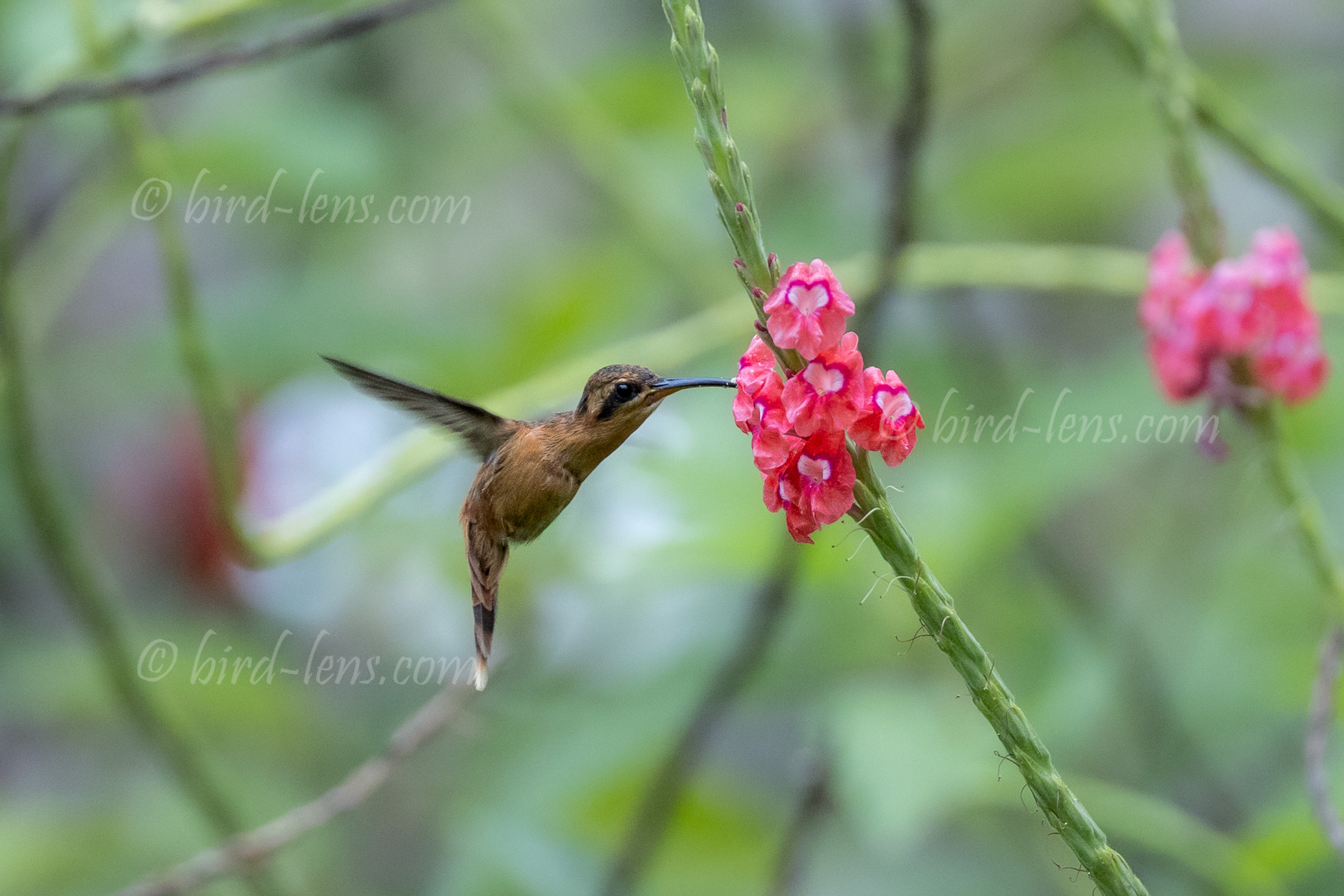
 A thunderstorm is brewing. In the afternoon, the sky has been clouded over. We are sitting near Gumna Reserve, on the outskirts of Belém, Brazil. But the air still feels heavy with humidity and scent—earth, leaf litter, and the faint sweetness of blooming flowers. Amid the dense understory, flashes of reddish bronze move in quick arcs between blossoms. It’s the Reddish Hermit (Phaethornis ruber), a small hummingbird with an unassuming name but remarkable poise. I watch as it hovers before a cluster of pink and red flowers, wings beating so fast they blur to a haze, the long bill dipping deep into each corolla with perfect rhythm.
Unlike many of its larger relatives, the Reddish Hermit favors the low, shaded layers of humid forests. Around Gumna Reserve, it is a frequent visitor to flowering understory plants, particularly those of Heliconia, Costus, and Psychotria. These blossoms, rich in nectar and tailored to long, slender bills, provide reliable foraging opportunities throughout the year. The bird moves along a predictable circuit—what ornithologists term a “trapline”—visiting individual flowers in sequence to maximize nectar intake while allowing replenishment intervals between visits.
Feeding behavior in Reddish Hermit mirrors the evolutionary refinement seen across the hermit clade. The bill’s curvature matches the floral geometry of its preferred plants, and the tongue’s length and structure enable efficient nectar extraction without damaging the corolla. This precision feeding also makes hermits important pollinators, transferring pollen on their forehead and throat feathers as they probe successive flowers.
Nectar, while central to their diet, is not the only nutritional source. Like other hummingbirds, Reddish Hermits supplement their energy-rich but protein-poor nectar intake with small arthropods—tiny flies and spiders captured mid-air or gleaned from foliage. These insects supply essential amino acids required for feather growth, muscle repair, and egg formation. The balance between nectar and insects allows these birds to sustain the intense metabolic demands of continuous hovering flight.
The habitat around Belém—lowland rainforest interspersed with secondary growth—offers ideal conditions for Phaethornis ruber and its congeners. Related species such as the Long-tailed Hermit (Phaethornis superciliosus) and the Straight-billed Hermit (Phaethornis bourcieri) occupy slightly different ecological niches, separated by microhabitat preferences and floral specializations. While the Reddish Hermit remains close to the shaded understory, the Long-tailed Hermit favors more open areas along forest edges and clearings. Such subtle ecological partitioning minimizes competition, allowing multiple Phaethornis species to coexist within the same general habitat.
As I watch, the Reddish Hermit darts to another cluster of pink blooms, pausing just long enough to sip before vanishing into the green. The forest returns to stillness, but the flowers carry faint traces of pollen on their petals—a quiet record of an ancient partnership between bird and bloom, unfolding every day in the shaded heart of the Amazon.
In order to meet the growing demand for top images of the rarer species of Palaearctic Bird-lens.com has specifically made trips to remote places. Additionally every chance is used, if a rare bird is around the homeground. This to do everything to ensure excellent photos of the Birds of the Western Palearctic. The yield of pictures also of rare Western Palaearctic birds is very good. There are other nice images of birds, that you will find behind the tab “Picture Shop“. Just give a notice if you need a picture of a bird which is not online.